An account of how Nehru frittered away 38,000 sq km area of Aksai Chin to China during 1951-59.
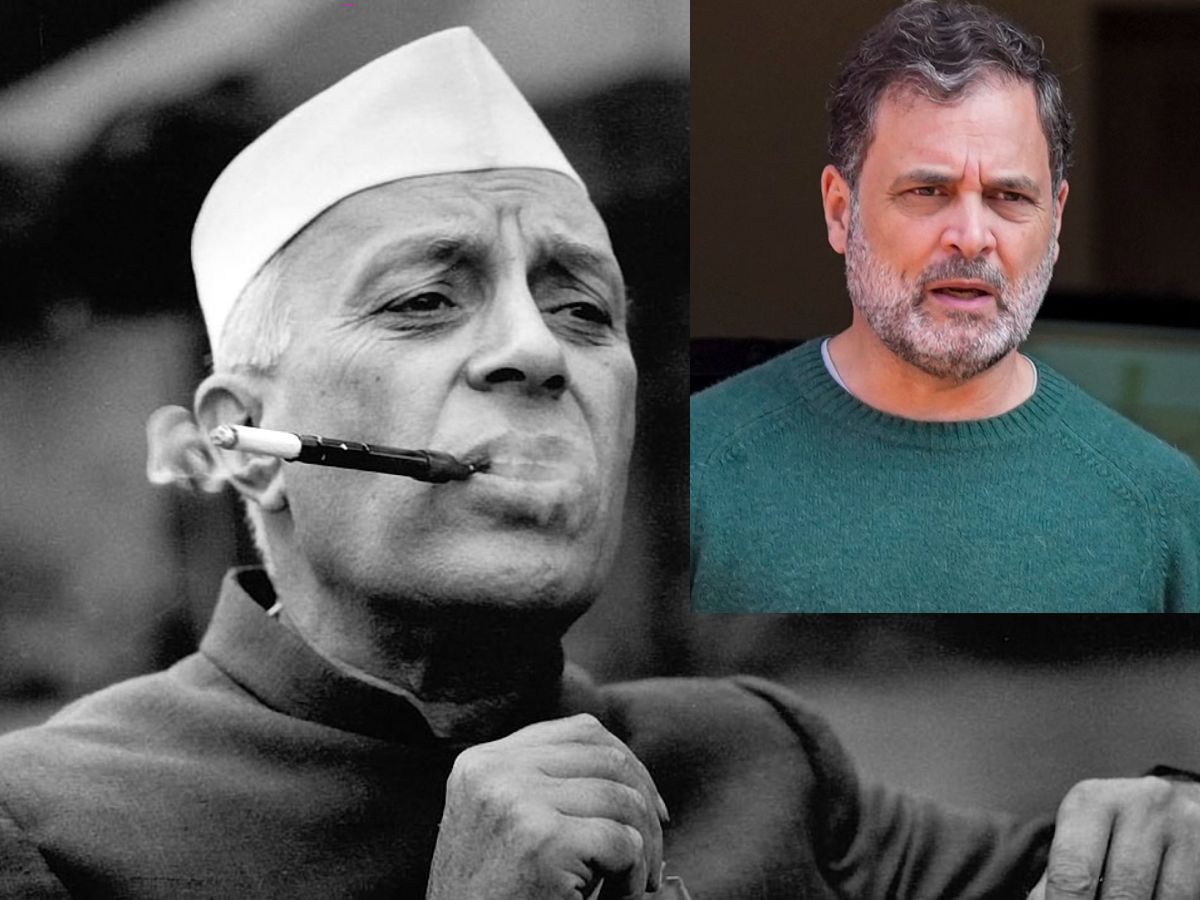
Rahul revives memories of Nehru’s blunders in Aksai Chin (Image: X)
Thanks to Congress leader Rahul Gandhi’s habit of jumping the gun, especially on highly sensitive political issues, he has been landing himself and his party into avoidable embarrassment. The latest case is the controversy he has raised by waving an unpublished book, attributed to the retired army chief, General Manoj Naravane. The sole aim is to focus this attack on Prime Minister Narendra Modi’s role during the India-China standoff that followed the Galwan episode in Ladakh. But by bringing in China and Ladakh into this high decibel political war, Rahul has unknowingly opened many old wounds inflicted by his worthy great-grandfather, Pandit Jawaharlal Nehru, on India and its national security by his timid and indifferent handling of relations with China.
All the trouble and challenges which India is facing today at the hands of China in Galwan, Depsang, Pangong Tso, Demchok, Siachen and Daulat Beg Oldi areas of Ladakh, have their common source in the great blunders committed by none other than Nehru. Unfortunately, it was Nehru as the first Prime Minister of India who knowingly allowed China to run away with the strategically sensitive 38,000 sq km area of Aksai Chin of Ladakh between 1951 and 1957 which is at the root of Chinese arrogance and aggression in Ladakh today.
The history of India of these fateful years, including official records of the Ministry of Defence, Ministry of External Affairs and the Parliament of India are brimming with incidents which show how Nehru refused to see, believe and act persistently for eight years when China not only illegally occupied Aksai Chin but went on constructing the 1,179 km long Tibet-Sinkiang military road which included 179 km within the Indian territory.
There are innumerable incidents on record which show that Prime Minister Nehru and his comrade Defence Minister, V.K. Krishna Menon consistently ignored the information and warnings from his own government’s official sources for eight long years. Nehru refused to act even when India’s Trade Representative in Tibet; Director of Military Intelligence; first hand eye witnesses including a British mountaineer and two uniformed spy soldiers of Indian Army; the Foreign Secretary of Nehru’s own government; Indian Army Chief Gen. KS Thimayya; and the Military Attaché and Indian Ambassador in Beijing informed him about India’s Aksai Chin being grabbed by China and the construction of a military road through that region. Nehru did not even take note of Chinese newspapers’ public announcements and glee over this historic “achievement” of China. This indifference towards national security came to fore in April 1959, one and a half years after the public inauguration of the Tibet-Sinkiang road, when an Indian Member of Parliament raised this issue in Parliament. But Nehru shouted at and snubbed MP Braj Raj Singh for raising the Aksai Chin issue.
To understand Pt Nehru’s approach towards China about the Aksai Chin blunder here is a blow by blow timeline of these events:
1949: China occupied East Turkistan which lay above India’s Ladakh and Gilgit Baltistan and renamed the region as “Xinjiang” (literally meaning “New Frontier”);
1950: China invaded eastern parts of Tibet and laid claims over entire Tibet;
1951: China occupied Tibet. Despite warnings from Indian leaders like Sardar Patel and Dr Ram Manohar Lohia, Nehru refused to help Tibet. Rather, Nehru helped China in grabbing Tibet as Indian government stopped United Nations from discussing Tibet;
1951-52: Chinese army walked into India’s Aksai Chin in Ladakh and started road survey to connect South-Western Tibet with Xinjiang. They snatched the wireless set of the Indian Trade Representative in Gartok when his team tried to travel to Rudok (midway on Kashgar-Lhasa road route) and Taklakot to check China’s road building activities. In November 1952, B.N. Mullik, Director of Intelligence Bureau reported to Nehru about China’s presence in Aksai Chin. No action was taken by Nehru;
1953: In his letter to Zou Enlai, PM Nehru mentioned the wireless incident but did nothing to follow it up;
1954: An overenthusiastic Nehru in his “Hindi-Chini Bhai-Bhai” ecstasy signed the “Panchsheel Agreement” with China. Ironically, the Agreement had no mention of “Panchsheel” in its preamble and was purely a trade-agreement. Through this agreement Nehru government not only formally admitted Tibet as a “part of China”, he also gave away India’s rights of maintaining a consulate, trade centres, right to maintain Indian soldiers in Tibet, and control over telecommunications network. Nehru believed that all these were merely a legacy of British imperialism;
1955: India’s military attaché in Beijing informed New Delhi about the Chinese road in Aksai Chin. But no action was taken by New Delhi. A British mountaineer, Sidney Wignall informed the Indian Army about the road construction in Aksai Chin. When Director, Military Intelligence (DMI) informed Defence Minister Menon about it in the presence of Nehru, Menon shouted at the DMI for “lapping up American CIA agent-provocateur’s propaganda”;
1957: China inaugurated the Tibet-Sinkiang road and invited Indian Ambassador and Military Attaché to the ceremony which was declined without any protest. Nehru instructed Foreign Secretary Subimal Dutt to send a strong letter of protest to Beijing. But soon he revised his order to send only “our maps”. And only an hour later he further revised his order and told Dutt to leave it because he will himself raise this issue “informally” with the Chinese PM. Records show that this “informal” protest never happened.
1958: In October 1958, only an “informal” note was handed over to the Chinese Ambassador in New Delhi. In this note India’s protest could not go beyond expressing “surprise” and “regret” that neither any permission from New Delhi was sought nor was it informed about constructing this road through the “indisputably Indian territory”. Ironically, GOI degraded its own protest by calling it just a “petty” matter.
1959: On April 22, 1959, Nehru shouted at and admonished MP Braj Raj Singh in Parliament for raising the Aksai Chin issue and asked other MPs “not to pay attention to such news items emanating from Hong Kong or other odd places.” It was only in August 1959 that Nehru finally admitted before Parliament that China had built its “Tibet-Sinkiang highway” through Indian territory in Aksai Chin.
1961: After being forced to retire as Army Chief by Nehru and Menon, Gen Thimayya, in his valedictory address to other Army officers said, “I hope I am not leaving you as cannon fodder for the Chinese communists…”
1962: China attacked India by using occupied Tibet as its launch pad and used the Tibet-Sinkiang road to transport Chinese soldiers and heavy equipment very close to Indian posts. In sharp contrast, the nearest Indian road for soldiers posted on the last posts was 200 to 300 km away in Leh.
Vijay Kranti is a senior journalist, veteran China watcher and Chairman, Centre for Himalayan Asia Studies and Engagement.
