Shankaracharya’s enduring influence flows from the depth of his writings. They address the root causes of human confusion: ignorance, ego
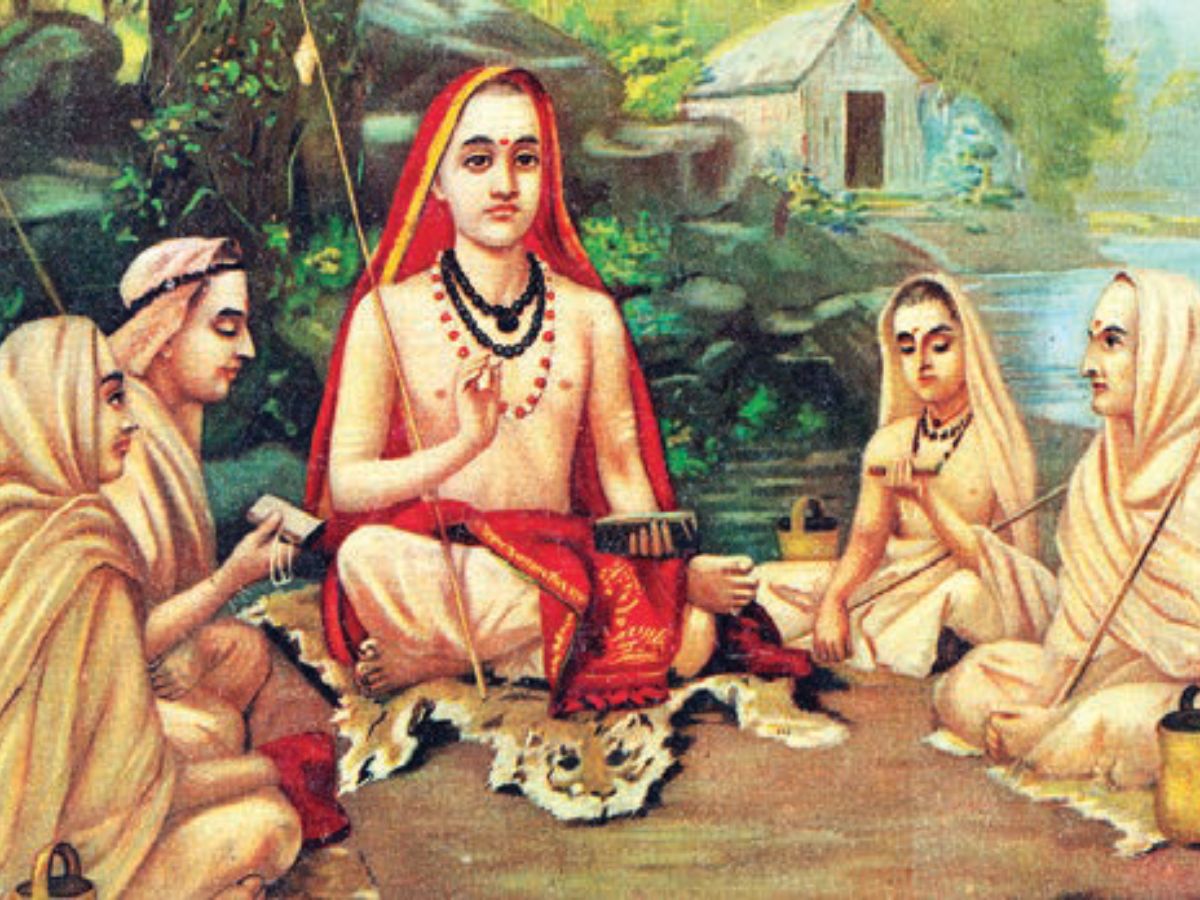
Adi Shankara with his disciples. A painting by Raja Ravi Verma.
Shankara is the foremost among the master-minds and the giant souls which Mother India has produced. He was the expounder of the Advaita philosophy. Shankara was a giant metaphysician, a practical philosopher, an infallible logician, a dynamic personality and a stupendous moral and spiritual force. His grasping and elucidating powers knew no bounds. He was a fully developed Yogi, Jnani and Bhakta. He was a Karma Yogin of no mean order. He was a powerful magnet.
There is not one branch of knowledge which Shankara has left unexplored and which has not received the touch, polish and finish of his superhuman intellect. For Shankara and his works, we have a very high reverence. The loftiness, calmness and firmness of his mind, the impartiality with which he deals with various questions, his clearness of expression—all these make us revere the philosopher more and more. His teachings will continue to live as long as the sun shines.
Shankara’s scholarly erudition and his masterly way of exposition of intricate philosophical problems have won the admiration of all the philosophical schools of the world at the present moment. Shankara was an intellectual genius, a profound philosopher, an able propagandist, a matchless preacher, a gifted poet and a great religious reformer. Perhaps, never in the history of any literature, a stupendous writer like him has been found. Even the Western scholars of the present day pay their homage and respects to him. Of all the ancient systems, that of Shankaracharya will be found to be the most congenial and the most easy of acceptance to the modern mind.
Shankaracharya’s life, as preserved in traditional accounts, is almost unbelievable by modern standards. Born in Kalady, in modern-day Kerala, he lost his father at an early age, adopted renunciation as a child, and immersed himself in rigorous study under his guru. From there, he set out on foot, moving from one centre of learning to another, engaging Buddhists, Mimamsakas, Sankhya thinkers, Shaiva and Vaishnava scholars and many others in open debate. The miracle is not just the volume of what he achieved, but the context in which he did it. India of that time was intellectually vibrant and argumentative. Multiple schools of thought coexisted and contested each other. Shankaracharya did not arise in a desert but in a civilisation that already revered learning, debate and philosophical experimentation.
Shankaracharya’s enduring influence flows from the depth of his writings. His commentaries on the Brahma Sutras, major Upanishads and the Bhagavad Gita, along with independent works like the Upadesha Sahasri, do far more than expound doctrine. They address the root causes of human confusion: ignorance, ego, fear and attachment. At the heart of his Advaita Vedanta (non-dualism) is the insight that the individual “self” is not ultimately separate from the ultimate “reality”. This sense of separation breeds insecurity and aggression, and therefore, the realisation of underlying unity nurtures responsibility and compassion. When he speaks of acting without selfish attachment, he is not asking us to escape from the world. He is asking us to participate in it fully, but without the egoism that turns every disagreement into a war and every public question into a battlefield of identities. This has immediate relevance in our time. In societies marked by polarisation, identity politics and a permanent sense of grievance, his insistence on a more profound unity does not magically erase conflict, but it changes the starting point. If I see the “other” not as a permanent enemy but as another expression of the same reality, then dialogue, compromise and restraint become signs of strength, not weakness.
His vision holds significance much beyond and to many of our contemporary problems. For instance, his ideas can indirectly but powerfully guide us to address our environmental and climate anxieties. Shankaracharya does not use modern terms like “sustainability.” Yet, his worldview leaves little room for treating nature as merely inert raw material. If the same sacred reality pervades everything, then rivers, forests and mountains become part of a shared existence, not lifeless resources to be drained. An education shaped by this sensibility is more likely to produce citizens who feel a moral and spiritual responsibility towards the environment, not just a regulatory one. In other words, his ideas can help us reframe the great debates of our time: from communal tension to social inequality, from ecological damage to cultural fragmentation. He does not hand us ready-made policy solutions, but he offers a way of thinking that disciplines emotion, broadens sympathy and insists on ethical self-scrutiny, something that our fractured public life is concerningly lacking.
Adi Shankaracharya is not known as a conventional “military genius,” as he never led armies or engaged in physical warfare himself. However, some accounts and popular imagination describe him as a “spiritual general” and attribute to him the foresight to organize a section of warrior monks, the Naga Sadhus, for the future physical protection of Sanatana Dharma (Hinduism).
Adi Shankaracharya’s genius is primarily described in intellectual, philosophical, and organizational terms:
“Spiritual General”: He is referred to as a “fittest Spiritual General” who championed the cause of the Upanishads through rigorous debate and intellectual engagement.
Philosophical Unifier: He travelled across India, engaging in debates with scholars from various schools of thought (including Buddhist and Jain philosophers), and established the doctrine of Advaita Vedanta, a non-dualistic philosophy that helped unify the various warring sects of Hinduism.
Organisational Reformer: He established four major monastic centres (Mutts or Peethams) in the four corners of India to preserve and propagate Vedic philosophy, which gave the diverse Sanatani traditions a collective identity and an organized structure that endures to this day.
According to traditional accounts, Adi Shankaracharya established akharas (spiritual and physical gymnasiums) and organized a section of ascetic monks into a warrior class to protect Hindu sites and practitioners in times of conflict, foreseeing a future need for physical defence against external threats. These groups, known as the Naga Sadhus, were later involved in numerous battles against Mughal and British forces in the following centuries. In summary, his “genius” in this context lies in his strategic foresight and organisational capacity to create a self-defending monastic order, rather than personal military prowess. His primary “battles” were fought in the realm of philosophy, logic, and debate, which ultimately revived and consolidated Hinduism.
If India is to truly enter a new phase of civilisational self-awareness—Amrit Kaal as PM Modi has outlined—then restoring and recovering the wisdom and teaching of the likes of Adi Shankaracharya cannot be optional. His life serves as a reminder of what a disciplined intellect and spiritual courage can achieve. In Adi Shankaracharya, we find the rare confluence of a philosopher of highest order, a logical and practical thinker, a devout renunciate and a trail blazing legacy builder.
Prof Santishree Dhulipudi Pandit is the Vice Chancellor of JNU.
