Japan would have no option but war were there to be a PLA invasion of Taiwan.
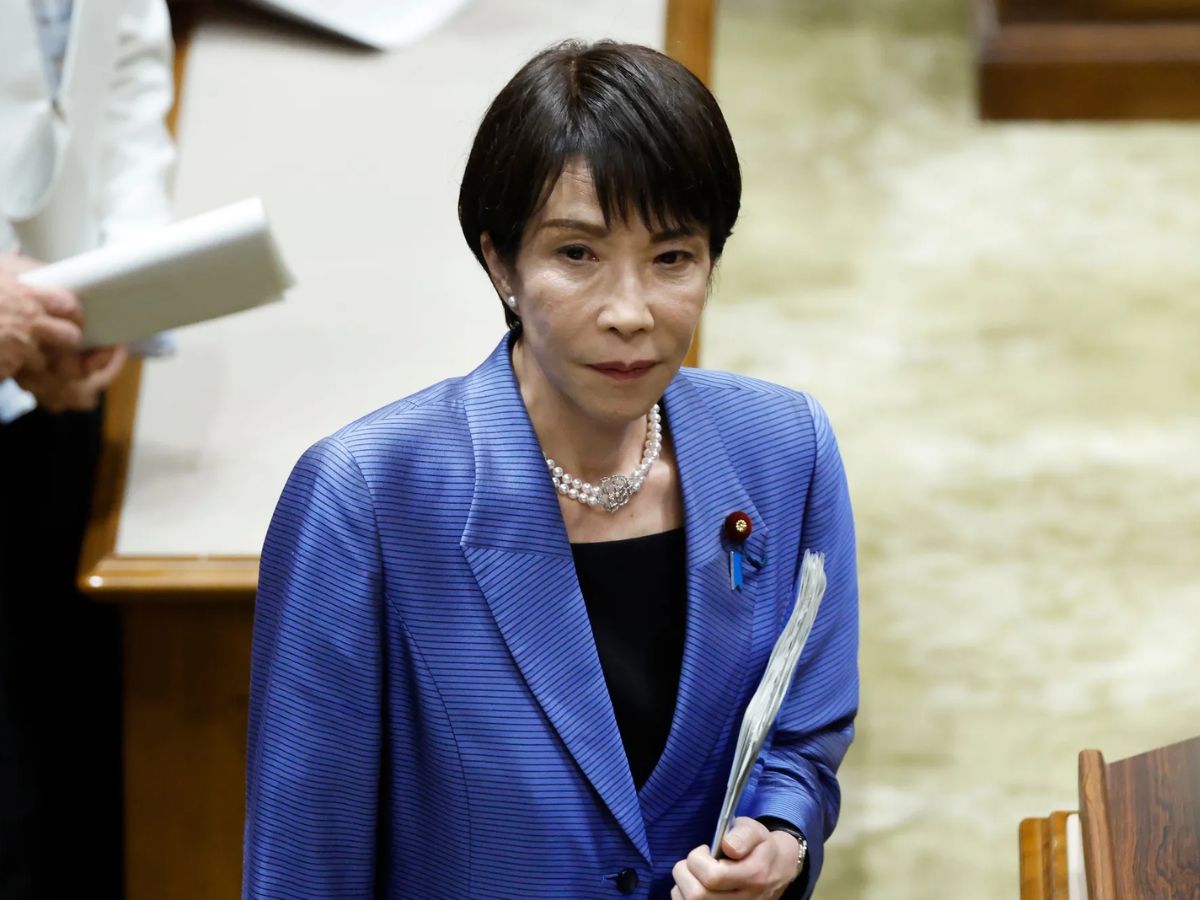
Sanae Takaichi (Image: X)
From the time he started living in 7 Lok Kalyan Marg, Prime Minister Narendra Modi made it a priority to have close relations with the United States. He knew that when a kinetic conflict with China came, a US-India partnership would make the difference between Democracy prevailing over Autocracy. Japan has been, from the start of its transition from Autocracy to Democracy in 1945, a treaty ally of the US. Now Prime Minister Sanae Takaichi of Japan made tempers flare in nearby China. She had said that any effort by the authoritarian superpower to take over Taiwan would be a grave threat to the security of Japan. By gaining control of Taiwan, the People’s Republic of China would have breached the first island chain of defences of the democracies ranged against the PRC. It would make not just Japan but South Korea, Vietnam, the Philippines, Indonesia and other countries much more vulnerable to attack by sea or air. Taiwan is often referred to as an “unsinkable aircraft carrier”, and so the island nation is. Accretion of Taiwanese capabilities would almost certainly put China ahead of the US in technology that plays a keystone role in modern warfare. The barrage of verbal abuse of Prime Minister Takaichi from the Chinese side included what amounted to a call by a senior Chinese diplomat to “cut her dirty neck”. Diplomacy is famed for its subtlety, but being subtle does not appear to be within the repertoire of the diplomat making such an offensive remark. Rather than chasten her as was intended, the abuse strengthened her resolve.
Medium Range Ballistic Missiles (MRBMs), therefore, have been positioned on a Japanese island less than a hundred kilometres from Taiwan. They would provide swift retribution to any attacker seeking to end the sovereignty of Taiwan. The feisty Japanese Prime Minister knows President Lai Ching-te of Taiwan, and has recently met him in the Office of the President in Taipei, which was once the office of the Japanese Governor of Taiwan. Because Taiwan was under the rule of the Japanese navy, it was much more benign than territories that were ruled by the Japanese army. As a consequence, while Japanese rule by the army was intensely disliked, to this day a substantial segment of the Taiwanese population look upon the occupation in a kindly way. In contrast, populations in places where the Japanese army was in control were often brutally treated, especially in China, where episodes such as the Nanking massacre remain fresh in the minds of the people native to that city. After the war, several perpetrators of such atrocities were executed on a scale far more than was the case in post-Nazi Germany, where in several territories conquered by the Wehrmacht (Nazi German army), the atrocities committed frequently outclassed even those perpetrated by the Japanese military. In their eagerness to enlist German support against the Soviet Union, which by early 1946 itself had replaced Germany as the principal foe of the US and its allies in Europe, excessive leniency was shown to several Nazi war criminals. Indeed, groups such as rocket scientists who had before the war been serving Hitler were given choice positions in the corresponding US agencies, Werner von Braun being one of many such examples.
Returning to the present, for only the second time a Chinese Communist supremo initiated a call to the President of the US. Trump and Xi inter alia discussed Taiwan. Going by the Chinese readout of the talks, the two agreed that “the fruits of victory in 1945 after the war should be preserved”. The “fruits of victory” included Taiwan, and it would appear that Trump agreed with Xi as to such a principle. In other words, that Taiwan belonged to China, an astonishing conclusion by a US President. It needs to be pointed out that at the time, China was ruled by the KMT and not the Chinese Communist Party. In 1949, the KMT fled to Taiwan and settled there. In other words, from then onwards, Taiwan once again “belonged” to the Taiwanese themselves. Trump does not seem to have understood the significance of the “fruits of victory” phrase that Xi was using, assuming of course that the CCP readout of the talks was accurate, an assumption at odds with the reality that very often, they were not. Soon after the KMT takeover, Taiwan became the location for US military bases, and to this day, serving US military personnel are stationed in Taiwan, often in civilian clothes. In any future conflict with Japan, Xi may be counting on the nuclear capabilities of China, which are indeed formidable but not invulnerable. For many years, Japan has been “just a screwdriver away” from being a nuclear weapons power, and is skilled in missile technology as well. An invasion of Taiwan by China would result at the least in sanctions which would cripple an already faltering economy. Several Japanese are faulting the so-called “warmonger instincts” of Sanae Takaichi. What they forget is that Japan would have no option but war were there to be a PLA invasion of Taiwan. Unless of course, they were willing that Japan, a country whose people are known for the steel in their spines, would become subservient to Chinese dictates. Even detractors of Prime Minister Takaichi would flinch from such a course.
India led by PM Modi is of a similar course, willing to fight to preserve our traditions and our freedoms. Modi seeks a “free, open and inclusive Indo-Pacific”, just as Japan does, and the PM has worked tirelessly to ensure such an objective, just as his friend Prime Minister Shinzo Abe and now Prime Minister Sanae Takaichi, a disciple of Abe San, is doing. No wonder both Prime Ministers have from the start of their first meeting become friends, indeed partners, of each other.
