Sewa is service without expectation or reward, and stands in contrast to the Western view that perceives it as charity.
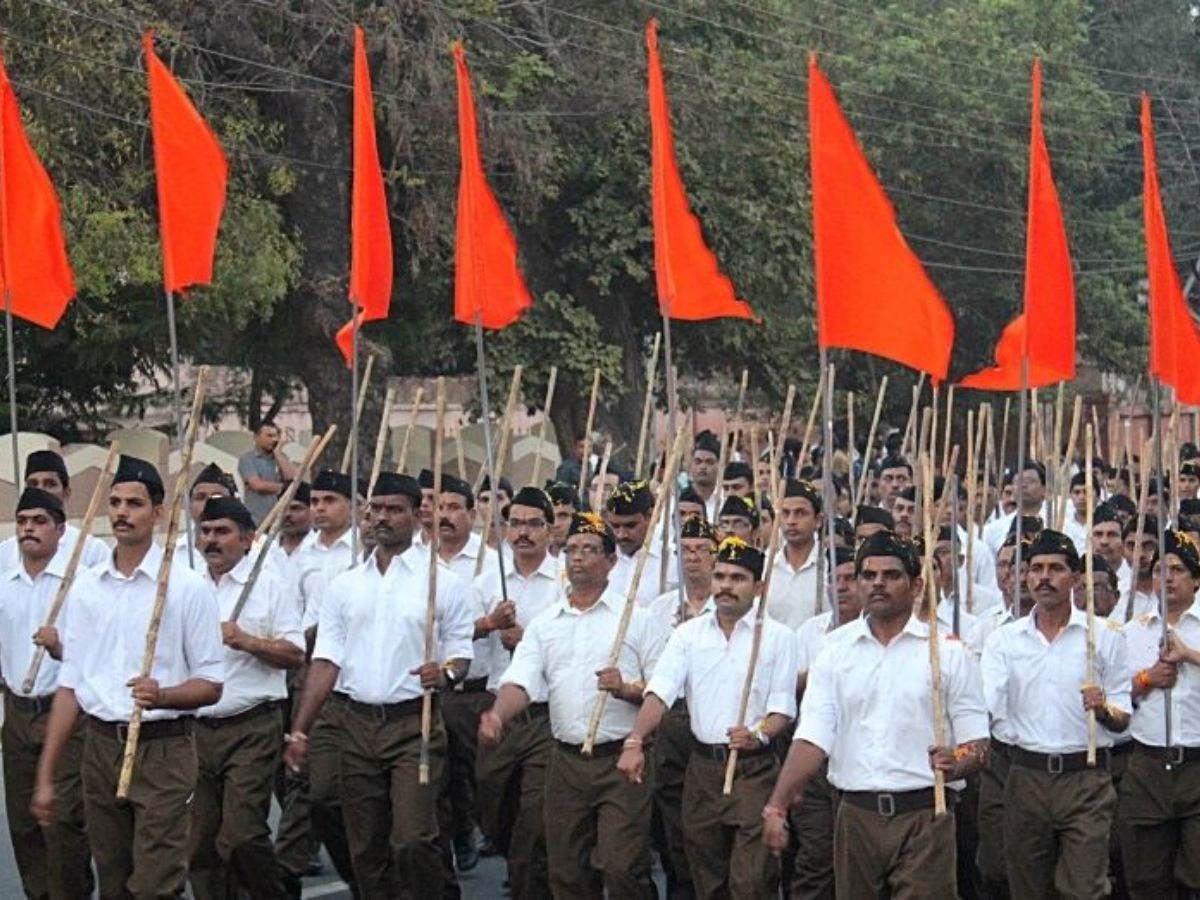
During the Covid-19 pandemic, RSS-affiliated volunteers distributed food, arranged oxygen cylinders, and managed cremations when fear had paralysed the world. (Image: Youth Ki Awaaz)
In an age of cynicism, where every act of service is often judged through the prism of politics, the Rashtriya Swayamsevak Sangh (RSS) has viewed sewa (or selfless service) as an act of worship. This critical distinction highlights the subtle yet profound understanding of the concept of Bharat by the RSS, which acknowledges the importance of service without expectation or reward, and stands in contrast to the Western view that perceives it as charity.
SEWA AS DHARMA
To understand the Sangh’s philosophy of sewa, one must return to Swami Vivekananda, whose call for “service to man as service to God” awakened modern India to the sanctity of action. Vivekananda taught that service was not an act of compassion bestowed upon the weak, but a sacred path of self-realization, which inherently serves as a means to purify the heart, discipline the will, and realize the oneness of all beings.
M.S. Golwalkar (or Guruji) gave this vision a more organized manifestation. He argued that the purpose of sewa was to destroy ego and awaken a sense of unity that transcends divisions of caste, creed, and community. To him, serving fellow humans was a “devoted worship of the Lord abiding in the heart of all beings.” Therefore, sewa becomes both a spiritual practice and a national duty, effectively serving as a bridge between the divine and the democratic.
For these reasons, the Sangh’s service activities since its inception have been an illustration of an enduring commitment, regardless of gender, caste, colour, ethnicity, or even religion. They are not episodic responses, limited to crisis, but rather components of the Sangh’s moral fabric, rooted in the ethos of Bharatiya traditions. Whether in slum schools, tribal villages, or flood-hit regions, its volunteers embody a deeply Indian understanding of compassion, wherein serving another is to serve oneself. It also means that duty and empathy are not treated as opposites, but rather as complementary to each other. Quite distinct from the concept of transactional philanthropy in the West, sewa in the Sangh tradition is anonymous, disciplined, and transformative.
INVISIBLE HANDS OF COMPASSION
During the Covid-19 pandemic, RSS-affiliated volunteers distributed food, arranged oxygen cylinders, and managed cremations when fear had paralysed the world. In disasters like earthquakes, floods, or wars, these nameless workers appear not as conquerors but as caregivers. They ask no one’s religion before offering help, all the while maintaining their silence because to them, service with silence is their strength.
But let’s also remember that to them, the idea of silence is not about secrecy, but about selflessness. And yet, critics often miss and at times wilfully overlook this essence of the Sangh and its work. They confuse anonymity with opacity, discipline with dogma, and moral conviction with rigidity. What they cannot comprehend is that an organization sustained for a century by voluntary participation cannot thrive on fear or paranoia. Instead, it has thrived on faith and servitude to human goodness and ideals of the Bharatiya civilization.
EVOLUTION OF SEWA
Each of these is, in truth, a form of sewa. The self who knows itself (swa-bodh) serves society through clarity of purpose. The family that nurtures values (kutumb prabodhan) serves the nation by cultivating compassion within its own home. The citizen who acts responsibly (nagrik kartavya) serves democracy by making it moral and desirable. The environmentalist who protects nature (paryavaran) serves creation itself. And above all, samajik samrasta, which calls for social equality and fraternity, is the highest form of service of all, since it heals the fractures of centuries and restores the idea of Bharat as one family.
It’s easy to overlook and misrepresent the Sangh as a static organization. The Sangh’s emphasis on ecological and social responsibility shows how its notion of sewa adapts with the times while remaining faithful to its spiritual core. The planting of trees, the cleaning of rivers, or the preservation of local biodiversity are not modern fads, but expressions of the ancient Vedic idea of the panchbhootas (five elements) that sustain life.
A CIVILIZATION OF SERVICE
Golwalkar once said that service should be without distinction, as calamities affect all people alike. This ideal is not theoretical but the essence of life. From the North to the South and East to West, the Sangh’s outreach to tribal and marginalized communities has been guided by empathy, not any sense of evangelism. Its schools in remote areas teach in local languages, preserve indigenous culture, as the Sangh works to instil self-respect among children who once felt forgotten. This aspect of sewa illustrates another core value of Sangh: social integration.
Examples like these dismantle the lazy caricature that the Sangh works only for one community. Instead, there should be recognition of a larger reality that, for the Sangh, the deepest impulse is the unification of the country through the bridging of social divides. It has taken decades to restore confidence after centuries of neglect and post-independence fissures in Indian society. When swayamsevaks rebuild homes in flood-hit Kerala or organize blood donation camps in Muslim localities, they are not engaging in propaganda, but rather fulfilling the call of Nar Seva, Narayan Seva.
In modern societies, where individualism often masquerades as freedom, the Sangh’s insistence on duty over entitlement can appear old-fashioned. Yet, that very ethic is what anchors communities against moral erosion. The concept of nagrik kartavya (civic duty) emphasizes that a citizen should be viewed as an active custodian of social order, rather than a passive recipient of state benevolence. Cleanliness, punctuality, and respect for the law are not administrative obligations, but rather moral virtues. The idea of sewa, as practiced by the Sangh, aligns rights with responsibilities, knowledge with humility, and faith with service, as it works to create a civic culture that grows from within.
THE UNBROKEN THREAD
In the ever-changing goalposts of Left scholars and so-called experts, the Sangh’s recent declaration of change is nothing but weakness and a confession of its inadequacies. It’s startling to see how much one has to innately loathe the Sangh to view its efforts of change and self-reflection as an admission of guilt. From Golwalkar’s reflections to Bhagwat’s advocacy of samajik samrasta, the movement has shown that introspection is not weakness but an indicator of strength. To adapt without losing one’s essence is the truest sign of vitality and originality.
As Bharat moves into Amrit Kaal, it is envisioning itself as a Viksit Bharat. In this journey to achieve such an ambitious vision, the philosophy of sewa will be more relevant than ever. In a fragmented world, it offers a unifying agenda, one where service is the foundation of freedom. Looking beyond self-interest, citizens may see the divine in each other. If they do so, there are no crises that are insurmountable and no divisions that are irreparable. For the Sangh, the next century is not a “project of power” but a “project of purpose.” It seeks to transform the culture of entitlement into a culture of duty and replace cynicism with compassion. Because at the end of the day, sewa is the soul and the unbroken thread of the Sangh and the Bharat, a living link between the individual and the sacred.
Prof Santishree Dhulipudi Pandit is the Vice Chancellor of JNU.
