
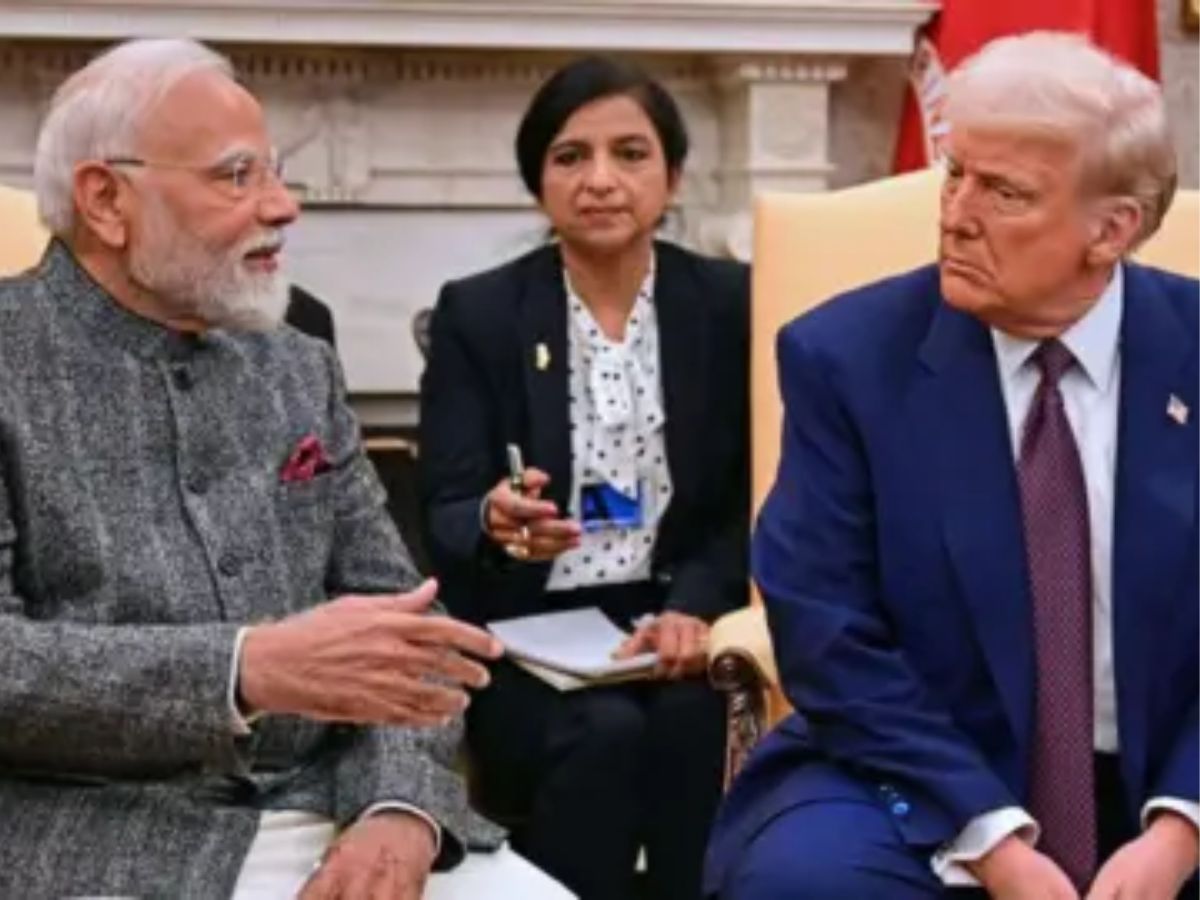
It is proving an impossible task to decipher the strategic cord binding the tactical moves that President Trump has been making on India. Perhaps because there is no linkage, and that each of his actions are to be taken as individual acts, absent a strategic motive.
Whatever, Donald Trump has done the impossible: he has reversed the overwhelming support he had among the public in India when he took charge in the White House, to an even greater number who have a dislike of not just President Trump but the US itself, as a consequence of the manner in which it has dealt with India.
After several countries bowed to his diktat out of fear of his reaction if they did not, India under PM Modi refused to budge when he demanded unlimited access to US grain and dairy products. Apparently, Trump would like India to open the door to purchases of surplus US grain and dairy products—an action that would send several millions of small producers in India on the brink of, or across, the boundaries of suicide. Those on the US side pushing for such concessions may do so devoid of concern for such a situation. The Government of India, however, cannot display the same attitude of indifference to the potential havoc some of the demands of President Trump could wreak among the people of India, were they to be conceded.
Day by day, action by action, President Trump is proving to be accurate the description of his niece Mary Trump—that the present occupant of the White House lacks even a fragment of empathy for those less privileged than himself. The appurtenances of power are a heady brew. Wherever he goes, usually a band strikes up “Hail to the Chief”, a song of praise modelled on “God Save the King”, a song accompanying King Charles of the UK on many of his public appearances.
President Trump, in his ambience of imperial power from the start of his second term, has acted as though the US government could be run in the way he does the Trump organisation—as a fiefdom. Now he has begun treating even close treaty allies of the US the same way, and to their discredit, several of them have genuflected before the President of the US. India under PM Modi has not, and this has obviously wounded the pride of the President, hence his adversarial attitude towards a democracy of 1.4 billion people. India has rallied behind the way in which the Government of India is doubling down in resisting the hostile actions of President Trump towards India.
For a country that needs 13 million additional jobs a year just to employ its youth, cutting off supplies from a country that takes up half the land space of Asia and Europe would be suicidal. The Russophobes were seduced by the fantasy that Russia would tire and sue for peace soon after the February 24, 2022, invasion of regular forces into Ukraine. Instead, it is the smaller country that is suing for peace, devastated as it has been by the war fought on behalf of some countries in NATO with Russia.
President Putin may be willing to give a 20% stake in the Sakhalin I oil project to Exxon Mobil, but not at the cost of India, which is expected to retain its 20% stake. Now begins the wait for US Trade Representative Peter Navarro to demand action against the US company for “fuelling the Ukraine war.” As he has not been asked to do so by President Trump, Navarro will keep silent on the matter.
More and more, and not just in India, are convinced that the outbursts made by some in the Trump administration about the close relationship India has with Russia were motivated by a desire to get back the 20% stake sold by Rosneft to India after Exxon exited the project following pressure from President Biden. Money may not necessarily be at the root of all evil, but it certainly is the motive for all too many of the actions directed by the White House.
Unfortunately for the security of the Indo-Pacific, President Trump has taken a sledgehammer to relations between Washington and New Delhi, to the delight of Beijing. There must be further glee in that sprawling capital at the statement by President Trump that as many as 600,000 Chinese students would be admitted to US universities. Vetting just 6,000 for reasons of national security would be a difficult task; adequately vetting 600,000 would be impossible.
About a third of the students would be genuine scholars, while another third would return to China filled with input including perceived vulnerabilities in US society and institutions, while the other third would seek to settle in the US. The CCP has both overt as well as covert members, and the latter has been growing in size as blowback against China gets stronger in parts of the world. The contest between China and the US as to whether the former will replace the latter as the numero uno power in the world is continuing in increasing force.
Hardly the time for the US to create turbulence in relationships with partners in what may be termed the global war for dominance of the Indo-Pacific by a single power. In the interests of the US, President Trump needs to dial back from his newly found hostility to India. Securing the Indo-Pacific from the creeping domination of China over more and more of its waters makes it essential that President Trump do so.




