
The controversy regarding the lighting of the Karthigai Deepam lamp atop Thiruparankundram hills near Madurai is a microcosm of the twin ills that plague India’s secularism, namely minority appeasement and Hindu bashing. By blatantly defying Constitutional authority to pursue its warped agenda, the DMK has added a new dimension and a new audacity to its ongoing campaign of Hindu vilification. Additionally, its specific and savage targeting of Justice Swaminathan is emblematic of its core ideology of Brahmin hate.
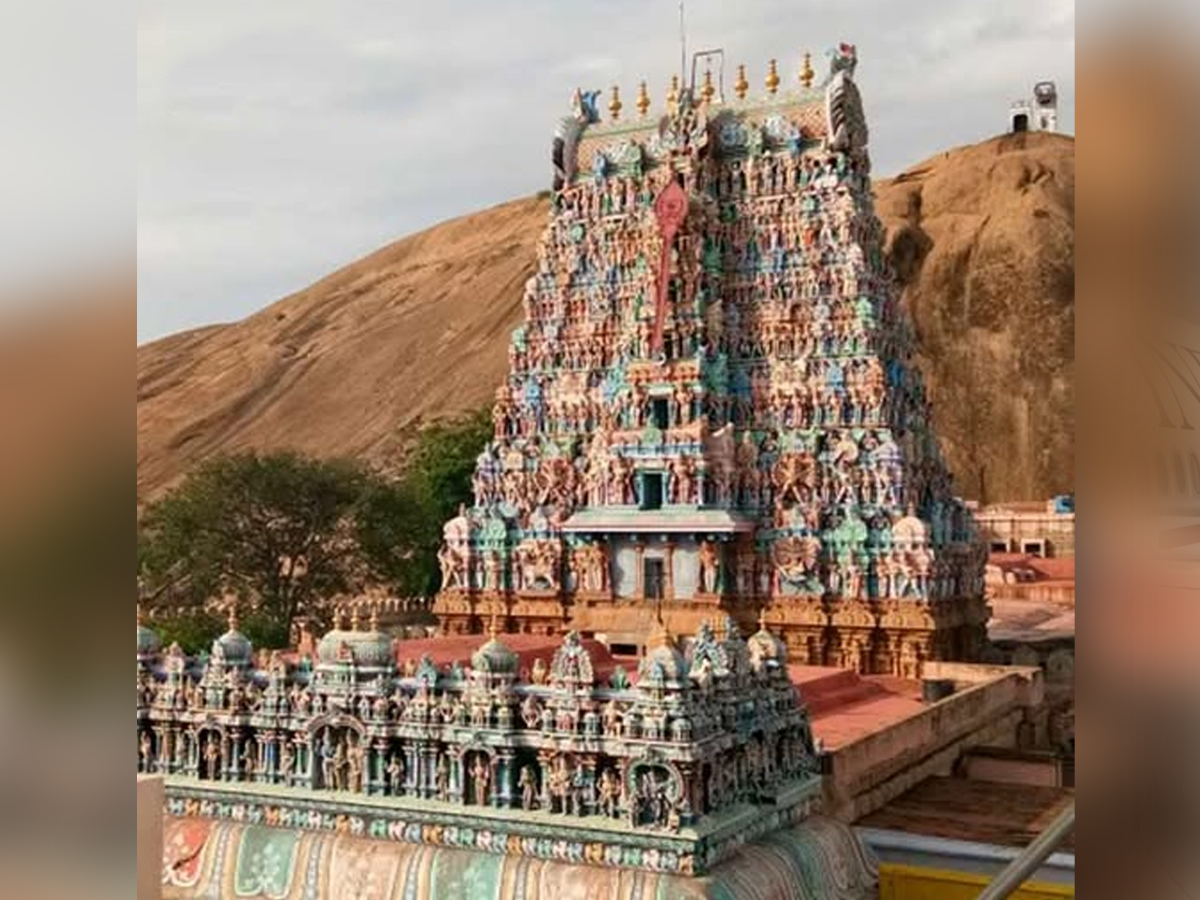
Lord Murugan, also known as Kartikeya, Skanda and Subrahmanya is a popular Hindu deity revered all across South India by all castes as the son of Shiva and Parvati. And Thiruparankundram is considered to be the first of the six abodes of Lord Murugan; it finds mention in Sangam literature, an ancient body of Tamil literature that dates back to 300 BCE, attesting to the antiquity of this association.
The Subramanya Swamy temple is a rock-cut structure built into the base of a large monolithic rock hill called the Thiruparankundram hill, also known as Kandhamalai (hill of Kandha). The temple was built around 6th century CE during the Pandyan period. Apart from the Subrahmanya temple, the Kashi Vishwanathar temple and Ucchi Pillayar temple are also located on this mound. Ancient Hindu and Jain structures including early cave temples going back thousands of years have been found on this hill making the association between this hillock and Hinduism undeniable.
Only much later around the 13th century, a simple memorial was built atop the hill in memory of Sikandar Shah, the last ruler of the Madurai Sultanate. The dargah itself was a latter addition, probably after 1858, not being visible in pictures prior to that.
The first question that comes to one’s mind in the context of this controversy is: of all the wide spaces available all around why was this specific Hindu holy site chosen to build a memorial to Sikander Shah? The intent is clear; it was a provocative act and a part of a wider strategic religious campaign to stamp the domination of Islam over Hinduism by either outright desecration or usurping its holy sites. Other sites across India like Ayodhya, Mathura and Kashi to name a few, testify to this malicious motive.
Our so called woke liberals are trying put a modern spin on this blatant example of religious domination by projecting it as an example of religious co-existence. Not true. It symbolizes forceful subjugation.
While Muslims have not opposed the lighting of the lamp at the Deepathoon, it is important to note that Thiruparankundram hill was brought into the spotlight earlier this year when pictures surfaced showing Muslims consuming nonvegetarian food on the sacred hill and attempts were made to rename the hill as Sikkander Malai. The courts had to step in and pronounce a verdict that banned animal sacrifice and prohibited any non-vegetarian food on the hill. Further the courts made clear that the hill will continue to be called Thiruparankundram hill.
The million-dollar question: Legally who owns the hill?
A trial court in 1923 unequivocally ruled that the temple owned the entire hill, except for about 33 cents of land, where the mosque and flagstaff of the dargah stand. Subsequent judgements in 1931, 1958 and 2011 reaffirmed this verdict.
So if the entire hill belongs to Hindus, it should then logically follow that Hindus have a right to light a lamp at the Deepathoon—a stone lighting pillar situated atop the hill on temple property, a few meters away from the dargah.
Simple. Right? But not so in India especially when it involves Hindu sentiments that are continually suppressed and thwarted.
It is important here to recapitulate the recent sequence of events to understand how the Constitutional process is being defied to follow a deceitful anti-Hindu agenda by the DMK government.
On December 1, Justice G.R. Swaminathan of the Madras High Court issues an order permitting the lamp to be lit atop the hill on December 3 before 6 pm, responding to a Hindu petitioner Rama Ravikumar.
The December 3 deadline passes. The lamp remains unlit. Justice Swaminathan convenes an unusual 6 pm video conference seeking answers from the Madurai collector and police commissioner. He then orders CISF cover to carry out his directive. In response the local administration imposes Section 144 and police obstruct the CISF. The lamp remains unlit.These actions by the DMK government amount not only to contempt of court but also a disregard for the rule of law on which a democracy runs.
In order to cover up its illegal stance and counter contempt moves initiated by the judiciary, the DMK government then approached the Madras High Court and subsequently the Supreme Court. And in a parallel move to further cover up its tracks, on December 10, 2024, approximately 120 MPs from the DMKled I.N.D.I.A bloc submitted a notice to Lok Sabha Speaker Om Birla seeking the impeachment of Justice Swaminathan.
The DMK has every right to dissent and approach a higher court but the move to impeach Justice Swaminathan is an extreme step that is not warranted especially when the verdict conforms to sound judicial norms: the division bench of the Madras High Court declined to stay Justice Swaminathan’s order and the Supreme Court too seemed to concur indirectly by deferring the hearing of the case without intervening promptly.Impeaching a judge sets a dangerous precedent with far reaching consequences for our democracy. Our democracy runs on the concept that differences will be resolved in a court of law and the verdict delivered by the court will be honoured by one and all. Willful failure to comply with court verdicts can result in anarchy and a total disregard for the rule of law leading to the demise of democracy.At this juncture it is important to address the elephant in the room. If the verdict is based on robust judicial principles, why is Justice Swaminathan being attacked so viciously? Is it because he happens to be a Brahmin? Brahmin hate is at the core of the DMK’s philosophy, which was popularized by its ideological father E.V. Ramaswamy Naicker (Periyar); he once famously said: If you see a Brahmin and a snake, kill the Brahmin first or words to that effect. Over the years the DMK has persistently persecuted Brahmins.In the current political ecosystem, it is not fashionable to protest hate directed towards Brahmins because of the odium of their historical misdeeds and many such incidents are allowed to pass. But one must remember that hate is hate whether it be directed against a Brahmin or a Dalit. Justice cannot be meted out by replacing one type of discrimination with another. The goal is to create an egalitarian society devoid of its past deficiencies.
Therefore, the DMK’s Constitutional blasphemy and Brahmin hate need to be called out loud and clear to preserve the fabric of our democracy and society. The Supreme Court or the Central Government has to take a stand.




