
In time, “announcement No. 62 of 2025” of the Chinese government may be remembered as the moment when the power balance of the world comprehensively tipped. The government order that made the export of rare earths—crucial to a range of industries from mobile phones to fighter jets—subject to official clearances showed that the Chinese could, at least in the near term, bring vital sectors to a halt if they clamp down on the source of rare earth minerals, of which China controls 70% of global supplies. In the immediate future, China, therefore, has an equal—if not even more powerful—leverage on America, as US President Donald Trump has with his tariffs upon China.
And despite ever more dramatic tariff escalations, India has not crumbled before the dictates of Trump. India has retained its relationship with Russia, and, despite Trump’s announcements, there has been no confirmation of any major reduction of Indian purchases of Russian oil.
In between, news of the arrest of Ashley Tellis, the most prominent India-pundit on the Beltway, accused of sharing top secret documents with Chinese officials, stunned the so-called “South Asia” community. The question of whether India-born Tellis, senior fellow at the Carnegie Endowment for International Peace, and former adviser to President George W. Bush, was an asset of the American deep state, or the Chinese one, now haunts “South Asian-ists.” If the charges are validated, this is damning evidence of the reach of Chinese espionage within both the US government and the “South Asian network.” Are there more such examples? Possibly.
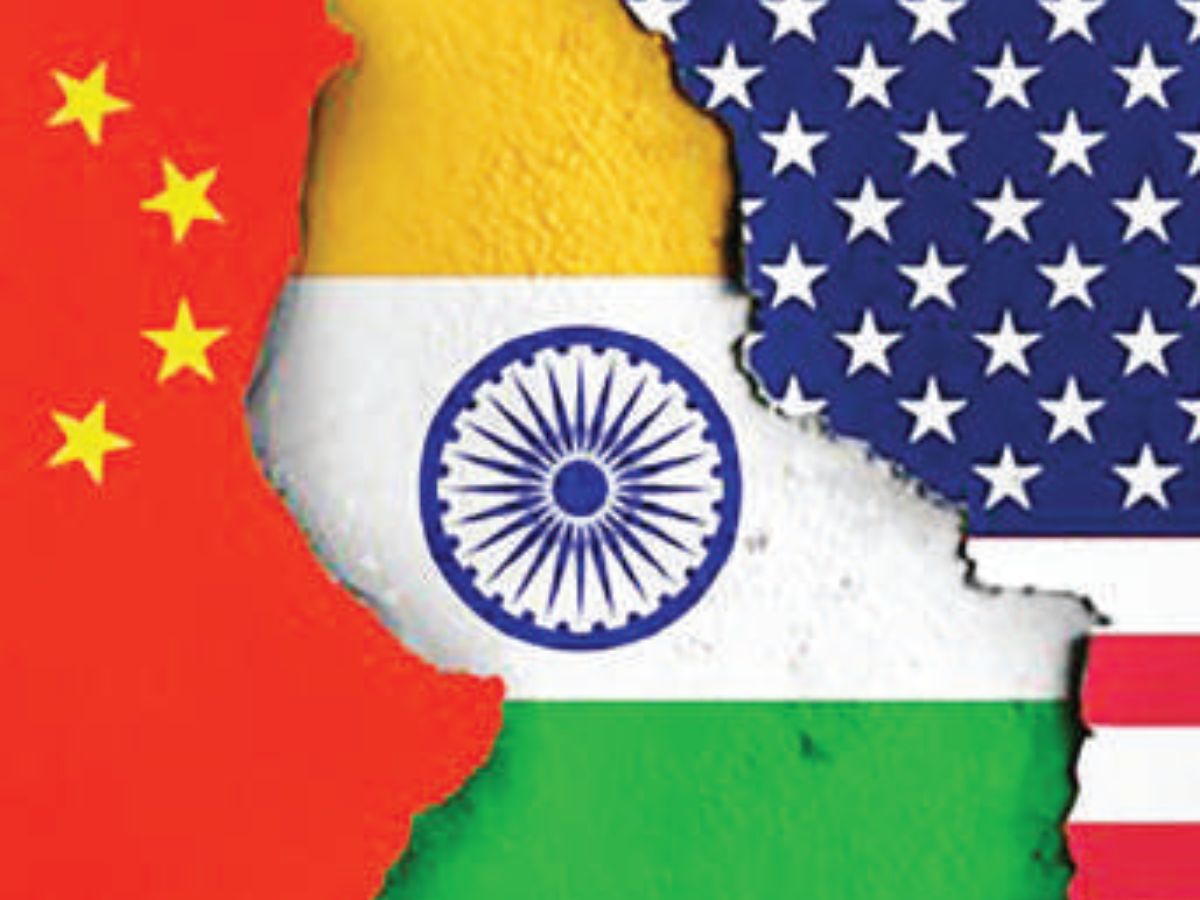
All of this adds up to a world where America is accepting that it has to accommodate China, and in the remaining space, India is jostling in. I call it the “G2 and a half” world. America’s reconciliation with a G2 world—a geopolitical structure in which the United States and China share global leadership—signifies a profound transformation from the unipolar moment that followed the Cold War into a multipolar or G2 and a half order. The United States has reluctantly accepted China’s structural parity in economic, technological, and military terms, though competition remains intense. The resilience of India, especially under sustained tariff pressures from President Trump, has added new complexity, positioning New Delhi as the intermediary power solidifying a “G2.5” world order.
The notion of a “G2” world, first popularized by economist C. Fred Bergsten in 2005, envisaged the United States and China as co-managers of global stability through joint responsibility on economic governance, trade imbalances, and global problem-solving. However, by 2025, that ideal has evolved into a pragmatic balance of rivalry and restrained cooperation. This estranged equilibrium still forces America to acknowledge China’s systemic parity.
The balance of trade continues to tilt toward China. Despite Trump’s 20% tariff on Chinese imports imposed in March 2025, the Chinese surplus with the United States rose to $33.5 billion in a single month. Yet, diversification of sourcing is eroding China’s dominance—its US import share declining from 21.2% in 2018 to just under 14% in 2023.
The United States’ economy remains 65-70% consumer-driven, while China’s continues transitioning from export-led to domestic-consumption-based growth. Retail consumption in China, reaching RMB 48.35 trillion ($6.8 trillion), represents a structural rebalancing of its economy.
The sphere where parity—or even Chinese predominance—is most evident lies in advanced technology. According to the Information Technology & Innovation Foundation (ITIF), China leads the United States in 57 of 64 critical technologies, from robotics and quantum communication to advanced materials and satellite positioning systems. In fact, the Australian Strategic Policy Institute found China produces a higher share of the top 10% of global research publications across all eight critical domains, including energy, environment, and AI.
China’s leadership is the product of decades-long industrial policy emphasizing STEM education, subsidies, and military-civil fusion. The result is a broad-based scientific ecosystem producing four times more STEM graduates than the United States annually. America retains an edge in foundational capabilities—semiconductor architecture, quantum computing, and vaccine technology—but China has closed the implementation gap. Its 1,200-mile quantum communications corridor and dominance in electric vehicle and solar panel production reinforce a structural shift in high-end manufacturing.
Though America continues to outspend China militarily—over $858 billion versus $296 billion for China—quantitative advantage no longer guarantees qualitative superiority. The Global Firepower Index places the Chinese military nearly neck-and-neck with the US. China has become a near-peer power in hypersonic weapons, satellite surveillance, electronic warfare, and autonomous drone systems. Military-civil fusion policies have blurred the line between strategic research and defence technology, while naval power projection in the South China Sea and beyond now rivals that of traditional US dominance.
America’s adjustment to this parity is visible in its pivot strategy: rather than seeking outright containment, it strengthens “techno-economic alliances” across AUKUS, Quad, and NATO. However, persistent reliance on global semiconductor supply chains—like Taiwan and South Korea—makes American strategic autonomy interdependent with Asian technological ecosystems, paradoxically reinforcing China’s centrality.
President Trump’s second term has pivoted back to hard tariffs and protectionism. Washington levied 20% tariffs on all Chinese imports, escalating from 10%. Beijing retaliated with 15% duties on US agricultural imports and imposed critical mineral export restrictions—including bismuth, tungsten, and molybdenum—threatening US manufacturing supply chains.
This policy has deepened rather than reversed interdependence. Despite the tariffs, Chinese exports globally continue to boom, with 10.7% year-on-year growth by late 2024. Washington’s rhetoric belies a structural acceptance: China’s supply chain dominance in batteries, solar, and electronics is indispensable. Even Trump’s 2025 corporate tax reduction proposal—from 21% to 15%—signals not decoupling but defensive adjustment.
In essence, America’s reconciliation with a G2 world arises from necessity, not design. The principle of confrontation coexists with interdependence: the US cannot isolate China without self-harm, given the latter’s grip on global manufacturing, rare earths, and renewable energy ecosystems. By 2025, China constitutes 35% of global manufacturing output, while the United States accounts for only 16%. Chinese companies like CATL dominate 56% of global EV battery production, and Huawei and BYD’s global market shares in 5G and green tech underline techno-industrial supremacy.
The American approach now resembles “competitive coexistence,” in which containment is balanced by collaboration in climate stability, financial regulation, and selective supply chain realignment. The G2 is no longer ideological—it is structural.
India has defied both American and Chinese expectations by consolidating strategic autonomy amid trade and tariff pressures. President Trump’s imposition of 50% tariffs on Indian imports in early 2025 sought to draw New Delhi into compliance, but India not only refused concessions—it expanded exports to Africa, West Asia, and ASEAN.
India’s resilience positions it as the third pivot in a G2.5 world. Its GDP reached $4.2 trillion in 2025, surpassing Japan and Germany, making it the world’s third-largest economy. It now accounts for over 16% of global growth, and sectors such as IT, digital payments, and pharmaceuticals rival those of both superpowers.
India’s ascent is particularly visible in three domains: digital infrastructure, where UPI beats Alipay and PayPal combined in volume; renewable energy, where India ranks third globally in solar capacity after China and the US; and space and defence, with Chandrayaan-3’s success and indigenous missile and satellite systems. India shows near-peer self-sufficiency unmatched by any middle power.
These advances position India as an indispensable swing power—aligned economically with G7 markets yet strategically autonomous in its dealings with China and Russia. The definitive case study of this autonomy was India’s response to the Trump administration’s tariffs. In 2018, the US imposed sweeping steel and aluminium tariffs and, critically, removed India’s Generalized System of Preferences (GSP) status, which had allowed billions of dollars of Indian goods to enter the US duty-free. These were “historic tariffs” designed to force a concession. Later escalations in 2025 saw tariffs on many Indian goods rise to 50%, even higher than those on some Chinese products.
A G2-world model would have predicted two outcomes: India either capitulates to US demands to preserve its export market or pivots fully into China’s economic orbit. India did neither. It absorbed the economic pain, filed a dispute at the WTO, issued its own calibrated retaliatory tariffs, and, simultaneously, deepened its strategic engagement with the US through the Quadrilateral Security Dialogue (Quad).
This demonstrated India’s new reality: it is too large to be bullied and too strategically independent to be bought, the essence of its “multi-alignment” policy. India is the only nation that is a full member of both the US-led Quad and the China-Russia-led Shanghai Cooperation Organisation (SCO) and BRICS. It has become a top buyer of discounted Russian oil, defying Western sanctions, while simultaneously conducting its largest-ever military exercises with the US. This is not confusion; it is confidence. India is the “swing state” in the G2 competition, a “half” that is, in reality, a full pole, courted by both sides but controlled by neither.
The emergent “G2.5” order is visible across distinct functional dimensions. While the US leads in foundational AI algorithms, China leads in AI deployment. India is now the world’s largest exporter of AI-enabled IT services, accounting for 40% of global business process outsourcing. Chinese AI startups raised $25 billion in 2024 versus $33 billion for US counterparts, while India attracted $8 billion, showing triangular competitiveness.
China supplies over 80% of global solar cells, the US dominates green R&D investment, and India pioneers cost-effective solar diffusion, providing the world’s lowest solar tariff rates ($0.022 per kWh). India’s International Solar Alliance now drives global energy diplomacy independent of the G2 structure.
The United States retains the largest defence budget, but China’s hypersonic and naval systems extend its operational reach, while India emerges as the fourth-largest defence spender, pursuing indigenization through the “Atmanirbhar Bharat” (self-reliant India) campaign. India’s 2025 arms exports, worth $2.8 billion, surpass Israel’s, signalling not only technological but strategic agility.
America’s acceptance of Chinese parity is effectively an acknowledgment that no unilateral order can sustain itself. Yet, the firmness of Indian strategic autonomy—especially its non-alignment with either bloc—has converted a G2 into a triangular arrangement. This structure functions as follows:
-
The US-China axis defines technological and financial rivalry.
-
The India-China interface embodies industrial competition.
-
The US-India partnership sustains democratic strategic balance in the Indo-Pacific.
Together, this G2.5 architecture operates neither as bipolar nor fully multipolar—it is a dynamic equilibrium anchored in mutual constraint.
The United States has adapted by strengthening industrial policies reminiscent of China’s own developmental model. Legislation under the revived “America First Productivity Initiative” in 2025 promotes re-shoring of semiconductor manufacturing, tax incentives for critical minerals, and green infrastructure investments. These reflect acknowledgment—if not endorsement—of Chinese-style state capitalism.
America’s financial markets remain dominant due to the dollar’s reserve supremacy, but even here, Chinese influence is unmistakable. The Yuan now accounts for nearly 8% of global trade settlements, and Beijing’s digital currency projects through the Belt and Road have expanded its transactional reach.
In this environment, the US focuses less on ideological containment and more on “selective decoupling”: prioritising national security domains (semiconductors, quantum AI) while retaining deep commercial ties in consumer goods, energy, and digital ecosystems. Yet the crucial stabiliser is India. Its autonomy transforms a binary G2 into a plural G2.5 framework that embodies the 21st century’s geopolitical signature: competitive multipolar interdependence.
America has not surrendered dominance; it has learned coexistence. China has not supplanted America; it has joined it. And India has not aligned; it has balanced them both—asserting a more distributive order than any since 1945. This is the G2.5 world.
The author is professor of international relations at the O.P. Jindal Global University, and director of the Jindal India Institute.




