
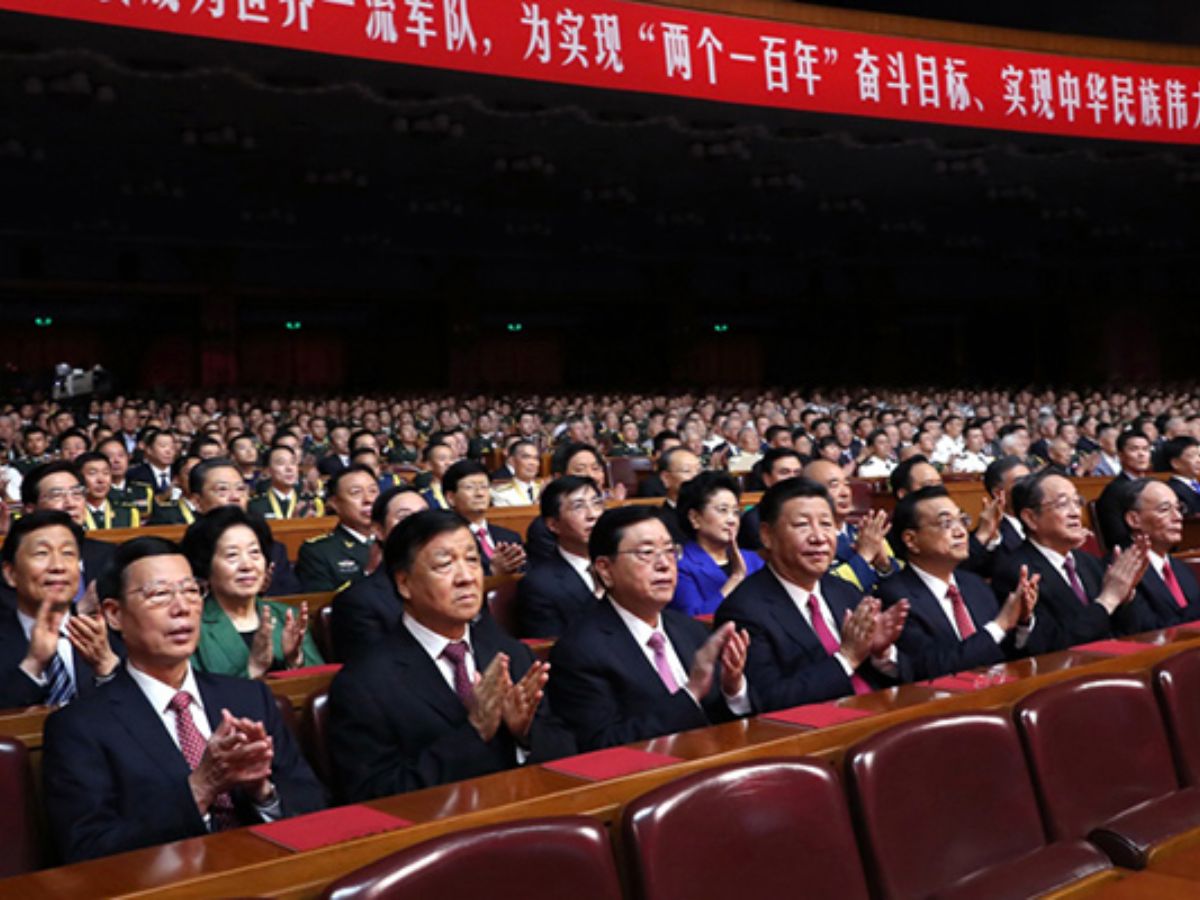
Zhang Youxia, long viewed as one of Xi Jinping’s most trusted military allies and a vice chairman of the Central Military Commission (CMC) with significant operational authority, has been purged alongside Liu Zhenli. In the aftermath of Zhang’s removal, the political climate within the Chinese Communist Party (CPC) has grown noticeably more strained, reflecting heightened elite sensitivities and possible tensions within the system’s upper ranks. The February 9, 2026 PLA Daily commentary by Ren Long, titled “Being Politically Strong Is the Most Fundamental Strength,” seems to suggest just that.
Ren Long’s invocation of Zhang Guotao is historically and politically significant. Zhang, who attempted to split the CPC and the Red Army during the Long March, represents the archetype of political deviation and factionalism within the CPC’s revolutionary narrative. By citing Zhang’s defiance and contrasting it with Zhu De’s loyalty, the commentary frames political betrayal as existential. The Mao-Zhang Guotao split during the Long March was essentially a struggle over supreme authority within the CPC: institutional legitimacy versus military strength.
While Zhang commanded the far larger Fourth Front Army, Mao controlled the Party Central Committee after the Zunyi Conference. Their strategic dispute—north to Shaanxi versus southwest to build a revolutionary base masked a deeper conflict over centralization and divided command. When Zhang formed a parallel “central” authority and declared himself “Chairman” in 1935, Mao treated it as factionalism and a threat to Party unity. Zhang’s subsequent military setbacks weakened his position, allowing Mao to consolidate control. Later condemned during the Yan’an Rectification Movement and ultimately defecting to the Kuomintang (KMT) in 1938, Zhang became a cautionary example in CPC doctrine, reinforcing the principle that military power without political submission to the Party centre is illegitimate.
Although the commentary refrains from naming Zhang Youxia and Liu Zhenli directly, its renewed focus on “political problems” unmistakably resonates with an earlier PLA Daily editorial that accused the two of “seriously undermining the CMC chairman responsibility system,” thereby reinforcing the political framing of their removal. At its core, the commentary reasserts the long-standing Maoist principle that “the Party commands the gun.” Political loyalty is therefore not one attribute among many, it is the ontological foundation of the force. Yet it does so in contemporary language tied to Xi Jinping Thought and the ongoing campaign of political rectification within the PLA.
Political “ability” is framed as the enabling “1” preceding all other “0s.” Without it, other competencies lack coherence and trustworthiness. This formulation is instructive. By conceptualizing political ability as the foundational digit that gives value to all subsequent abilities, Ren effectively subordinates operational capability to ideological reliability. The metaphor implies that military modernization, technology, joint operations capability, combat readiness have value only insofar as they are politically anchored. In other words, a technologically advanced but politically unreliable force is strategically dangerous to the regime. This logic explains the commentary’s warning that “if political ability is not strong, it will collapse without even fighting.”
The commentary’s assertion that when political discipline weakens, “maladies multiply, hearts are scattered, morale is lost” reflects a classic CPC diagnosis of organisational decay. The Party historically interprets internal crises through the lens of ideological laxity. Disunity is attributed to erosion of political clarity; corruption is interpreted as a failure of ideological commitment. The Zhang Guotao analogy may likewise be extended to a series of high-profile political and military figures who have fallen from power in recent years, for the commentary explicitly links corruption eradication to political rectification, arguing that “the stock of corruption has not yet been completely eliminated” and must be addressed through political strengthening.
Ever since Xi’s anti-corruption tirade, the fallen “tigers” include Zhou Yongkang, a former member of the Politburo Standing Committee; Xu Caihou and Guo Boxiong, both former vice chairmen of the CMC; Sun Zhengcai, once widely viewed as a potential successor ahead of the 20th Party Congress; more recent dismissals encompass former defence ministers Li Shangfu and Wei Fenghe, former Rocket Force commander Li Yuchao, and CMC member and head of the Political Work Department Miao Hua, collectively underscoring the breadth and intensity of elite turnover at the highest levels. Tian Xuebin, a former secretary to Wen Jiabao and Vice Minister of Water Resources, has become the first vice-ministerial-level “tiger” to fall in the 2026 anti-corruption campaign.
The reference to the Party’s “four major tests” and “four kinds of dangers” situates the PLA commentary within a broader CPC self-assessment narrative. These categories typically include governance capacity, reform pressures, external challenges, corruption, and loss of mass support. By stating that these dangers persist over the long term, the commentary implies structural vulnerability. As China advances toward the PLA’s centenary in 2027 and the 21st Party Congress, the year 2026 is likely to be characterized by extensive purges and personnel reshuffles across multiple tiers of the system. In this context, the evolving linkage between anti-corruption enforcement and political loyalty will be closely scrutinized by analysts.
Does the commentary imply that political disloyalty inevitably produces institutional collapse, as it suggests? Within CPC theoretical logic, yes. The Party’s historical narrative from the collapse of the Soviet Union to intra-Party struggles during the revolutionary and construction periods, frames ideological erosion as the precursor to systemic breakdown. From a strategic perspective, this emphasis also reflects China’s perception of external ideological competition. The “complex and profound changes” in the international environment likely reference geopolitical rivalry, technological decoupling, and information warfare. Political consolidation within the PLA thus becomes part of broader regime hardening.
Finally, by declaring “political ability” as primary, the Party signals that military modernization must remain politically embedded. The risk being mitigated is not battlefield defeat but political estrangement between the PLA and the Party centre. The February 9 commentary, therefore, is a doctrinal reaffirmation of Party supremacy over the military at a moment of consolidation and transition. Its invocation of Zhang Guotao, its fusion of anti-corruption and ideological rectification, and its elevation of political ability above all other competencies collectively indicate a regime security logic. In this sense, the commentary reflects continuity rather than rupture. It is a modern articulation of an enduring Leninist principle—the durability of the system depends on the political reliability of the armed force.
* B.R. Deepak is Professor, Center of Chinese and Southeast Asian Studies, Jawaharlal Nehru University, New Delhi.




