
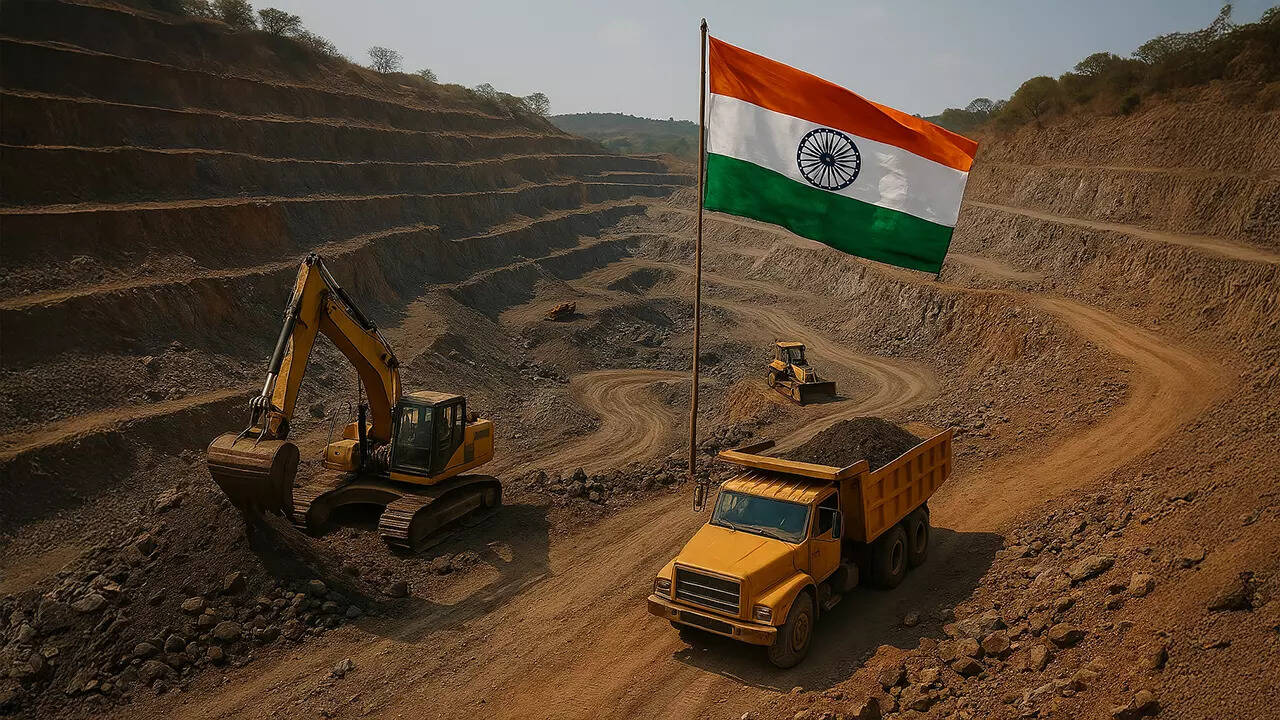
Each leap forward in human civilisation has been defined by mastery over a material— bronze, iron, coal, oil. Rare earth elements, a subset of Critical Minerals, are now the foundations of another such epoch, and the coming decade in geo-economics will be defined by the Great Game—competition and even conflict over access, ownership, control and deployment of these resources. They are integral to the green energy transition, advanced defence and aerospace systems, semiconductors, and digital infrastructure, and to India meeting its Viksit Bharat goal.
For us, therefore, this moment is more than a strategic opportunity; it is a civilisational inflection point that allows us to convert natural wealth through technology, investment, and entrepreneurship into long-term sovereignty, accompanied by autarky and global influence. Seventeen Rare Earth Elements (REE), a subset of Critical Minerals, including neodymium and dysprosium to terbium, europium, and yttrium, are used in everything—from precision-guided missiles and satellite communication systems to EV motors, solar panels, smartphones, and semiconductors. Rare earth magnets, especially Neodymium-Iron-Boron (NdFeB) types, power everything, from wind turbines to fighter jets.
Cerium and lanthanum are used in catalysts and ceramics, while europium and terbium are vital for display technologies and lasers. No modern nation can claim strategic autonomy without secure access to these critical inputs. India is the world’s thirdlargest holder of rare earth reserves, with 6.9 million metric tonnes of rare earth oxides, primarily located in the monazite-rich sands of Kerala, Tamil Nadu, Andhra Pradesh, Odisha, and West Bengal. Yet, it contributes less than one per cent of global production, ranking eighth or ninth, far behind China, the United States, and Australia. In 2023-24, India produced approximately 2,900 tonnes— barely a fraction of its potential. Meanwhile, imports surged, with India bringing in nearly 54,000 tonnes of rare earth magnets in FY25, up from just 12,400 tonnes in FY21.
The mismatch between domestic reserves and value-added output highlights the urgency of building full-spectrum capabilities. There is a global awakening about the fragility of REE global supply chains. In 2010, China cut off rare earth exports to Japan over a maritime dispute. In 2024, it tightened controls on gallium, germanium, terbium, and dysprosium—elements essential for EVs, wind turbines, and defence systems—citing national security. In April 2025, China introduced new licensing rules and export controls requiring buyers to declare end-use and commit to non-defence purposes, and stalled rare earth and magnet shipments to Indian firms. We know that this is not a transient problem. China controls 70 per cent of the world’s REE production and nearly 90 per cent of its processing. China is reinforcing this advantage by investing in politically unstable areas like Myanmar, where the United Wa State Army—backed by Beijing— is consolidating control over dysprosium and terbiumrich deposits. From Chinese investments in Latin America, Africa and Myanmar to Pakistan’s Balochistan province, where American firms have entered into joint ventures, the rare earth scramble is intensifying, and the Great Game is afoot.
The G7’s 2025 Critical Minerals Action Plan commits economies to inoculate themselves against the weaponisation of critical minerals—rare earth elements—by anticipating supply shocks, coordinating responses, and diversifying mining, processing, manufacturing, and recycling capacities. India formally endorsed this Action Plan, aligning itself with the G7’s framework for standardsbased markets, responsible sourcing, and innovationdriven supply chains. This endorsement reflects India’s strategic convergence with advanced economies on the governance of critical minerals, and especially of REEs, amid growing concerns over concentrated dependencies. At the G20 as well, India played a leading role—especially during its 2023 presidency—in shaping consensus around resilient mineral ecosystems, with specific emphasis on sustainable extraction and equitable access to rare earth supply. The New Delhi G20 Leaders’ Declaration, in which China was a participant, reaffirmed the collective resolve to diversify sources, promote transparent global REE trade, and support just transitions in resourcerich developing economies.
These endorsements deepen India’s operational and normative alignment with global mineral governance, reinforcing its ambition to move from resource holder to rule-shaper in the evolving rare earth order. India’s multidimensional game plan in this Great Game is anchored in Atmanirbhar Bharat and strategic autonomy. The Modi Government has taken decisive steps to bridge shortterm supply gaps while building long-term domestic capacity. Customs duties on 25 critical minerals were removed in Budget 2024-25. The 2025-26 Budget extended duty exemptions to imports of cobalt ore, lithiumion battery scrap, lead, zinc, and 12 additional minerals. This import bridge reflects a smart and WTO-compliant strategy of building valueadded manufacturing in India while securing raw materials globally. The Mines and Minerals (Development and Regulation) Act was amended in 2023 to liberalise private exploration.
For the first time, non-radioactive rare earths and lithium were opened to commercial mining. The new Exploration Licence regime enabled the auction of 24 critical mineral blocks, including lithium, nickel, and rare earths, and the granting of 13 new licences. The Ministry of Mines has initiated the first dedicated e-auctions for strategic minerals, and new projects like the Reasi lithium deposit, in the Jammu region, are being actively explored. A landmark initiative is the National Critical Mineral Mission (NCMM). Adopting a whole-of-government approach, the Mission will work closely with relevant ministries, PSUs, private companies, and research institutions to achieve its objectives. With a planned expenditure of Rs 16,300 crore, supplemented by an additional Rs 18,000 crore investment by PSUs and private investors. Under the NCMM, the Geological Survey of India (GSI) has been tasked with conducting 1,200 exploration projects from 2024-25 to 2030- 31; GSI has undertaken 195 exploration projects in FY25 alone, with 227 more planned in FY26. The mission also aims for five mineral stockpiles, four processing hubs, and overseas acquisitions.
India’s refining capacity, however, remains a bottleneck. Indian Rare Earths Limited (IREL), the lone state miner under the Department of Atomic Energy, reached 531,000 tonnes of mineral production in FY24. While IREL aims to commence four new mines and scale up neodymium oxide production to 450 tonnes in FY26, and double it to 900 tonnes by 2030, there is perhaps a need to strengthen its technical capabilities, expand midstream infrastructure, and ensure consistent strategic leadership to match rising domestic demand. To catalyse downstream value addition, the Ministry of Heavy Industries launched a Rs 1,345 crore production-linked incentive scheme for rare earth magnet manufacturing.
The goal is to produce 4,000 tonnes of NdFeB and samariumcobalt magnets by 2030. Companies like Mahindra, Sona BLW, Uno Minda, and Hyderabad-based Midwest Advanced Materials have stepped forward. The latter, supported by the Ministry of Science and Technology, will begin commercial production of rare earth magnets in late 2025 with a capacity of 500 tonnes per year, scaling to 5,000 tonnes by 2030. This marks the first true industrial magnet manufacturing capacity in India. This push is also aligned with India’s broader energy and industrial roadmap. India’s installed renewable energy capacity has reached 220 gigawatts, including over 110 gigawatts of solar and 50 gigawatts of wind. India targets 500 gigawatts of non-fossil capacity by 2030.
These systems require rare earths and critical minerals like gallium, tellurium, indium, dysprosium, neodymium and ultra-pure silicon. Meanwhile, India is targeting 30% of new vehicle sales to be electric by 2030, which will drastically increase the demand for lithium, cobalt and nickel. India’s urban mining sector is quietly emerging as a strategic asset. Attero Recycling, one of the world’s few integrated critical mineral recyclers, is expanding capacity from 300 tonnes to 30,000 tonnes of rare earths annually by 2026. It has developed high-purity recovery technologies for lithium, cobalt, neodymium, and praseodymium from spent batteries and e-waste. The Ministry of Mines is designing a PLI scheme for recycling to support this ecosystem. In parallel, India is investing in alternative technologies that reduce the critical minerals pressure.
The Production-Linked Incentive scheme for Advanced Chemistry Cell batteries, with an outlay of Rs 18,100 crore, has seen progress. Ola Electric began trial production of lithium-ion cells in early 2024 and is scaling up capacity toward commercial production by 2025-26. Reliance’s acquisition of UKbased Faradion has brought sodium-ion battery technology to India; a 30 GWh gigafactory is under construction in Jamnagar, due to commence production in 2026. India’s first silicon carbide fabrication plant is being set up in Odisha, while the Ministry of Electronics has funded Gallium Nitride R&D at IISc and DRDO labs. These third-generation materials offer pathways to reduce dependency on conventional critical mineralbased components.
However, some policy challenges remain. Restrictions under the Nehru-era Atomic Energy Act of 1962 limit private access to monazite-bearing minerals due to thorium content. This has historically reserved beach sand mining for PSUs like IREL, constraining scalability. Even now, most private investment is limited to downstream magnet-making, not upstream mining or refining. India needs a dedicated critical minerals authority to coordinate exploration, licensing, technology acquisition, environmental approvals, and commercialisation. Such an entity could replicate the success of ISRO, DRDO, or UIDAI in focused mission delivery. Geopolitically, India has asserted leadership in multilateral efforts to reshape the critical minerals order but is also building bilateral partnerships across continents. Latin America presents a frontier for strategic engagement.
Prime Minister Modi’s recent visits to Argentina and Brazil, part of the lithium-rich “Triangle,” underscore this push. In 2024, Khanij Bidesh India Ltd (KABIL)—a JV between PSU giants NALCO, HCL, and MECL, operating under the Ministry of Mines— signed a US$24 million agreement to explore lithium across 15,703 hectares in Argentina’s Catamarca province. With its presidency of BRICS+ in 2026, India is poised to propose a Critical Minerals Cooperation Initiative linking African reserves, Brazilian geology, Gulf investments, and Indian refining and manufacturing. India is also a founding member of the U.S.-led Minerals Security Partnership (MSP), a leading voice in the Quad’s Critical Minerals Initiative, and is actively engaging through the Indo-U.S. iCET framework. These platforms offer India not only avenues for coinvestment and technology transfer but also diplomatic leverage to shape a transparent, diversified, and rulesbased global mineral order.
India’s transformation as the world’s fourth-largest economy is built on a decade of institution-building and execution under Prime Minister Modi. India leads in digital public goods like Aadhaar, UPI, and CoWIN. UPI now handles over 650 million transactions a day, more than Visa. We have launched lunar and solar space missions, delivered vaccines to the world, and emerged as the fastestgrowing major economy. The same capacity-driven mindset must now energise India’s rare earth revolution.
Lakshmi Puri is a former Assistant Secretary-General of the United Nations and Deputy Executive Director of UN Women; and a former Ambassador of India.




