While India should pursue the RIC troika, it must also get back to normalising India-US ties which have been assiduously cultivated over the past 25 years. Both the US and the Indian administrations are working overtime to get things back on an even keel, and that could well come about.
There is a saying in world affairs, “Never waste a good crisis.” The recent trainwreck of US-India relations has been one of the greatest crises Indian diplomacy has faced in decades. It is to our credit that we have used it both as a vindication of our own stand, and as a means to explore other options that lie ahead.
The harangue of Trump and his aides against India, and the arbitrary imposition of 50% tariffs on Indian goods, seems to be based more on personal pique for not being credited for the ceasefire between India and Pakistan—something that he hoped would bolster his claims for a much-coveted Nobel Peace Prize—than any economic or strategic considerations. The signals emanating from his administration have toned down and more and more voices are reiterating that the India-US ties remain “the defining partnership of the 21st century.” Perhaps this crisis will tide over and even the tariffs could eventually be rolled back. (Maybe by the US judiciary itself which has declared them as exceeding the President’s authority). But what would take more time to repair is the loss of trust that has now come about in India-US relations.
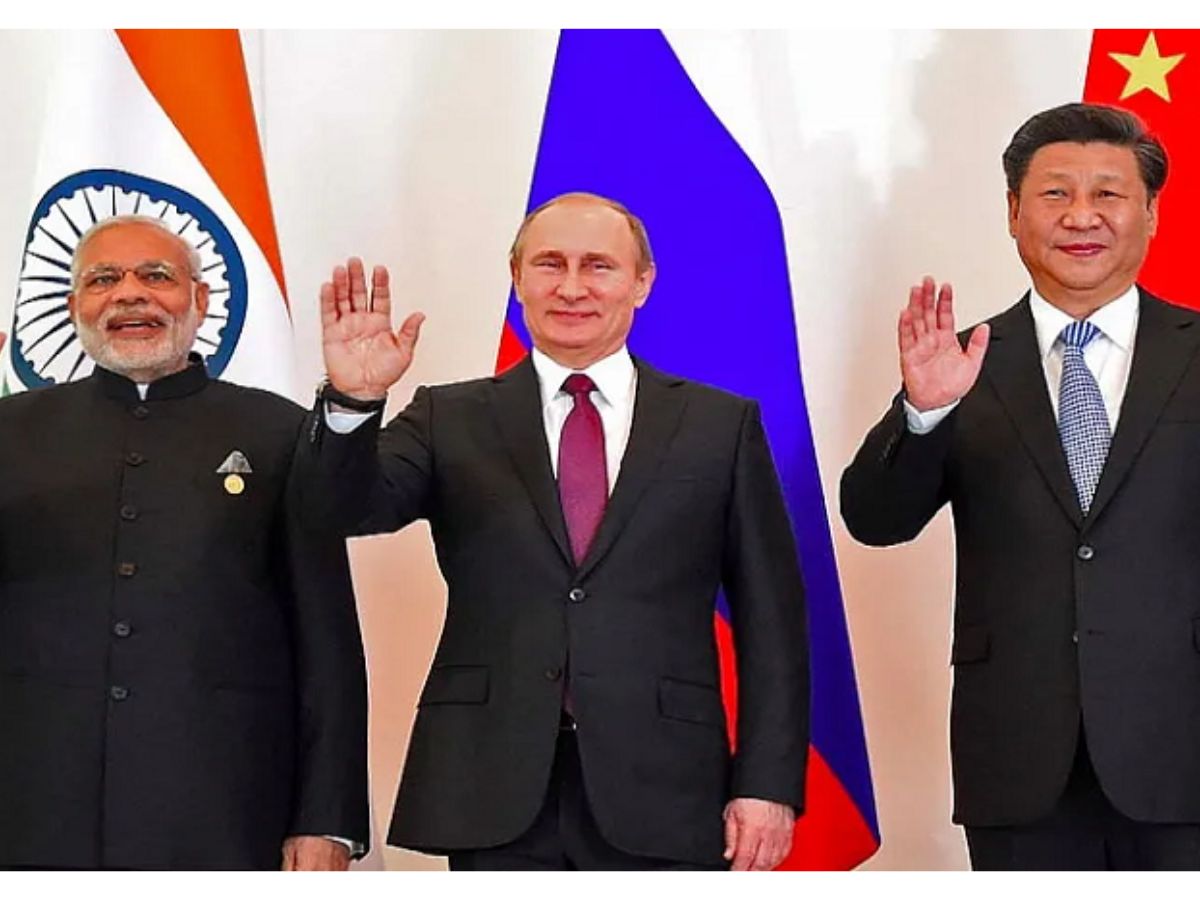
US actions have pushed India towards its traditional friend, Russia; and a traditional adversary, China, in an unlikely, but not entirely inconceivable troika between the three nations. The optics of Prime Minister Modi with President Putin and Xi Jinping in the SCO summit at Tianjin was there for world display. The triple handshake and the personal warmth were unmistakeable. Much has also been made of Modi’s drive with Putin in his limousine, and his 45-minute tete-a-tete on the sidelines. Much of it was for optics, but the underlying message was clear. India has demonstrated that it has choices besides the US and the West, and the choices that it makes can completely rebalance the world order.
The bonhomie and the signals emanating from the three—coupled with the wrecking ball of Trumpian policies—has re-raised the idea of the Russia-India-China compact (RIC)—an economic and strategic partnership first proposed by Russian Prime Minister Yevgeni Primakov during a visit to India in 1998. The concept took slow shape in the early 2000s and the first RIC meeting between the foreign ministers of the three nations took place in 2007 at the Delhi Security Summit. Over 20 ministerial level meetings have taken place since then, but the concept never really developed into an alliance. The idea was eventually grounded after the 2020 Galwan clash between India and China and has resurfaced only now after the recent thawing of ties.
The proposal of a compact between Russia-India and China is mouth-watering—and a game-changer. RIC accounts for over a third of the world’s population and encompasses over a fifth of the global landmass. They hold the world’s second largest, fourth largest (soon to be third) and 11th largest economies and account for 23% of the world’s GDP. Scientifically, technologically and industrially, they are amongst the leaders in the world and possess vast resources of oil, gas, food and minerals. They are amongst the top four military powers of the world—after only the US. Economically, they outstrip the G7 nations. Strategically and economically this compact can more than counter-balance the US-led western order, facilitate de-dollarisation and an alternate currency, and create a pole of power that upends the US and its western allies.
It is tempting, but there are dangers and pitfalls along the way. For starters, is the state of India-China relations which though on the mend, have been plagued by distrust since 1962. The two share the world’s largest disputed border which will require a much wiser generation to resolve. And then there is the irritant of Pakistan and the subtle conflict for regional supremacy and resources that can spill over at any time. Even worse is the likelihood that in the murky world of realpolitik the US could just cut a deal with China or Russia or both and isolate India.
Russia would, of course, want to form this troika and is its most ardent proponent. With India there, it balances its own equations with China (with which it is a relatively junior partner on its own). It also provides the economic and strategic alternative that enables it to firmly break the isolation that the West has imposed upon it.
For India, it is an interesting prospect that can be developed in the long term—largely dependent on the trajectory of India-China ties. The stance India takes will shape the global balance of power. It will also hasten the East-versus-West divide and place India firmly on one side—a position we have steadfastly avoided so far to preserve our strategic autonomy.
So, while India should pursue the RIC troika, it must also get back to normalising India-US ties which have been assiduously cultivated over the past 25 years. Many US analysts—including former NSA Jake Sullivan—have been scathing in Trump’s rebuffing of India, calling it as the “USA’s greatest strategic blunder.” Both the US and the Indian administrations are working overtime to get things back on an even keel, and that could well come about.
India is more aligned to Western values and concepts. Economically too, we have more to gain from the West in terms of markets, technology and investments, than from China and Russia. Last year, India-US trade stood at $129 billion—with India exporting $87.5 billion and importing $42.5 billion worth of goods. And while India-China trade rose to a record $136 billion, it was made up largely of a staggering $120 billion of Chinese exports and just around $17 billion of Indian goods. Chinese investments in Indian markets would also be fraught with long-term risk—especially in critical sectors such as telecom. So, in spite of the Trumpian rants, it will be best to repair the damage to India-US ties, while still preserving our strategic choices, of which RIC is a very viable one.
There are other choices as well. PM Modi’s recent visit to Japan further galvanised India-Japan relations, in what can be the most consequential Asian partnership. There has also been heightened strategic and economic cooperation with Europe and the European Union especially after the trade deal with UK, and a likely one with the EU. Trump’s policies have caused a wariness amongst its partners, and India is emerging as the alternative and a hedge against frequent US turnarounds. Trump’s actions have also weakened Quad, NATO and other US-led alliances. In fact, Trump may not even visit India for the Quad summit to be held later this year. But India can still go ahead with a trilateral meet along with Japan and Australia so that the alliance does not lose momentum completely.
As western-led alliances weaken, other alliances such as SCO and BRICS get strengthened. BRICS—which has just added six new members to the original five—could well emerge as an alternate economic order, with Russia, India and China at the centre.
As India navigates an uncertain global climate, two things stand out. Firstly, our concept of strategic autonomy has held us in good stead and should be maintained. Secondly, there are choices available—both with individual nations like Japan, Germany, Russia and others and multilateral ones like Quad. RIC is one of the choices that India can explore. It is still in a nascent stage and could take many years to fructify—but it is an idea which is awakening, and one whose time seems to have come.
Ajay Singh is the international award-winning author of seven books and over 250 published articles. He is a regular contributor to The Sunday Guardian.
