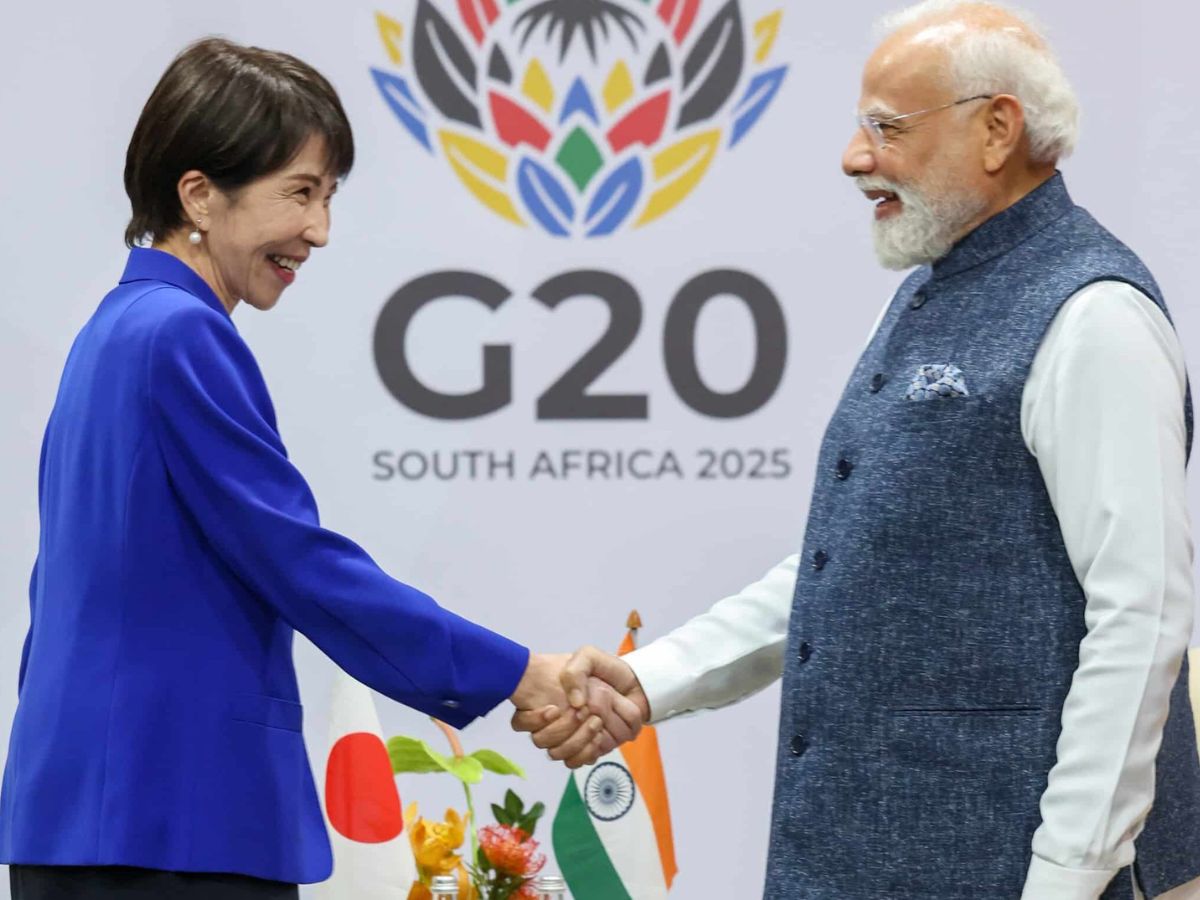
PM Sanae Takaichi - PM Modi (Image: X)
Takaichi Sanae has won the largest mandate in any Japanese parliamentary election in 80 years. Her Liberal Democratic Party (LDP) has a two-thirds majority on its own in the (more important) lower house of the Diet, sufficient to override any contrary votes in the upper house, where it lacks a majority. With her coalition partner, the right-wing Japan Innovation Party, Takaichi has an unprecedented three-fourths majority that gives her carte-blanche to pursue her stated agenda of raising defence spending to 2% of GDP, cutting the consumption tax on food for two years, and raising armaments production and exports.
Having become Japan’s first female leader in 254 years (since the abdication of Empress Go-Sakuramachi in 1771), Takaichi’s remarkable self-made story has made her the most popular prime minister in Japan’s history. Unlike her mentor Abe Shinzo, and his mentor Koizumi Junichiro (the two longest-serving PMs of the past quarter-century), Takaichi did not inherit her parliamentary seat. Like Narendra Modi, she has had to forge her own path in politics. That contributes vitally to her popular appeal, as does her unconventional image as a heavy-metal drummer and motorbike-rider in her youth.
One of her formative political experiences was an internship in 1987 with US Congresswoman Patricia Shroeder, who had run the ill-fated presidential campaign of Senator Gary Hart that year, and considered running for president herself before tearfully announcing she wouldn’t. That year also marked the peak of Japanophobia in the US, with 63% of Americans supporting higher trade barriers against Japan because of its soaring bilaterial trade surplus with the US, and President Reagan retaliating against Japan’s allegedly unfair semiconductor trading practices, having already forced a sharp appreciation of the Japanese Yen via the Plaza Accord two years earlier.
Takaichi came away from that experience convinced that Japan was grossly misunderstood in the US, its closest political ally. Ironically it strengthened her resolve to forge closer ties to the US, but also made her a life-long advocate of a stronger Japanese military, including amending Japan’s postwar constitution to allow it to possess ‘war potential’ (not merely ‘self-defense forces’). This dovetails perfectly with US president Donald Trump’s insistence on allies taking more responsibility for their own defense by spending more.
Despite being an admirer of Margaret Thatcher, Takaichi is not a dogmatic free-marketer. Instead, she has outlined 17 clusters of industry that she wants to revitalize through a ‘state-led growth strategy’ similar to what fuelled Japan’s industrial success in 1950-90. At the top of her list are AI and semiconductors—perfectly consonant with India’s current focus on catching-up to the world leaders in those sectors. Japan’s technological lead in semiconductors was deliberately undermined by the US in the 1990s, but Japan still has considerable wellsprings of strength in semiconductor equipment, and across most of the chip supply chain. Marrying those with India’s strength in chip design and software would be the ideal partnership to build an Asian AI and semiconductor alliance.
Biotechnology and Drug Discovery are two other clusters in the Takaichi vision. India is a global leader in generic pharmaceuticals (accounting for 40% of US imports of generics), but has made relatively scant progress in drug discovery. This year’s India Budget however placed a renewed emphasis on biopharmaceuticals and healthcare to stimulate the discovery of new molecules and biologics. Marrying Japanese capital and Indian skills could contribute to a synergistic partnership in this area of mutual focus.
Unlike the antagonistic historical memories that China and Korea harbour towards Japan, India has a positive memory of Japanese support for India’s freedom movement extended to Rashbehari Bose (the Ghadarite revolutionary from World War I who took refuge in Japan) and Netaji Subhas’s Azad Hind Fauj during World War II. Tokyo’s Yasukuni Shrine (controversial in China and Korea) houses a memorial to Justice Radhabinod Pal, who was the only judge with expertise in international law and strongly disagreed with the majority judgement in the post-WWII war crimes tribunal appointed by the Allies.
Japan and India have forged stronger economic ties especially since Abe Shinzo’s second prime ministerial term (December 2012-September 2020). Japan’s excess savings (reflected in consistent current account surpluses for the past 35 years) should find a natural outlet in investments in India’s infrastructure build-out—from bullet trains to smart cities, semiconductor supply chains to AI and quantum computing.
Suzuki and Honda (in cars and motorcycles) and Panasonic in white goods have long had a presence in India, but it is time to widen opportunities for a broader range of Japanese brands in India, and for Indian software, electric vehicles and renewable energy in Japan. In particular, India needs to encourage Japanese SMEs (like Germany’s mittelstand the heart of Japan’s economic strength, with considerable technological knowhow) to expand their presence. There are 6000 Japanese companies (primarily SMEs) operating in Thailand, but only 1500 operate in India—outlining the vast opportunity to expand collaboration.
India and Japan have deep civilizational links evident in the use of the Brahmi-based Siddham script in Japanese tombstones, and the almost exact parallels between Saraswati and Benzaiten (the Japanese goddess of learning, music and fine arts), as well as deep-seated reverence for elders and ancestors. Unlike India, however, Japan’s culture was never undermined by foreign rule, and hence remains deeply embedded in its society. Discipline and punctuality are Japanese attributes that India would do well to emulate.
Our co-membership in the Quad adds a security dimension to the relationship, since both Japan and India have long-festering border disputes with China that the latter regularly stokes. As India steadily import-substitutes its defense needs, Japanese proficiency in shipbuilding and both nations’ emerging capabilities in armament manufacturing offer broadening dimensions for partnership. With dynamic leaders in Modi and Takaichi committed to rebuilding great civilizational states, this is a perfect time for a deepening of the bonds between Japan and India.
Prasenjit K. Basu is the author of Asia Reborn and a former Chief Economist for Asia at Daiwa Securities.
