No single nation or its leader, including the USA or China, can assume stewardship of the emerging, diffused global order.
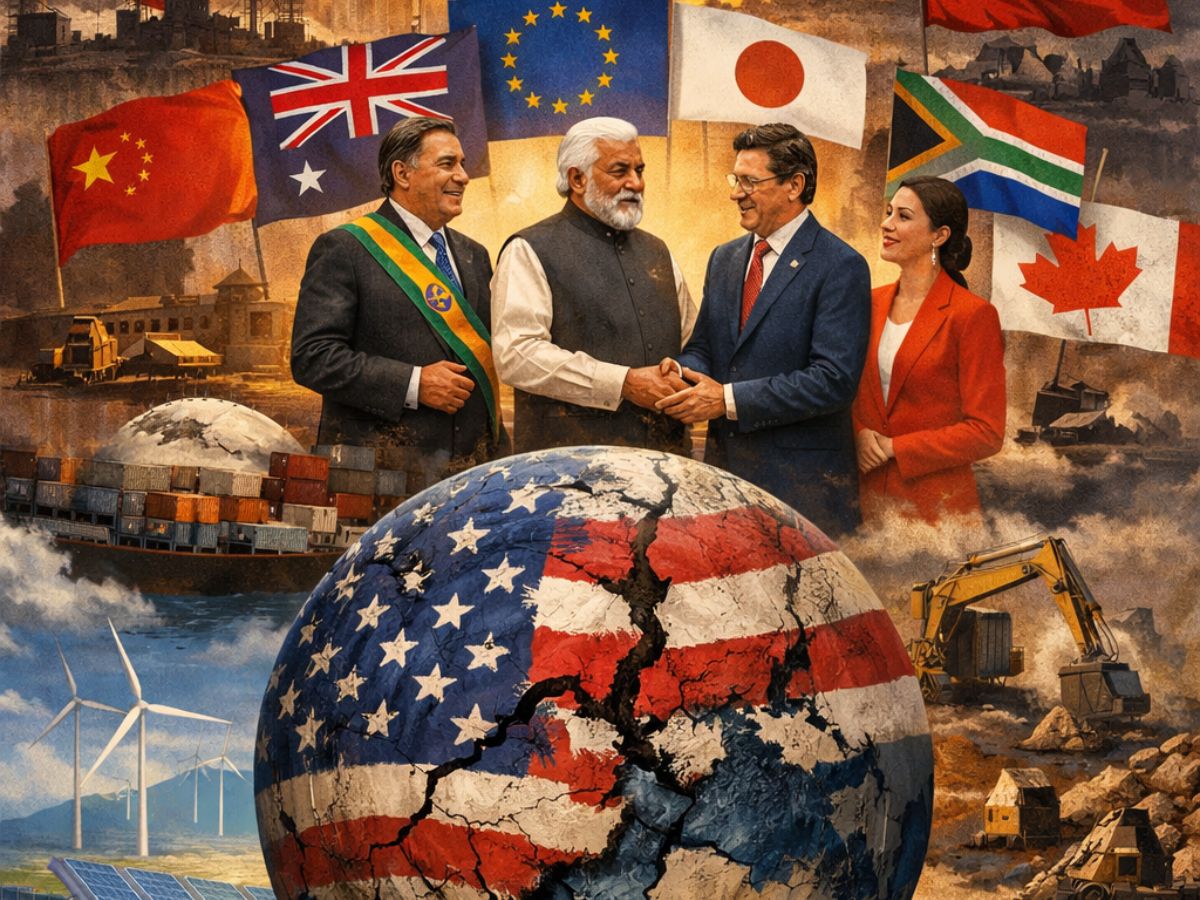
The world order changeth gradually, though surely (Image: Ref)
2025, the year gone by, began rather ominously for the superpowers. It ended with the global influence of the USA palpably diminished. China remained more concerned with rebuilding its economy rather than its external standing, while Russia continued to struggle with the debilitating four-year-old war with Ukraine and has yet to embark on any credible effort to regain its lost Cold War–era status. Simultaneously, new poles in international affairs are getting evolved around the world. Australia, Brazil, Canada, India, Indonesia, Japan, South Africa, and more recently even the EU and ASEAN as large regional entities, are emerging as new centres of influence.
Anticipating that fractured trade and geopolitical tensions are not transient concerns but likely to become permanent features of an increasingly fragmented world, these nations and groupings are drifting away from prior alliances and partnerships that demand uneven and uncertain commitments. Their yearning for greater predictability in economic and material security is well founded.
To begin with, efforts are underway to re-establish resilience through a new web of ad hoc cooperation. By forming pragmatic coalitions built around shared interests and occasional shared values, these entities are cautiously but steadily moving towards evolving new arrangements. Trade networks and supply chains are being reconfigured, and the provision of cleaner energy is being accorded the priority it deserves.
In terms of geographic location, demography, and economic scale, the participating countries, which span all five continents, represent viable and credible entities. Somewhat coincidentally, most have long histories of being fair and forward-looking. The building of purpose-built alliances in areas where they share specific goals and values can only be expected to gather momentum. Take for instance, one such evolving example – a new climate architecture that could be “an amalgam of trade rules anchored by the EU, technologies centred in China and India, and nature-based solutions grounded in Brazil.” Going by their track records, most of these countries can be expected to favour the rule of law and abide by the established and evolving norms of global institutions.
President Trump’s disdain for liberal Westernism of the kind practiced in Europe and elsewhere has grown increasingly shrill, often accompanied by assertions that the United States would no longer bear the burden of policing the world or striving to make it a better place. Longtime allies such as Europe, Japan, and South Korea have been asked to pay for their defence and fend for themselves on several fronts. US overseas- diplomats no longer question the fairness or legitimacy of elections in their assigned countries and have retreated from the pursuit of loftier democratic or moralistic values. USAID offices were abruptly shut, and significant American international assistance, including critical healthcare programmes supplying HIV patients with antiretrovirals (ARVs) in sub-Saharan and other severely affected African countries, have been terminated. In making these moves, Trump reversed a decades-long pillar of US foreign policy that President Bush had once described as “serving our strategic and moral interests.”
President Trump’s larger-than-life self-image, combined with the financial and military might of the US, has led him to consciously underplay the role of global institutions and national leaders unwilling to align with him. His trigger-happy approach saw US and Israeli air forces ruthlessly bomb suspected nuclear sites in Iran. Currently, the US Marine Corps is similarly confronting Venezuelan vessels allegedly carrying harmful drugs. Such bravado, however, recedes sharply when faced with Chinese actions, whether the forcible island-occupations in the Pacific, repeated threats to close ally Taiwan, or more recently its aggressive posturing with Japan. Similarly, Russian actions against Ukrainian civilians have also been met with conspicuous indifference.
Trump’s oft-stated goal of Making America Great Again (MAGA) is predicated on the difficult-to-achieve revival of domestic manufacturing and related economic activities. In pursuit of this objective, he sought to virtually shut out imports from nations with high trade surpluses, as well as from countries whose leaders he does not see eye to eye with. Through shortages and inflation, one could argue this approach has hurt the US as much as it has harmed the higher-tariffed nations. Weaponizing trade through high tariffs, multiple barriers, and restrictions on technology flows, while bartering access to the American market in exchange for exorbitant investment-demands have become Trump’s preferred tools. When confronted with the ground realities of China’s entrenched advantages, however, he has been quick to retreat from such positions.
Brazil, Canada, and India are three nations that fall squarely into the category of countries significantly impacted by US tariffs. Despite lacking China’s leverage to retaliate, each of these countries have demonstrated resilience and have been able to partially soften the blow. India has found alternate markets for several labour-intensive sectors such as gems and jewellery, electronics, and pharmaceuticals. In preparing for the future, it is signing pacts with new trade partners. To boost domestic consumption, Goods and Services Tax rates have been lowered, and inflation, particularly in food items, has moderated. Expectations of sustaining GDP growth through higher private corporate capital -formation and rationalization of direct taxes in the forthcoming Budget offer further promise in the face of growing protectionism.
Brazil, another large country like India, was subjected to crippling 50% duties. After persuading Trump in Washington, President Lula da Silva, a left-wing stalwart serving his third term, secured the removal of most tariffs on Brazilian staples such as coffee, beef, and fruit. To stimulate domestic demand, he pushed through a 60% increase in the income-tax exemption limit and substantially lowered rates in the next slab, while hiking taxes on the wealthy, fintech firms, and betting companies. Simultaneously, the noose was tightened around powerful criminal gangs, with provisions for easier confiscation of their assets. President Lula also highlighted the accelerating destruction of Brazil’s vast rainforests, a development affecting farmers’ livelihoods and posing serious risks to national agriculture. His recent hosting of COP-30, the UN climate conference in Belém, northern Brazil, succeeded in drawing global attention to the urgent need for forest restoration.
More recently, Brazilians have been encouraged to address historic racial inequities affecting Black citizens, many descended from enslaved labourers. These communities continue to lag behind Whites and Browns across most human-development indicators. During his visit to Ethiopia last year, described by him as one of his most important trips, Lula publicly declared: “Brazil doesn’t have everything, but we want to share everything Brazil has with the African continent. We want to give back, in the form of possibilities and development, what you gave us in the form of a workforce for 350 years.”
Much to Trump’s concern, it is therefore unsurprising that the 80-year-old President has seen his domestic approval ratings rise. Trump had, in fact, openly backed former President Jair Bolsonaro, who is now serving a 27-year prison sentence for attempting a coup after losing the 2022 election. With Brazil’s fragmented right-wing parties remaining deeply divided, Lula appears to be a strong beneficiary ahead of the elections due later this year.
Meanwhile, Canada’s new Prime Minister, Mike Carney, a distinguished banker who previously led both the Bank of England and the Bank of Canada, has articulated a clear strategy to confront American pressure. His Liberal Party formed a minority government following Justin Trudeau’s resignation. During the campaign, Carney promised to “stand up” to America, a commitment he demonstrated by telling President Trump at the White House that Canada is not for sale - an explicit rebuttal to Trump’s outlandish earlier suggestion that Canada should become the 51st US state. His rejection of the US invocation of the antiquated 19th-century Monroe Doctrine has resonated not only with Canadians but also with Latin and South American nations long subjected to American pressure.
Canada, the US, and Mexico has been historically deeply linked through long-standing trade arrangements. Their interdependence had deepened over decades, with steel, aluminum, timber, and assembled vehicles flowing daily from Canada to the US. Yet, Trump imposed tariffs on Canadian steel, aluminum, and cars, hurting both Canadian exporters and US manufacturers dependent on those inputs.
To offset the impact, Canada’s new Budget provides for increased investment in infrastructure, housing, and defence, even at the risk of a higher fiscal deficit. Carney has also removed federal barriers to inter-provincial trade to create a “one Canadian market.”
Looking ahead, Canada is preparing for a new trade order amid concerns that the US could impose duties on up to 85% of its remaining duty-free exports, worth nearly $250 billion. Fearing that trade barriers may persist even beyond the Trump era, Carney is actively pursuing alternative trade arrangements in Europe and fast-growing Asia.
Another illustration of Canada’s preparedness is its leadership in promoting a critical-minerals strategic alliance. This purpose-built coalition aims to secure and diversify supply chains through mining investments, stockpiling, and standards-based markets. China’s recent retaliatory restrictions on 17 critical elements, essential for products ranging from smartphones to electric motors, triggered global shortages with wide-ranging consequences. Through such initiatives, Canada and its partners seek to better insulate themselves and the broader international community.
Going forward, it is evident that while the world order changes slowly, it does so inexorably. Rather than being dominated by two or three centres of power, global governance is likely to see much greater diffusion. New understandings and associations will emerge to address both specific urgent issues as well as tackle broader longer-term challenges. These alliances may not be comprehensive, but purpose-built to achieve limited objectives. The proliferation of such focused arrangements may, in fact, offer the most pragmatic path to solutions while serving the strategic interests of participating nations.
Dr Ajay Dua is a development economist and former Union Secretary, Commerce & Industry.
