
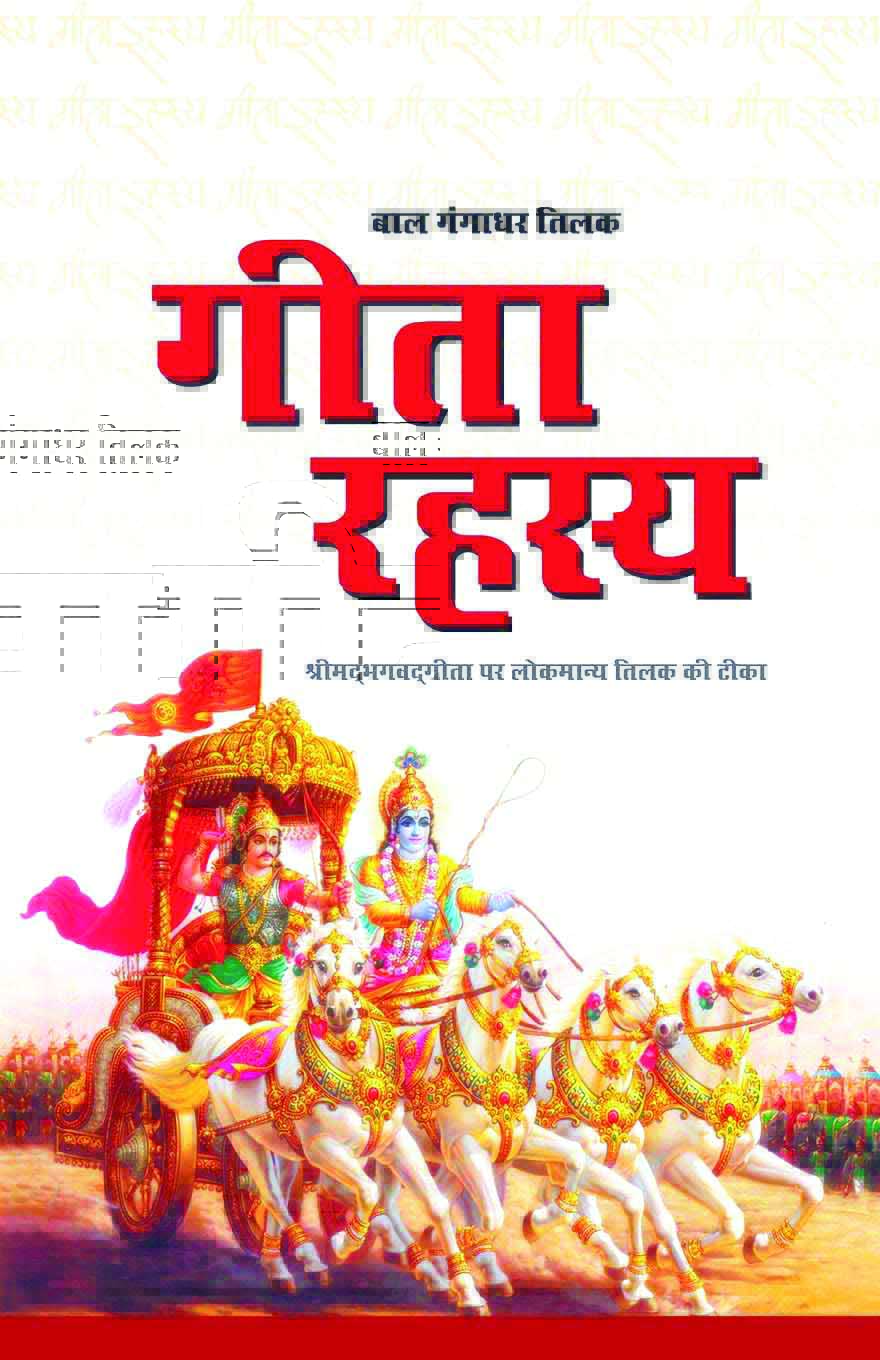
Bal Gangadhar Tilak’s “Shrimadh Bhagavad Gita Rahasya”, composed during his imprisonment in Mandalay between 1908 and 1914, was not just an act of personal intellectual labour but an urgent intervention for the rejuvenation of the Bharatiya consciousness. Tilak believed that freedom for India could not be secured solely through political struggle or constitutional reform, but a side-by-side reawakening of the civilisational mind was essential. In such a sense, for Tilak, the Bhagavad Gita had an essential role. It was not a relic to be worshipped from a distance, but a text to be lived, a manual for purposeful action, ethical clarity, and service to the larger community.
At the heart of “Gita Rahasya” lies his bold reinterpretation of the Gita’s core teaching: that life’s highest calling is to perform one’s duty without attachment to the results. Tilak saw nishkam karmayoga not as an ascetic withdrawal from the world, but as a call to enter life’s struggles with discipline and detachment. This insight carried political urgency in the nationalist movement of his day; today, it carries ethical urgency for a world facing crises of trust, leadership, and purpose. In the IKS tradition, philosophical texts are not frozen in time.
They are subject to reinterpretation to meet the needs of changing eras. Tilak’s work embodies this tradition, using indigenous interpretative methods like the Mimamsa framework to challenge dominant readings and make the Gita speak to the pressing issues of his age and ours.
NISHKAM KARMAYOGA AS A PHILOSOPHY FOR ACTION
Tilak’s assertion that the Gita’s essence lies in nishkam karmayoga, action without selfish desire, directly challenged the renunciatory readings popularised by earlier commentators like Adi Shankara, who placed greater emphasis on karma sanyasa (renunciation of action). For Tilak, this was a misreading of Krishna’s message to Arjuna. The battlefield of Kurukshetra was not a metaphor for retreat; it was a stage for righteous engagement. Tilak built a logical and internally consistent case for his thesis by applying Mimamsa principles.
He argued that detachment is a matter of mental disposition, not physical withdrawal. Instead, this represents a state where one remains free from the binding effects of action by relinquishing possessiveness over its fruits. This reading resonated deeply in colonial India, where political work demanded persistence without the certainty of immediate victory. The relevance today is obvious. Modern life rewards visible outcomes, quarterly profits, social media engagement, and quick wins, but rarely honours the long arc of sustained, principled effort.
Whether it is a public health worker combating vaccine hesitancy, a civil servant pushing through a reform in the face of resistance, or a climate activist nurturing a fragile ecosystem, the karmayogi’s ethic applies: act with conviction, let go of the scoreboard. In Tilak’s framing, this is not passivity but resilience. The karmayogi works with the steadiness of someone building a cathedral, knowing they may never see its completion because the value lies in the doing, not the applause.
DHARMA IN A PLURALISTIC SOCIETY
Within the broader Indian Knowledge System (IKS) framework, dharma functions as a dynamic and adaptive moral compass. It is not merely a personal code or religious injunction, but a principle of balance between individual obligations and the welfare of the collective. Tilak’s contribution was to reassert this dharma elasticity for the nationalist context. He believed true dharma is not confined to ritual observance or caste-based duties.
And it also extends to the protection and flourishing of the community as a whole. What this meant during his time was that participating in the national movement was a dharmic obligation. As opposed to the Left historians’ narrative, he did not conflate dharma with a narrow sectarian worldview. Instead, he treated it as an integrative force capable of harmonising India’s multiplicity of traditions into a shared civic ethic. This perspective is profoundly relevant to a 21stcentury India negotiating between rapid technological transformation, widening economic disparities, and deep cultural diversity.
Today’s dharma may mean safeguarding digital privacy, ensuring equitable access to education, or addressing the ethical dimensions of artificial intelligence. The challenge is to retain moral anchors while adapting to new contexts, a capacity Tilak demonstrated by drawing on the Gita’s teachings to address colonial political realities. From an IKS standpoint, such adaptability is not dilution but deep continuity. Dharma’s vitality lies in its capacity to respond to the needs of the moment while remaining rooted in enduring principles, much like a river that changes course yet remains the same river.
Tilak connected this vision to lokasangraha, the Gita’s concept of “holding the world together.” In practical terms, it means that the measure of any action, policy, or decision is whether it contributes to collective stability and well-being. This standard is urgently needed in our policy-making today, where short-term expediency often trumps longterm societal health.
RECLAIMING CULTURAL AGENCY
One of Tilak’s most innovative political strategies was cultural: transforming religious festivals like Ganesh Chaturthi and historical commemorations like Shivaji Jayanti into instruments of public education, social unity, and political mobilisation.
This was a masterclass in cultural agency, as understood in IKS, which is the ability to activate inherited traditions as living, participatory spaces that strengthen the social fabric. Such an approach stands in stark contrast to both lifeless preservationism and cynical commodification of culture. For Tilak, culture was a vehicle for civic engagement and moral instruction. By placing these festivals in the public square, he gave them new relevance and harnessed their emotive power to foster national consciousness.
The lesson for our digital age is clear: cultural forms inviting meaningful participation can counteract algorithm-driven media’s isolating and polarising effects. This does not mean simply reviving old practices unchanged, but reinterpreting them to address today’s concerns, much as Tilak reinterpreted the Gita. In modern contexts, reclaiming cultural agency could mean integrating indigenous ecological practices into climate action strategies or using traditional storytelling formats to spread public health awareness. The key is that such interventions connect people to their heritage while mobilising them to meet contemporary challenges.
TOWARDS AN ETHICAL SWARAJ
There is little doubt that Tilak’s “Gita Rahasya” was a nationalist text, but when looked at more deeply, it is more—it is a work of civilisational renewal. It reflects an IKS ideal where philosophy is inseparable from the practical business of living, shaping conduct in the home, marketplace, workplace, and political sphere.
In the 20th century, his reading of the Gita helped Indians envision political Swaraj. In the 21st century, this can guide us towards ethical Swaraj, a liberation from the subtler but equally corrosive forces of selfishness, shortterm thinking, blamegames, and ethical complacency. Such a Swaraj would protect political freedoms and strengthen the moral foundations without which those freedoms cannot endure. An ethical Swaraj built on nishkam karmayoga demands that we recalibrate our measures of success. It calls us to value the integrity of process as much as the achievement of goals, to judge leadership not by charisma but by constancy, and to assess policy not by immediate popularity but by its long-term justice.
Tilak’s genius was to show that these are not abstract ideals but actionable principles rooted in our own intellectual heritage. In this way, Gita Rahasya bridges the timeless and the timely. It acts as a dialogue between ancient wisdom and contemporary necessity. For a century that rewards speed over reflection and visibility over depth, Tilak’s work remains a reminder and a moral compass. A reflection that true progress is measured not by what we gain, but by what we give steadily, selflessly, and with the quiet assurance that comes from aligning one’s life with dharma.
Prof. Santishree Dhulipudi Pandit is the Vice Chancellor of JNU.




