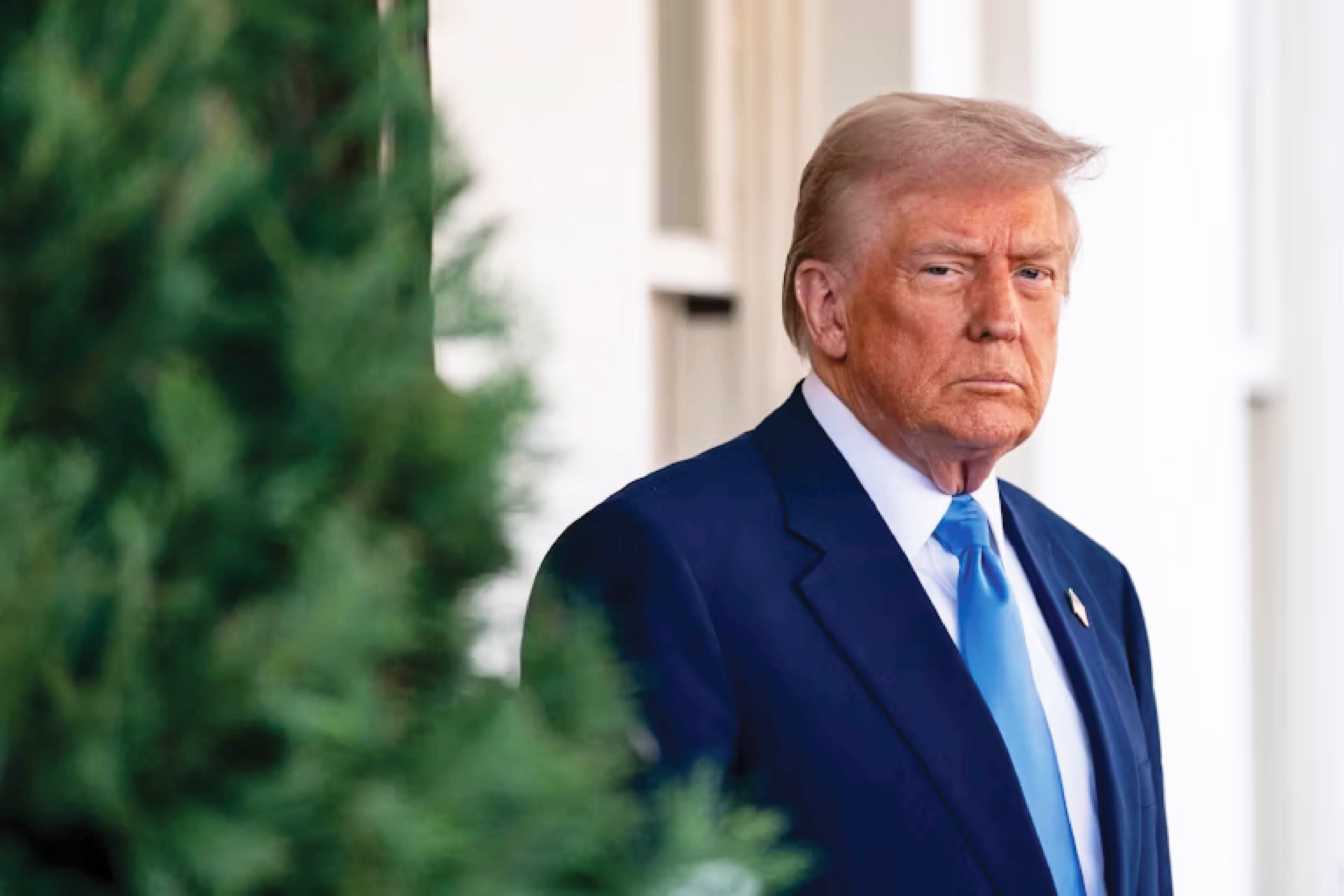
The last 200 days have seen world affairs go topsy-turvy because of the impulsive and uncalled-for acts of a single nation. Beginning with efforts to balance external trade, the conduct of President Donald Trump, elected for a second fouryear term in January 2025, has extended to fulfilling his ill-conceived personal geopolitical ambitions. Furthermore, the mercurial and ever-shifting head of the US administration is not averse to deploying his country’s economic and political heft to interfere in the internal affairs of other nations. The emerging global multi-polarity, with several centres of power that bring along checks and balances, is being consciously trodden upon.
President Trump intends to enhance his personal international and domestic standing by seeking to extend US hegemony around the globe. By pushing through his loosely defined, and often amorphous objective of MAGA (Make America Great Again), he is unashamedly deploying US geopolitical standing, financial resources, and economic muscle, while also showing a willingness to back these with military threats. The established global mores and norms for conduct of state business are being knowingly trampled upon.
The credibility of global institutions, forums, and other established platforms has been undermined like never before. By doing so, one could argue that the wealthiest and mightiest nation, the US, may rapidly be losing its assiduously built status as the beacon of the free world and a consistent advocate of righteousness. US long-term strategic and commercial partnerships with countries of Europe, North America, and Asia are being sidelined.
One day Russia and its reigning President Putin are called close friends, and the very next day treated as unreliable and virtual foes. The treatment of China, the sine qua non for Quad and bilateral formations in the Indo-Pacific region, keeps alternating widely. Most long-standing allies in NATO, along with Japan and South Korea, are being treated as strangers. Northern neighbour Canada, as well as Panama, and distant entities like Greenland, have been threatened with physical annexation.
The rules and regulations of UN bodies such as the Security Council, WTO, and WHO are violated with impunity, and their leaders publicly ridiculed. Walking out of the laboriously negotiated Paris and subsequent Climate Change Agreements, and resuming the extraction and use of hydrocarbons and fossil fuels in the US, have virtually nullified decades of collaborative work by nations, think tanks, and well-meaning NGOs around the world. Concern for free trade, human health, and sustainability no longer remains a priority.
Instead, securing temporary benefits and immediate advantages has become a major focus of Trump’s state policy. The extensive US aid given for decades to needy countries and people in distress across the globe has been abruptly ended to serve such distorted self-gains. In seeking to wipe out trade deficits with every trading partner through higher basic or reciprocal tariffs, the principle of comparative advantage—enunciated by economist Ricardo and the very basis of trade among nations—stands challenged by the emerging Trumpism.
How should the 200-odd nations of the world face the alarming situation created by the US? Ninety-two of them already face enhanced US tariffs. Should they give in and bow before the US because might, unfortunately, has often been deemed right? Or should they stand up to the potential bully and begin to question him? If the latter course is to be adopted— and it may be needed— should each nation do so only when its own interests are affected, or also when US harassment becomes more intensive elsewhere in the world? Should countries respond only when their immediate interests are impacted, and remain unconcerned about longerterm issues?
While such questions will continue to arise as Trump marches on with his self-serving acts, history and wisdom suggest that early and prompt responses are needed to limit their spread and potential to cause harm. A more important issue is recognising the difficulty in checkmating the US. It is an enormous and expanding economy with vast natural and manmade resources, combined with raw armed strength that is unmistakably large and lethal.
China, globally the second largest economy and military power (with its own aspirations and ambitions not too dissimilar), is perhaps the only entity in a position to singly contest the US’ lofty current goals. For others, getting together to challenge offensive actions via the use of acceptable global and regional institutions can be the starting point. To be meaningful, the strategy should involve creating numerous coalitions of impacted nations for each deleterious action by the US. However, rather than taking an adversarial stance in all matters, the finalised action must invariably be reasonable and targeted.
The general American public must not get the impression of being targeted, lest patriotic emotions come into play. That would render any relenting or recanting by the US Administration rather unlikely. The positions of the hurt parties might vary. For example, EU nations—almost all of which are also in NATO—may prioritise US security support over trade and economic issues. For export-dependent nations like Canada, Mexico, Vietnam, Bangladesh, and even Thailand and Malaysia, the continuance of bilateral commercial relations would weigh heavily.
Predominantly energy importing countries like China and India would have to remain aware of the reactions of their oil-sourcing nations to any moves against the US. Similarly, countries having the US as their sole or significant buyer of primary goods or processed commodities would remain concerned about possible US retaliatory actions directed at them. To cushion the impact of US retaliation, a necessary prerequisite for most affected nations would be to diligently reduce their trade with the US. That might demand structural changes in their economies, which would require time.
Meanwhile, diversification of exports to third countries through concerted policy measures, and entering into BTAs, FTAs, and CEPAs, would need to be pursued. Adopting a variety of fiscal and regulatory pro-export measures in extraction, processing, and manufacturing would require greater focus, along with streamlining logistics and shipping. By consciously imposing restrictive tariffs and other trade barriers on identified goods, volumes of non-essential imports can certainly be checked. Import substitution efforts must be made to bear fruit, which might require extensive state-supported R&D to develop local substitutes.
In challenging the US, countries with large populations, sparse natural resources, and democratically elected governments might face greater challenges than better-placed ones like Japan, the UK, South Korea, EU members, or China. Smaller developing nations with fewer means would necessarily be less equipped to play an effective role. It is the middle-income and somewhat militarily strong countries like Canada, Brazil, Argentina, Switzerland, India, Iraq, South Africa, Indonesia, and Malaysia that would have to take on the mantle of masterminding the plan and prioritising joint as well as individual actions.
Galvanising the concerned UN bodies through the General Assembly to take up for consideration the US-caused injuries to a large number of nations should not be difficult. Specialised institutions like the World Trade Organization (WTO), Food and Agriculture Organization (FAO), World Health Organization (WHO), and World Intellectual Property Organization (WIPO) would then be the right entities to examine the causes, effects, and possible remedies.
They could check the spread of US actions, including continued threats related to trade, agriculture, pharmaceuticals, medical devices, and the special IPR privileges granted to the Global South and other developing nations. Though all of them work on the basis of consensus, the very act of deliberation by a large number of members—whether a majority or not—would convey to the US, as a founder of the UN system, and to the American public at large, that they must take notice of global concerns and undertake ameliorative steps.
Several multilateral regional forums, such as the development banks that provide financial and technical assistance to member nations—like the Asian and African Development Banks and the Cairo-headquartered African ImportExport Bank—could also enable impacted nations to collectively consider dealing with the actions of President Trump. Discussions on trade-related platforms like EEC, USCAM, RCEP, MERCOSUR, SAFTA, and the GCC could also play a role in forging coalitions against unilateral US actions.
Seeking greater market access for their exportable products, protection for sensitive sectors, and demanding predictability in US trade policy cannot be considered unreasonable or hostile. Smaller and weaker nations might be reluctant to point out such deviant conduct by the US individually, but operating within a coalition should make them bolder. Pointedly exposing the US’ selective targeting of nations and its emerging double standards—as seen recently in the case of sanctioned Russian crude oil—should not go unchallenged. Retaliatory trade penalties in particular must not be used as instruments of economic and political coercion.
Also, Trump’s threats of annexation to countries like Panama for allowing a Chinese company to operate the canal, Greenland for possessing certain mineral deposits and being a Danish territory, and Canada for standing up to him and rejecting his remark about making Canada the 51st state, cannot be accepted in the modern age. Chiding elected leaders of nations around the globe for not seeing eye to eye with him is not only outright childish but also diplomatically inappropriate. Using the above-mentioned institutions and forums to collectively retaliate would give affected nations the muscle needed to be effective, as well as enable them to render mutual assistance in the interim.
China, with its significant economic and military strength, is perhaps the only nation that can on its own meaningfully question US intimidation. Besides proportionately raising duties on US imports, it promptly retaliated by putting curbs on the export of half a dozen critical rare earths required for magnet-making, and used extensively in missiles, high-end automobiles, and wind turbines.
In no time, the US backed down and withdrew its impositions, including certain restrictions on technology flows, and agreed to begin negotiations on a bilateral trade pact. China unequivocally conveyed to the US that it would not be pushed to conclude the deal by any particular date. But China is an isolated case, and most other nations are not in such a fortunate position. For them to be heard meaningfully, well-thought-out collective action can be the best way forward.
Dr Dua, a development economist, is an ex-Union Secretary, Commerce & Industry
