
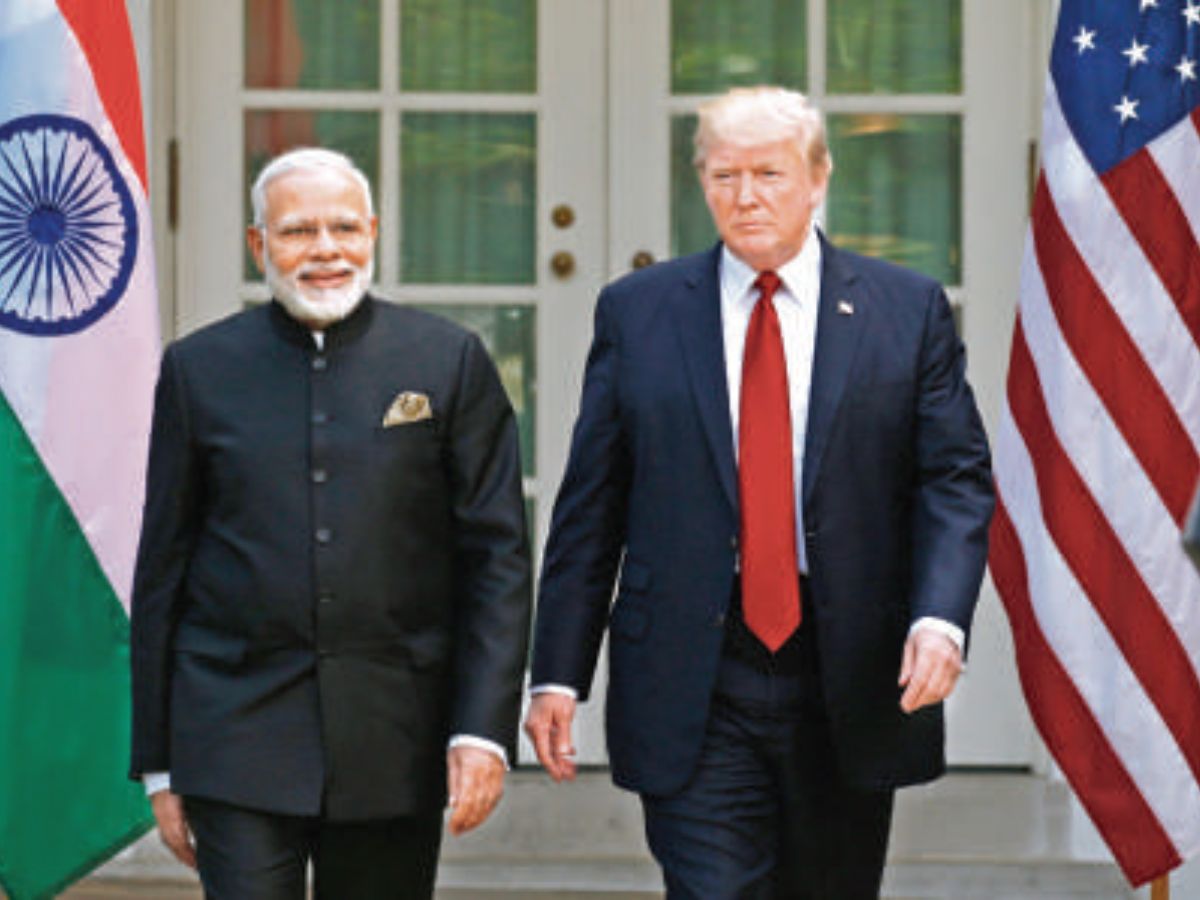
In the theatre of global politics, few actors understand the power of spectacle better than Donald Trump. And last week, as the curtains parted on yet another dramatic confrontation—this time between the White House and the Supreme Court of the United States—the world watched a familiar script unfold: confrontation, defiance, and an escalation that only Trump could brand as victory.
In a 6-3 verdict authored by Chief Justice John Roberts, the Supreme Court ruled that the sweeping tariffs imposed by President Trump were illegal. The court held that he had exceeded his executive authority in imposing broad global levies without congressional sanction. For any other administration, such a judicial rebuke would have triggered recalibration. For Trump, it triggered retaliation. Within hours of the verdict, he announced 10% global levy on imports—effectively doubling down on the very trade weapon the court had sought to blunt. And in a moment that revealed both his temperament and his political calculus, he lashed out at the justices, calling some of them “fools and lapdogs,” declaring himself “ashamed” of their lack of courage; signalling, that while the court may question his method, it would not deter his mission.
The message was unmistakable: the tariff war is not merely an economic instrument. It is central to Trump’s political identity.
For India, the developments were both dramatic and curiously predictable. Earlier this month, Washington and New Delhi had announced a framework for an interim trade agreement. The contours suggested recalibrated tariff structures, strategic concessions, and a reset in trade asymmetry. But with the Supreme Court ruling threatening the legal foundation of Trump’s tariff regime, questions naturally arose: Would the India deal unravel?
Trump’s response was blunt. “Nothing changes,” he declared. “They’ll be paying tariffs, and we will not be paying tariffs.”
It was vintage Trump—transactional, unapologetic, and rhetorically combative. He described the deal as a “little flip”, asserting that India had previously been “ripping us off” but now would be the one paying. For Indian policymakers, the optics matter as much as the substance. Public posturing in Washington does not necessarily alter negotiated frameworks. But when tariffs become political theatre, predictability becomes collateral damage.
Yet Trump also struck a notably warm tone about Prime Minister Narendra Modi, calling him a “great gentleman” and affirming that their relationship is “fantastic”. In Trump’s worldview, confrontation and camaraderie coexist comfortably. He can accuse India of trade exploitation in one breath and praise Modi in the next. The underlying message is consistent: loyalty is appreciated, leverage is rewarded.
Perhaps the most consequential—and controversial—claim Trump made was that India had “pulled way back” from buying Russian oil at his request. Since the outbreak of the Russia-Ukraine conflict, India has strategically increased its purchase of discounted Russian crude, prioritising energy security and economic pragmatism over Western pressure.
If India had reduced its Russian oil purchases under pressure from Washington, it would have marked a clear and consequential policy shift. To the best of my knowledge, no such shift has occurred. In that context, Trump’s assertion appears less a statement of fact and more an attempt to reinforce his self-crafted image as the decisive power broker at the centre of global conflicts. Trump framed it as part of his larger mission to “settle that horrible war where 25,000 people are dying every month.” The numbers may be rhetorical, but the ambition is clear: position himself as the indispensable peacemaker.
At the heart of this episode lies a deeper constitutional question within the United States itself.
The Supreme Court’s 6-3 ruling signals judicial resistance to executive overreach. Chief Justice Roberts’ majority opinion underscores that tariff powers, especially sweeping global levies, cannot be unilaterally expanded without legislative grounding. It is a reaffirmation of separation of powers.
Trump’s response—immediate escalation and public condemnation—reflects a broader philosophy of executive dominance. For him, institutional constraints are obstacles to be navigated, not boundaries to be respected.
This tension between judiciary and presidency will shape not just America’s domestic legal landscape but also global economic stability. Markets crave predictability. Allies crave clarity. Adversaries test ambiguity. For India, the implications are layered.
First, the trade framework must now be insulated from legal volatility in Washington. If US courts continue to scrutinise executive tariff authority, future agreements could require congressional backing to ensure durability. Second, India must navigate the optics of Trump’s public claims. Silence may be strategic. Rebuttal may be necessary. The balance will depend on diplomatic calculus. Third, the broader India-US relationship remains strategically aligned—driven by Indo-Pacific security concerns, technology partnerships, defence cooperation, and supply chain diversification. Trade disputes, even dramatic ones, operate within that larger architecture.
Trump’s assertion that “nothing changes” may be politically convenient. But in geopolitics, everything changes—slowly, subtly, and often beneath the surface. What we witnessed was not merely a reaction to a court ruling. It was a reaffirmation of Trumpism as doctrine: tariffs as leverage, confrontation as strategy, and narrative dominance as power.
By announcing additional global levies hours after being judicially restrained, Trump signalled that he views trade authority not as a delegated power but as an inherent presidential prerogative.
For India, the calculus is pragmatic. Engagement continues. Negotiations proceed. Strategic alignment deepens. But vigilance is essential. Because in Trump’s world, deals are never static. They are living instruments of leverage. And when the gavel falls in Washington, the echo is heard in New Delhi.
The question is not whether “nothing changes.” The question is how prepared we are for when it inevitably does.
-
Savio Rodrigues is the Founder and Editor-in-Chief of Goa Chronicle.




