
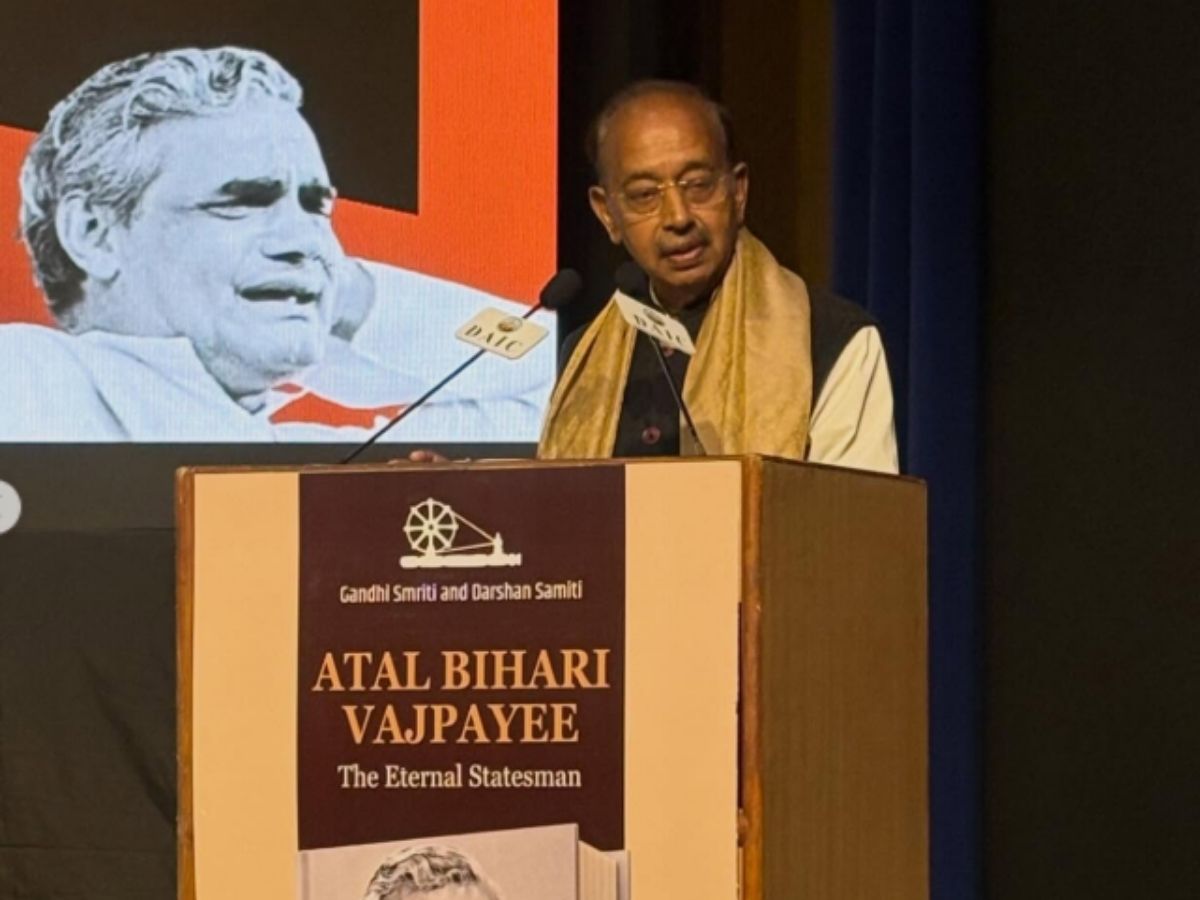
Without any doubt, Atal Behari Vajpayee was amongst the finest Prime Ministers, and the first to occupy the august office with a non-Congress background. He was extremely popular, politically astute, a great orator and someone who placed the country above everything else. His over six decades of political innings, commencing with being a principal opposition face, inspired millions. His incredible journey has now been captured vividly in the form of a coffee table book by one of his numerous admirers and junior colleagues, Vijay Goel, who served as Minister of State in the Prime Minister’s Office and who was associated with the luminary for nearly 50 years, from the time when he was a student activist till his very end.
Titled “Atal Behari Vajpayee: The Eternal Statesman”, the book spans 312 pages and transcends the boundaries of a standard biography; and according to some of those who have read it, “it is a visual odyssey dedicated to a Bharat Ratna, who served as the heartbeat of Indian democracy.” Vajpayee not only governed the nation but redefined the soul of the political discourse with unmatched grace.
Vijay Goel, who is, at present, Vice Chairman of the Gandhi Smriti under current Prime Minister Narendra Modi, followed Vajpayee from close proximity and thus has been able to bring out multiple facets of the departed leader. Vajpayee was not an ordinary politician, but someone who saw history unfolding in Parliament where he first made his debut in the late 1950s.
He was never hesitant in acknowledging that India’s first Prime Minister Jawaharlal Nehru had left an impact on his political evolution and although he remained committed to the Jana Sangh ideology, he had strong bonds with leaders cutting across party lines. For him political differences never amounted to personal differences and he was always there to help even some of his bitterest critics when they fell on bad times. Vajpayee is often referred to as the “last Brahmin” Prime Minister of the country, something which can never be said with finality, given the uncertainties of politics. However, his faith and belief in values never came in the way of pursuing his politics. He practised Rajdharma and always stood by his colleagues on major issues, a fact that was mentioned by Dr Murli Manohar Joshi, his colleague, during the release of the book by Vice President C.P. Radhakrishnan at the Dr Ambedkar International Centre late last month.
There has been a generation of BJP leaders who have been inspired by Vajpayee’s oratory and continue to speak publicly in his inimitable style, though it is not easy to capture the wit, humour and sarcasm that laced his political discourse. The former Prime Minister had a close relationship with the national capital, which he represented in the Lok Sabha both in 1977 and 1980. Therefore, it was but natural that he was familiar with the city and its people and always enjoyed campaigning during any polls that were conducted there.
Vijay Goel, who has also been a Lok Sabha member from two important constituencies—Delhi Sadar and Chandni Chowk—besides being the president of the Delhi University Students Union, keenly observed Vajpayee during his long career. Many in the capital believe that Goel would have been an extremely successful Chief Minister, had he got the opportunity given his understanding of various issues.
Being a contemporary in the University, I have had the opportunity of watching Vijay Goel’s political evolution. He was fearless when he courted arrest during the Emergency at the Law Faculty Coffee House and shouted slogans and distributed pamphlets while on the roof of the old barracks that existed there opposite the Ramjas College on the other side of the dividing road in Maurice Nagar. Subsequently, he had in 1977 been elected as the DUSU president with eminent media personality Rajat Sharma as his general secretary.
Vijay Goel came from a political family. His father, the late Charti lal Goel was a member of the Metropolitan Council from Kamla Nagar and the first Speaker of the Delhi Assembly when Madan Lal Khurana took over as the Chief Minister in 1993. His commitment to politics allowed him to be a Rajya Sabha member later and Narendra Modi handpicked him for his current assignment.
Coming back to Vajpayee, there are unending anecdotes about him. H.K. Dua, veteran journalist who passed away some days ago, used to often narrate his encounters with “Atalji” as he was referred to by his well-wishers. Dua would recall that once Vajpayee as a Jana Sangh leader had convened a press conference at the Vithalbhai Patel house complex and he had been assigned to cover it during his stint with the Indian Express. On his way to the venue, when he was about to cross the Ferozeshah Road-Kasturba Gandhi Marg crossing, he saw Vajpayee looking for a taxi. Dua stopped his scooter and Vajpayee gladly got on to the pillion requesting him to hurry. After his media interaction was over, Vajpayee again requested Dua to drop him back from where he had picked him. This was his simplicity.
Vajpayee emerged as the Prime Ministerial face of the BJP in the 1995 Mumbai conclave. L.K. Advani, who was at that time more popular than him, particularly after his numerous Rath Yatras and appeal to the cadres, proposed his name. There are also stories about that but history was made in Mumbai. Vajpayee’s place in politics has been carved by his dedication and commitment to his beliefs. Between us.




