India’s recognition of Israel was a long-term investment: not a political embrace, but a pragmatic determination that Israel was a fact in the international system.
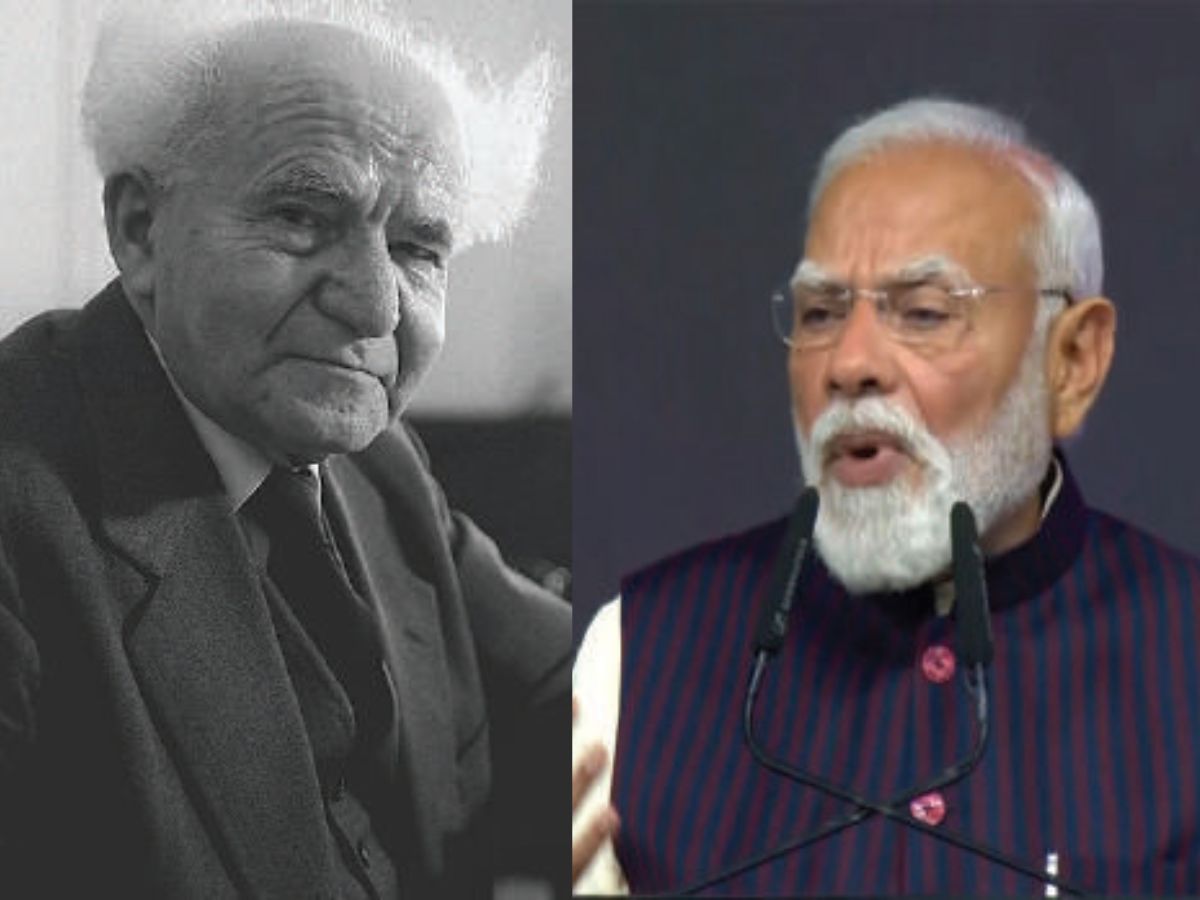
David Ben-Gurion | Prime Minister Narendra Modi
In the 1950s, Ben-Gurion was looking ahead, beyond the immediate diplomatic moment. There is evidence that he viewed India as a future great power that would eventually awaken, and that when that moment arrived, it would matter that Israel was already present, recognised, and understood, before the international system settled into a new set of rules.
India’s recognition of Israel on 17 September 1950 was precisely a long-term investment: not a political embrace, but a pragmatic determination that Israel was a fact in the international system. It did not erase India’s historically pro-Palestinian instinct, but it opened a door, and that door became a long corridor leading from 1950 to 1992, to 2017, and to the inflexion point of 2026.
In 1992, India and Israel established full diplomatic relations; in 2017, Modi took the first major public step, moving the relationship out of closed rooms and into the open; and in 2026, he is no longer merely “sustaining a relationship” but trying to convert it into a strategic asset with measurable outputs. That is the deeper meaning of his most recent visit to Israel: no longer a relationship anchored primarily in defence procurement, but an architecture of capability partnership development, production, technology, and coordination mechanisms. This was reflected officially in the language of upgrading ties and in the signing of a broad set of understandings and documents, including security-technology components.
This is the angle Israeli audiences need to grasp: India did not “fall in love with Israel”; it is building an instrument of power. India’s defence establishment faces a multi-front threat environment (Pakistan, China, terrorism), and its central lesson in recent years is that national resilience is built through a combination of technological edge, domestic industry, intelligence, and calibrated deterrence. That is why Modi and his system are not looking only for “weapons systems,” but for the capacity to produce, sustain, and upgrade precisely the language of advanced defence partnerships. The same logic appears in the public narrative of the visit: strengthening defence cooperation, innovation, cyber, and artificial intelligence.
Then comes the paradox that frustrates Israelis: how can the same India strengthen Israel in the security domain while simultaneously voting differently or joining critical wording in international forums? The answer is not hypocrisy; it is de-hyphenation in the Indian model. India has detached itself from the “Palestinian ceiling” that for decades prevented an open, fully realised relationship with Israel but it has not abandoned the principle it consistently declares: support for a two-state solution. In the context of the 2026 visit, this was particularly visible: a week before the visit, India joined a UN statement condemning Israeli actions perceived as expanding Israel’s presence in the West Bank.
To read this correctly, one must replace a values discourse with an “architecture discourse”: India did not change its values; it changed its operating mechanisms. It dismantles the forced linkage between Israel and “the Palestinians” at the bilateral level and shifts management of the Palestinian issue to multilateral channels where it accumulates identity capital as a leading voice of the Global South, preserves international consensus, and reduces political costs vis-à-vis Arab and Muslim actors. In parallel, it allows itself to work with Israel “below the UN’s normative radar” in an arena where the operative currencies are technology, security, industry, and innovation.
This is not only external. India has complex domestic politics, a large Muslim population, and a constant competition for legitimacy as a leader that is not “dragged into one camp.” Put differently, India is manufacturing an ability to absorb dissonance. It can tell Israel: we are with you against terrorism and in capability-building. And in the same breath, it can tell the international community: we oppose unilateral steps in the territories. This is not a soft both-sides posture it is a risk-management mechanism.
From an Israeli perspective, this requires a reset of expectations. Those looking for “automatic votes” will be disappointed; those who understand India as a power that maximises interests by splitting arenas will recognise a genuine strategic opportunity. The opportunity is to transform India from a major customer into an industrial–technological partner, especially in areas where Israel is strong, and India is “hungry”: multi-layer air defence, counter-drone systems, electronic warfare, data-driven intelligence, cyber, and the integration of civilian innovation into defence applications. The recent visit signals that the Indian side wants exactly this: frameworks for deeper cooperation, not only discrete transactions.
And this is precisely where the 1950–2026 circle closes. Ben-Gurion understood that time favours those who establish an early presence vis-à-vis the great powers of the future. Modi is implementing that insight not out of romance, but out of a strategic conviction that ties with Israel can become a force multiplier in India’s power-building project. Israel, for its part, must read the map without illusions: India will continue to support the two-state idea, will continue to conduct UN diplomacy that is not always comfortable for us, but will deepen the partnership when we speak the right language the language of capabilities, industry, and technology under political constraints.
If Israel wants 2026 to be more than a momentary peak and instead a stable step-change, it must build not only projects with India, but institutions: permanent coordination mechanisms, joint R&D tracks, and frameworks that allow New Delhi to demonstrate at home that it has secured strategic returns without being compelled to “choose sides” publicly. This is not a compromise; it is the only way to work with a power that is constructing its own global architecture.
Dr Lauren Dagan Amoss teaches at the BESA-Bar Ilan University in Israel.
