
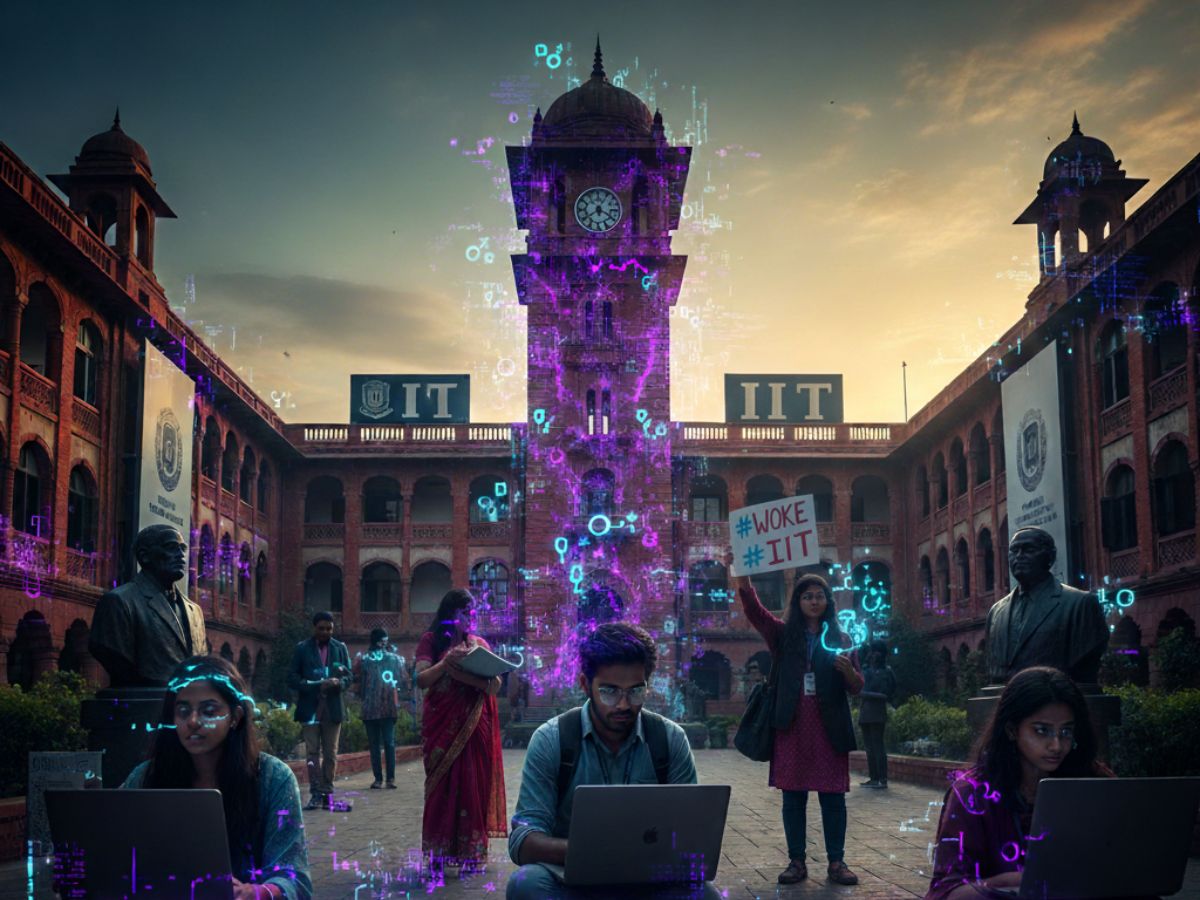
For decades, the IITs have been held up as temples of modern India, producing some of the sharpest minds who went on to shape industry, science, and technology worldwide. But look closer today, and a disturbing pattern is emerging.
The very institutions that were meant to be the powerhouse of a confident and self-reliant Bharat are increasingly becoming laboratories for ideological experiments imported wholesale from the West. The “woke agenda” has crept into the walls of IITs along with various HEIs (higher education institutes) like IIMs and others. It has occurred often through their humanities and social sciences departments, and is slowly colonising young minds under the garb of postcolonial and social justice. At this point, one must ask: Is such scholarship or selective ideological engineering?
TROJAN HORSES IN THE IITs
The humanities departments in IITs were never meant to become ideological command centres. When these institutions were founded, humanities had a modest role, like teaching ethics, communication, and some social sciences to help humanize engineers while keeping them abreast with realities on the ground. In more recent inventions like AI, such a need for ethics is welcome and desirable. But over the last two decades, what has unfolded is a quiet transformation.
Newer IITs like Gandhinagar and Indore have been champions of this new and dangerous pattern where, under the name of “interdisciplinary” programs such as MA in Society and Culture, they have inducted western concepts, only to juxtapose them with the Indian context without a thought given to culture and societal realities.
The said MA paper, for instance, looked progressive in outline, but in practice, it’s merely serving a pipeline of postcolonial theory and Marxist discourse. The only takeaway for innocent students who come out of curiosity ends up taking is grievances and revulsion towards their own culture.
From such initiatives, run and dominated by Left scholars, it has spread as a contagion. Similar courses appeared in IIT Delhi and IIT Bombay. Recruitment patterns further revealed a familiar story, wherein the faculty trained in JNU, TISS, or liberal arts institutions in the West, with a strong Left disposition, steadily took over, reproducing themselves by hiring and mentoring students in the same mould. Effectively, what began as an experiment in diversity of thought soon hardened into a monopoly.
One of the defining features of this ideological capture is its selective application of critique. With all its 20th-century legacy, Marxist dialectics is treated as a sacred theory. But Bhartiya knowledge systems, from Mimamsa to Vedanta, from Kautilya to Nagarjuna, are either ignored or trivialized as oppressive relics of the past.
Western universities proudly run courses on Aristotle, Aquinas, or Christian theology. But try suggesting courses on Nyaya logic or Arthashastra in an IIT, and you will be accused of “saffronization.” Ayurveda or Yoga are quickly dismissed as pseudoscience. Yet, the same gatekeepers happily introduce Freudian psychoanalysis or Gramscian hegemony into syllabi without demanding empirical validation. This is not critical thinking but an exercise in selective prejudice dressed up as evolution.
INTERNATIONAL NETWORKS AND DOMESTIC ECHO CHAMBERS
This ideological drift did not emerge in isolation. Global donor networks, from the Ford Foundation to the Open Society Foundations, have long shaped research agendas in Indian academia. Their money comes with strings attached, privileging discourses of caste victimhood, gender oppression, and minority grievance, while systematically discouraging research on indigenous systems. Domestically, this aligns with academic silos, wherein linguistic and identity-based clusters dominate hiring and promotions. The result is an echo chamber. PhD candidates proposing work on Bharatiya political thought or traditional sciences are either screened out beforehand or discouraged and dismissed during their coursework.
Meanwhile, those parroting the latest Western fashions, be it intersectionality, Islamophobia studies, or caste apartheid analogies, are rewarded with grants, international conferences, and publication opportunities, besides countless praises, legitimising them in the process.
The recent international two-day workshop of these woke activists in the disguise of academics on “Capitalism and Majoritarianism: Exploring South Asian Capitalism” at IIT Bombay on 12 September 2025, had nothing to do with South Asia; it was all India bashing. The imagery was so offensive, indicating a biased and partisan agenda setting to destabilize a legally elected NDA government. In the name of international collaboration and international faculty, is it a means of undermining our best institutions through narrative power?
Narrative power sustains political power and it is time we realized these destabilizing forces creeping into our HEI’s fabric.
THE CIVILIZATIONAL COST
This selective woke agenda is not just an internal academic squabble. It has civilizational consequences. Graduates of these institutions, funded by the Indian taxpayer, are being trained to distrust their own society’s aspirations. Make in India is dismissed as “corporate fascism.” Digital India is caricatured as “state surveillance.” The New Education Policy 2020 is branded “Brahminical restoration.” What a striking double standard! Western nations celebrate their technological modernization as innovation. But it’s a uniquely Indian phenomenon to tell and convince our own scholars to pathologize it as “authoritarianism.” Such cannot be brushed under the carpet as a critical approach.
Reading different perspectives and addressing them through compare and contrast is academic inquiry. Abandoning or stigmatizing issues and a whole branch of knowledge systems as oppressive is civilizational sabotage.
If Bharat is serious about becoming Viksit Bharat by 2047, we cannot afford an intellectual elite alienated from its roots. Or worse, a class of intellectuals and scholars is actively trying to subvert it from the inside. Our ancient universities thrived because they holistically combined science, philosophy, and spirituality. Nalanda and Takshashila produced mathematicians, logicians, and physicians who were global authorities in their time.
Therefore, the answer to such subversion cannot be merely dismantling our institutions but rather reclaiming them, requiring a multipronged approach that needs to be adopted with clarity and courage. First and foremost, we need to subject the curricula in these courses to serious audits that expose ideological bias and restore balance. Our syllabi cannot remain echo chambers of imported theories while systematically excluding indigenous frameworks.
Equally urgent is the need for transparent hiring that breaks the cartelization of faculty networks, where ideological affinity has too often trumped scholarly merit.
Building independent intellectual ecosystems, Indic research centres, oral history programs, peer-reviewed journals, and platforms is non-negotiable. The recent IKS (Indian Knowledge System) conference at JNU was the first serious effort in that direction, which aims to inspire others to follow suit. Only by doing this can we counter the globalist monopoly and give scholars rooted in Bharatiya traditions the space to thrive.
Finally, engineers, scientists, and technocrats must be equipped with civilizational literacy to engage with modern challenges without being cut off from their roots. Only then can our institutions combine global excellence with civilizational confidence.
RECLAIMING THE ACADEMIC SPACES
The challenge is both academic and civilizational, therefore a threat to Indian democracy. The enemies outside are less dangerous than those within, because they wear the cloak of scholarship and intellectual liberty as they steadily undermine our intellectual sovereignty. Bharat must reclaim its academic spaces not through censorship but through confidence, not by silencing others but by ensuring plurality, not by nostalgia but by a culture of Shastrartha.
We must remember that pluralism cannot be selective. True academic diversity means allowing multiple frameworks to contend, not erecting gatekeeping mechanisms that silence one side. For Viksit Bharat, our IITs cannot afford to churn out ideological parrots and anti-national wokes. They must once again become crucibles of excellence, serving all purposes: scientific and civilizational. Moving forward, the message must be clear: we honour diversity of thought but reject intellectual servitude disguised as scholarship. It is time we woke up and acted with a Bharatiya narrative architecture.
Prof Santishree Dhulipudi Pandit is the Vice Chancellor of JNU.




