The Bihar verdict of 2025 ultimately reflects a clash between two political cultures: the NDA’s disciplined, data-driven, cohesive structure versus the MGB’s chaotic, personality-driven, fragmented approach.
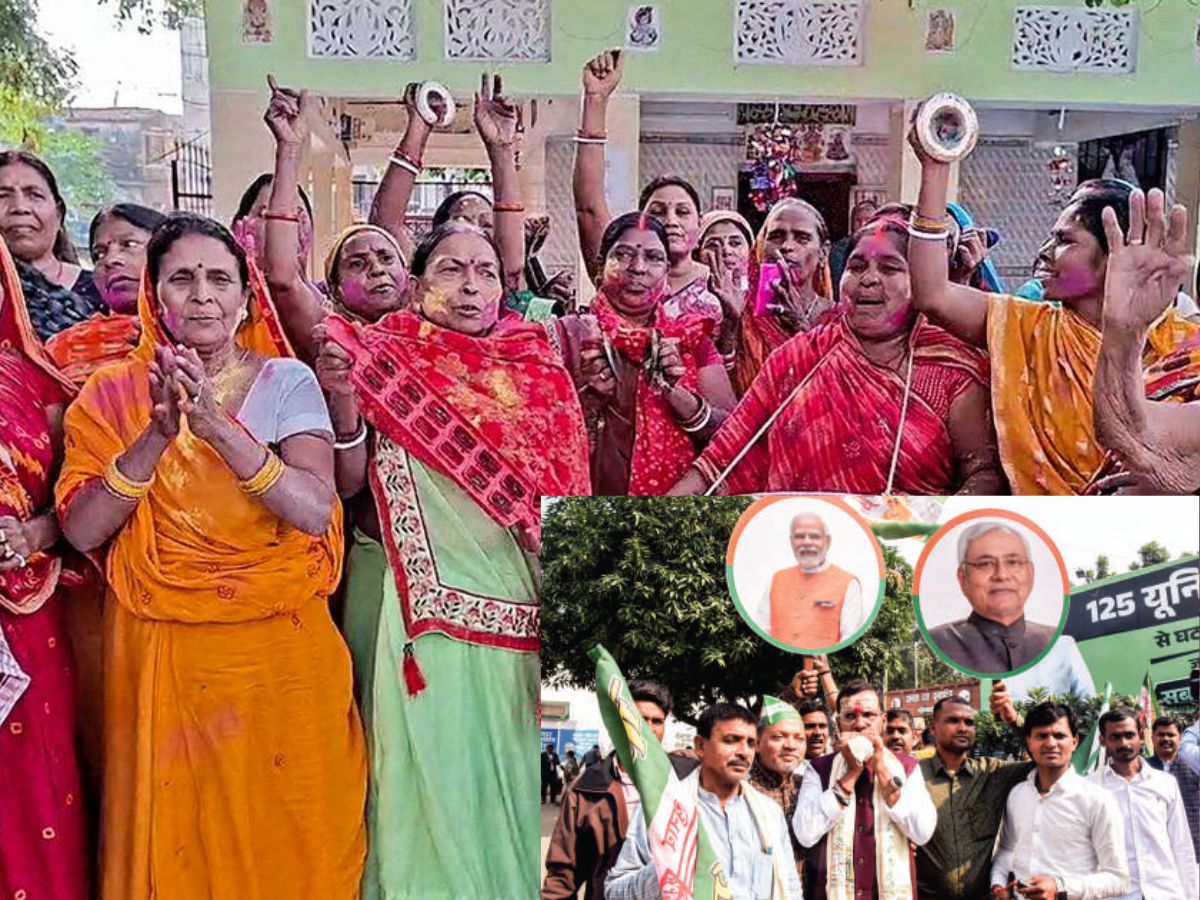
Women and caste unity gave NDA a landslide in Bihar
The 2025 Bihar Assembly election delivered one of the most decisive mandates in the state’s history, propelling the National Democratic Alliance (NDA) to a sweeping victory and reducing the Mahagathbandhan (MGB) to a marginal political presence. The NDA crossed the majority mark with 202 seats, while the MGB collapsed to 34 and AIMIM secured 5. Beyond the headline numbers, this verdict reflects a deeper story of strategic brilliance, disciplined alliance management, and unmatched vote conversion by the NDA, contrasted sharply with the MGB’s electoral incoherence and organisational breakdown.
At the heart of the NDA’s success was the strategic inclusion of Chirag Paswan’s Lok Janshakti Party (Ram Vilas). This single decision had a transformative impact on the election. In 2020, LJP fought independently and cut into NDA votes, costing the alliance dozens of seats. In 2025, however, LJP(RV) was integrated smoothly into the NDA framework, converting a previously adversarial force into an electoral asset. Chirag Paswan’s appeal among Dalit communities, especially Paswan voters, combined with his personal brand of youthful assertiveness, helped consolidate the pro-NDA mood and translate it into actual victories on the ground. This consolidation ensured that no anti-NDA vote leakage occurred in constituencies where the margins historically remained narrow. What could have been a liability turned into a vote-converting engine, amplifying the NDA’s reach across central and northern Bihar.
The core NDA partners—the BJP and the JDU—further demonstrated an exceptional rise in electoral efficiency. Despite contesting fewer seats in 2025 (202 seats collectively) compared to 225 in 2020, they managed to increase their total seat tally by 57. This dramatic rise in their strike rate is proof that the NDA did not simply rely on sentiment; it mastered the science of seat allocation, micro-management, and cadre coordination. Every contested seat was chosen deliberately. Every constituency had a calculated candidate. Every vote bloc was approached with clinical precision. This was not traditional electioneering; it was a calibrated performance rooted in analytics and grassroots mobilisation.
Nitish Kumar’s JDU showcased remarkable resilience, defying analysts who predicted diminishing influence. Despite contesting 14 fewer seats than in 2020, the JDU increased its vote share by an estimated 3.55%. This shift is impossible to explain without acknowledging the disciplined transfer of LJP(RV) votes and the strengthened synergy within the NDA. Nitish Kumar’s credibility among women voters—who turned out in record numbers—as well as his developmental narrative around roads, electricity, welfare and security, contributed to the steady rise in JDU’s support base. Far from being overshadowed, JDU emerged as a stabilising pillar within the alliance.
THE WOMEN FACTOR
The surge in women’s turnout—from 59.69% in 2020 to an unprecedented 71.6% in 2025—emerged as one of the most decisive factors behind the NDA’s sweeping victory in the Bihar Assembly elections. This remarkable 12-point jump not only elevated the overall polling percentage but fundamentally reshaped the electoral landscape in favour of the NDA. Over the past decade, women have steadily evolved into a politically assertive constituency in Bihar, responding strongly to welfare schemes, direct benefit transfers, and improvements in last-mile delivery of essential services. By 2025, this trust matured into a powerful electoral force. The NDA’s consistent focus on women-centric governance—ranging from housing and healthcare to LPG access, sanitation, and security—translated into mass turnout in rural and semi-urban regions, where female voters outnumbered men at several booths.
This unprecedented mobilisation disrupted traditional caste equations and weakened the Mahagathbandhan’s voter base, which relied heavily on male-dominated turnout patterns. Women voters not only turned out in record numbers but voted with remarkable cohesion, helping the NDA convert close contests into decisive victories. In essence, the women of Bihar didn’t just participate in the 2025 elections—they propelled a mandate, reshaped political arithmetic, and played a defining role in the NDA’s landslide win.
SOCIAL COALITION
The NDA’s 2025 victory was anchored in its ability to construct a broad, durable, and strategically aligned caste coalition that the Opposition simply could not match. Traditional forward castes remained solidly behind the alliance, ensuring a stable and influential vote base. At the same time, OBCs and EBCs—long considered the decisive electoral force in Bihar—shifted towards the NDA in substantial numbers, drawn by development-driven governance, targeted welfare schemes, and consistent political outreach. What made the coalition truly formidable, however, was the consolidation of a significant section of Dalit voters, strengthened further by the NDA’s alliance with the LJP(RV). This combination created a rainbow bloc cutting across caste lines, one that proved immune to the Opposition’s attempts to revive old identity narratives. With such a wide and balanced social coalition behind it, the NDA neutralised any caste arithmetic the Mahagathbandhan hoped to rely on and converted its social support into an overwhelming mandate.
STRATEGIC MASTERY
The vote share and seat tally comparison exposes one of the clearest indicators of the NDA’s strategic mastery. The combined BJP-JDU vote share increased by just 3.83%, a modest rise at the macro level. Yet this translated into a dramatic 57-seat surge—a 23.45% jump. What this reveals is a near-perfect vote-to-seat conversion ratio, a rare achievement in Indian elections. The NDA concentrated its vote growth in constituencies where it mattered, avoided wastage, minimised internal vote-splitting, and built a unified alliance structure capable of delivering at the booth level. This synergy is what converted small voteshare gains into enormous seat gains.
In contrast, the Mahagathbandhan suffered a collapse that goes far beyond numerical decline. The RJD-led alliance saw only a marginal vote share dip of around 0.95% compared to 2020. However, this tiny erosion in vote percentage resulted in a staggering loss of 63 seats. This imbalance demonstrates a catastrophic failure in converting votes into winnable constituencies. The MGB’s support base, instead of being strategically channelled, was scattered, diffused, and rendered electorally ineffective. Their vote was strong in pockets but weak across the battleground constituencies that decide the election. Their messaging lacked coherence, their candidate selection lacked discipline, and their alliance coordination was marred by ego battles and organisational fragmentation.
One of the most consequential strategic failures of the MGB was its inability to bring AIMIM into the alliance fold. While the NDA streamlined its partners and ensured disciplined vote transfer, the MGB could not overcome internal fractures or ideological anxieties around aligning with AIMIM. This failure proved costly in Seemanchal, a region where AIMIM maintains strong local influence and can move thousands of votes per constituency. Had the MGB secured AIMIM’s participation and consolidated the Muslim vote, several close contests could have shifted in its favour. Instead, AIMIM ran independently, splitting minority votes and indirectly aiding the NDA’s rise in critical margins.
Looking forward, the MGB and the broader INDI Alliance face an existential challenge. If they intend to remain politically relevant, they must adopt a more mature approach to alliances, learn the discipline displayed by the NDA, and prioritise seats over egos, strategy over rhetoric, and ground reality over social media optics. The 2025 mandate is not just a defeat; it is a reprimand—a clear warning that fragmented alliances, scattered campaigns, and emotional politics cannot withstand the NDA’s professional election machinery.
CLASH BETWEEN POLITICAL CULTURES
The Bihar verdict of 2025 ultimately reflects a clash between two political cultures: the NDA’s disciplined, data-driven, cohesive structure versus the MGB’s chaotic, personality-driven, fragmented approach. The result was inevitable. The NDA’s victory is a case study in how strategic clarity, alliance discipline, and tactical precision can reshape an entire electoral landscape. The MGB’s collapse is a reminder that sentiment without strategy leads only to defeat.
The NDA’s victory in Bihar was not an overnight development but the culmination of a carefully crafted political and social strategy. At its core was an unprecedented women-led turnout, which shifted the electoral balance and strengthened the NDA’s support across rural and semi-urban constituencies. This was complemented by a broad caste consolidation, with forward castes, OBCs, EBCs, and significant Dalit sections rallying behind the alliance, creating a stable and diverse voter base. Effective organisational management, disciplined cadre coordination, and seamless vote transfer further amplified the NDA’s advantage. In contrast, the Opposition entered the election fragmented and uncertain, offering an incoherent alternative that failed to inspire trust or project stability.
Above all, the NDA’s leadership pitch—rooted in continuity, governance credibility, and a promise of further development—resonated deeply with voters shaped by Bihar’s long political memories of instability. The verdict reflects both evolving societal aspirations and the electorate’s clear preference for steady, proven leadership over uncertain experimentation.
Savio Rodrigues is the Founder and Editor-in-Chief of Goa Chronicle.
