
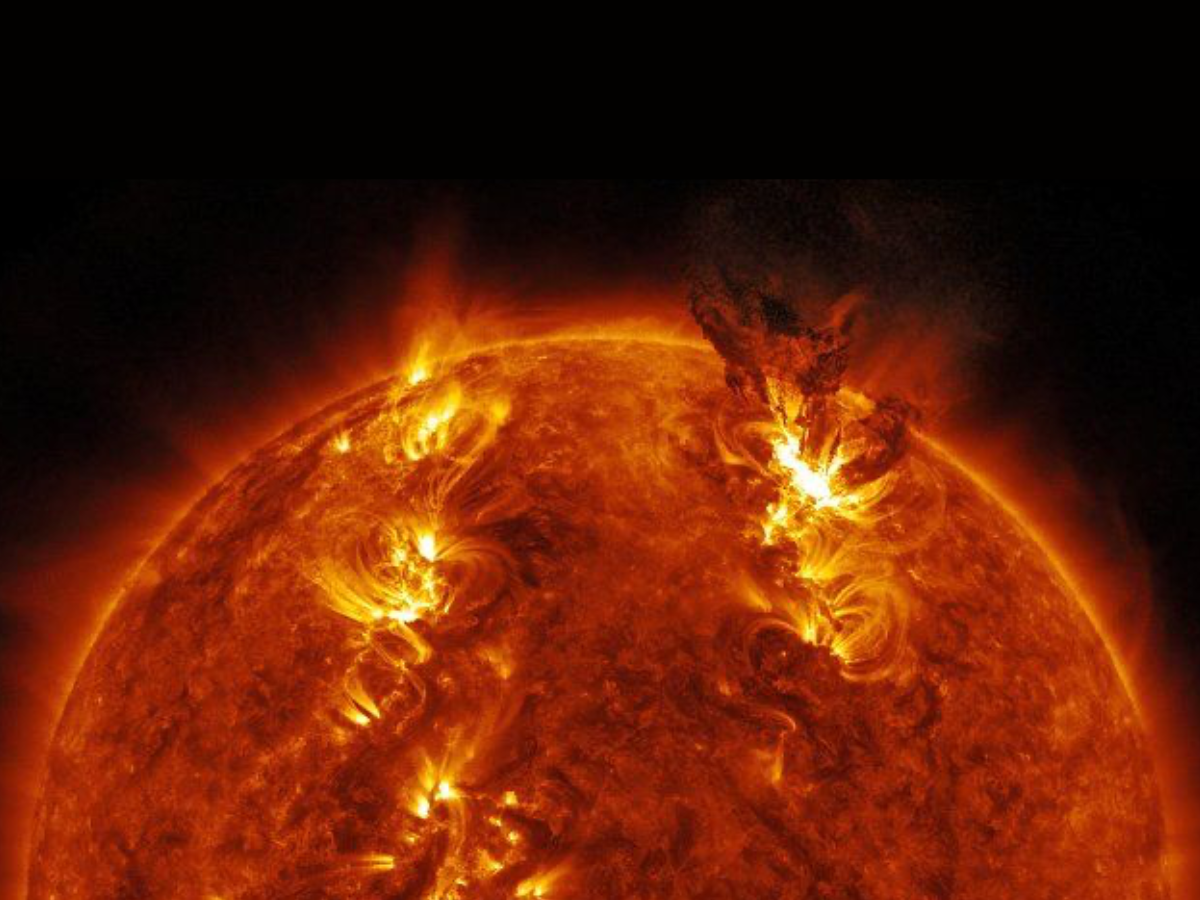
India may be severely affected as the Sun is about to release its latest outburst with solar flares warning ISRO and other space organizations around the world. Solar flares can be dangerous to communication and satellite systems and this highlights the vulnerability of our advanced technology to space weather over 50 Indian satellites are being closely monitored to prevent any disruption in their services.
What Caused the Solar Storm?
The solar activity has its roots in Active Region 14366, which is a compact group of sunspots that emerged in early February within two days, it released four large flares, culminating in an X8.1-class flare, which is the brightest of 2026 so far. According to NASA, this flare is the brightest since October 2024 and ranks in the top 20 since 1996 and this is a part of the Sun’s 11-year cycle, which is currently in its solar maximum phase.
|| CESSI FLARE ALERT + SPACE WEATHER ADVISORY ||
CODE ♦️ SEVERE
The Sun has launched multiple solar flares over the past 24 hours, the strongest one being an X8.1 flare at
2026/02/01 23:57 UT (flare light curve below).
1/n + pic.twitter.com/4RW89i5ysp— Center of Excellence in Space Sciences India (@cessi_iiserkol) February 2, 2026
Impact on Earth & India
These intense solar flares release massive amounts of electromagnetic radiation that reaches Earth almost instantly though they do not directly threaten human life, they cause disturbances to the ionosphere, resulting in radio blackouts in the high frequency range, interference with navigation signals and higher radiation exposure for satellites. Flights passing through high latitudes may encounter disruptions and spectacular auroras are also witnessed. ISRO’s Anil Kumar stated that contingency plans are prepared to be put into action immediately in case of any irregularities.
Why the Storm Is Being Closely Monitored
Though there are no major CMEs directed at Earth, scientists remain alert with a weaker CME is on its way, but the active region of the Sun is close to the Sun-Earth line. Hence, more intense effects cannot be ruled out “The highly active region has been erupting again and again, which gave initial warnings to Indian scientists,” said Professor Dibyendu Nandi of IISER Kolkata.
India’s Aditya-L1 on the Frontline
India has made a bold move with its first solar observatory satellite, Aditya-L1, which is positioned approximately 1.5 million kilometers away from the Earth at the L1 Lagrange point and the satellite provides ISRO with real-time information regarding solar flares, magnetic fields and high-energy particles, which in turn enables the immediate issuance of warnings that protect space infrastructure.
NLST & Future Preparedness
The next target of India is a “sister” mission to Aditya-L1, namely the National Large Solar Telescope (NLST) located at Pangong Lake in Ladakh. This 2-meter optical and near-infrared facility, costing close to ₹1000 crores, will be used to investigate solar magnetic fields and the dynamics of solar flares. Together with Aditya-L1, NLST will help enhance the ability of India to predict and mitigate the effects of solar storms.




