Total Lunar Eclipse 2026: Blood Moon to light up skies on March 3. Check IST timings, visibility in India, moonrise, sunrise & how to watch safely.
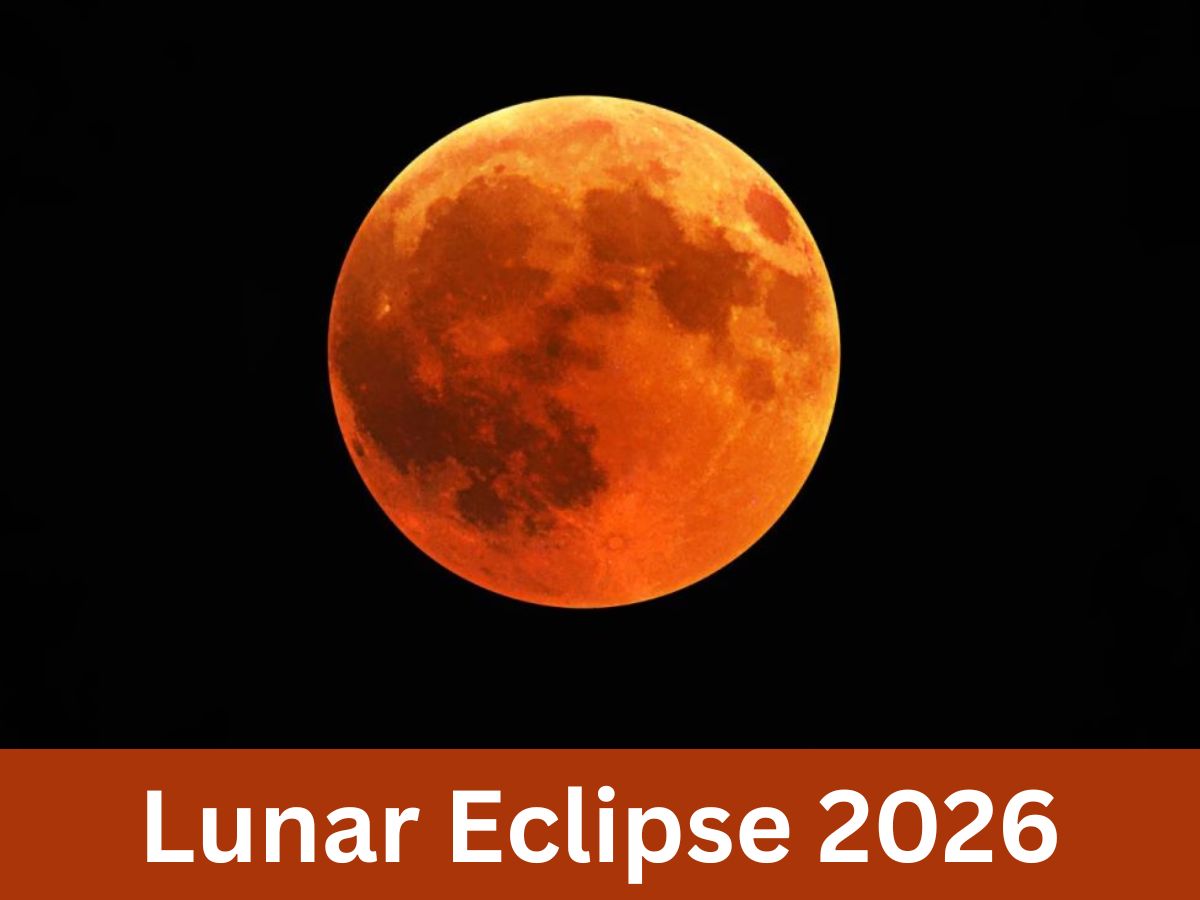
Total Lunar Eclipse 2026: Blood Moon to light up skies on March 3 [Photo: X]
Skywatchers are gearing up for a spectacular celestial event as a total lunar eclipse, popularly known as the Blood Moon, will illuminate the skies on March 3, 2026. During this rare phenomenon, Earth will pass directly between the Sun and the Moon, casting a shadow that gradually turns the lunar surface a deep copper-red.
The event will unfold over several hours in the early morning, offering a dramatic and photogenic sky show. Unlike solar eclipses, this celestial spectacle is completely safe to watch with the naked eye. With no special equipment required, it promises to be one of the most accessible astronomical events of the year.
In India, the lunar eclipse will occur during the early morning hours of March 3, 2026 (IST). However, visibility will depend on location and moonrise timing. Northeastern states such as Assam, Arunachal Pradesh, Meghalaya, Manipur, Mizoram, Nagaland, Tripura, and the eastern parts of West Bengal are expected to get a better view.
In many other parts of India, the Moon may set or rise during key phases, limiting full visibility of totality. Observers should look toward the western sky before sunrise or the eastern horizon at moonrise, depending on their city. Clear skies will play an important role, so checking local weather forecasts is advised.
The total lunar eclipse will take place on March 3, 2026 (IST).
Lunar Eclipse 2026: Key Eclipse Timings (IST)
The total phase will last about 58 minutes, while the entire eclipse will span approximately 4 hours and 38 minutes.
Lunar Eclipse 2026: Global Visibility
Some regions may miss totality due to the Moon being below the horizon.
For skywatchers in Delhi, the Moon will rise during the early hours of March 3, 2026.
Since totality occurs earlier between 3:34 AM and 4:32 AM IST, Delhi will likely miss the peak Blood Moon phase, as the Moon will still be below the horizon during totality.
Residents may be able to see the ending partial or penumbral phases shortly after moonrise, depending on visibility and local skyline conditions. For the clearest view, find an open eastern horizon and arrive a few minutes before 5:45 AM IST.
The Moon turns red during a total lunar eclipse because Earth blocks direct sunlight from reaching it. However, sunlight still passes through Earth’s atmosphere.
The atmosphere filters out shorter blue wavelengths and bends the longer red wavelengths toward the Moon. This scattering effect creates the copper-red glow, often called the Blood Moon effect.
It is similar to seeing multiple sunrises and sunsets projected onto the Moon at the same time.
Watching a lunar eclipse is simple and completely safe.
If clouds block your view, several observatories and space agencies may livestream the eclipse online.
This eclipse is particularly significant because it will be the last total lunar eclipse visible globally until 2029.
That makes it a rare opportunity for sky enthusiasts, photographers, and casual viewers. The long gap between total eclipses adds to its importance, making March 3, 2026, a must-watch date on the astronomical calendar.
Unlike solar eclipses, lunar eclipses are completely safe to observe. However, here are a few general tips:
Most traditional precautions associated with eclipses are cultural beliefs rather than scientific requirements.
The total lunar eclipse will conclude when totality ends at 4:32 AM IST.
However, the partial phase will continue until 5:47 AM IST, and the penumbral phase will finally conclude at 6:50 AM IST, marking the complete end of this celestial spectacle.
Sunrise timing will affect how long the eclipse remains visible across different Indian cities.
Cities with earlier sunrise, especially in Northeast India, may have reduced visibility during the final stages due to increasing daylight. Observers should check their exact local sunrise timing to plan viewing accordingly.
