
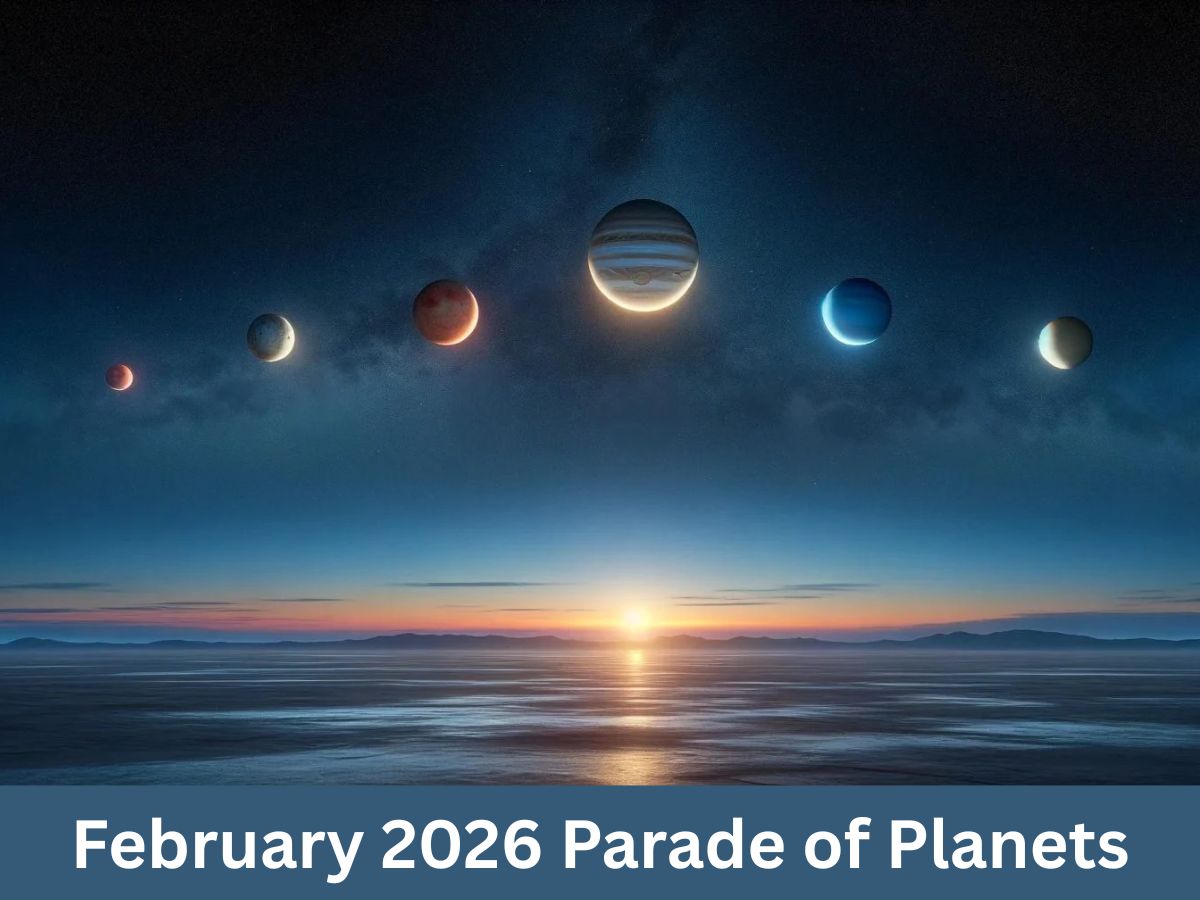
February 2026 Parade of Planets: A rare sky event will close out February 2026 as six planets- Jupiter, Saturn, Venus, Neptune, Uranus and Mercury appear to line up in the evening sky.
Although this alignment will not include all seven planets visible from Earth like the major event in 2025, it still offers skywatchers a special chance to spot several worlds at once.
What is Parade of Planets?
The phrase “planet parade” is not an official scientific term. Instead, it is an informal way to describe a time when several planets can be seen together in a line across the sky, according to NASA.
Unlike distant stars, planets are much closer to Earth. Because of this, they appear to move slowly across the sky over time, while stars seem fixed in place. Since all the planets orbit the Sun along roughly the same flat path, they can sometimes look as though they are arranged in a row.
When Will the February 2026 Planet Parade Happen?
The alignment will take place on the night of February 28 and continue into the early hours of March 1. Observers will need clear skies and a good view of the horizon to catch the best glimpse.
The February 28–March 1, 2026 parade of planets can be viewed from most parts of the world, provided the sky is clear and the western horizon is unobstructed.
It will be visible across:
-
North America (United States, Canada, Mexico)
-
South America
-
Europe
-
Africa
-
Asia (including India)
-
Australia and New Zealand
However, visibility may vary slightly depending on your location and local sunset time. Jupiter will be easiest to see worldwide, while Mercury, Venus, and Saturn will be harder to spot because they will sit
Which Planets Will Be Easiest to Spot?
This year’s display will be less bright and dramatic than the 2025 event. According to Michael Shanahan, director of the Liberty Science Center Planetarium in New Jersey, one planet will clearly stand out.
“The only planet you have an easy chance of seeing is Jupiter,” Michael Shanahan, the director of the Liberty Science Center Planetarium in New Jersey, tells TODAY.com. “Just look up anytime from dusk to about 3:30 a.m., find the brightest dot, and that will be Jupiter.”
Jupiter will shine brightly in the sky, making it the simplest target for casual viewers.
Which Planets Will Be Harder to See?
Spotting Mercury, Venus and Saturn will be more challenging. Shanahan explained that these planets will set between 6:30 p.m. and 7 p.m. on February 28. “They might be visible with binoculars,” he said. “All are very low in the West in the early evening.”
The best chance to view them will be around 6:15 p.m., shortly after sunset. Neptune will not be visible without a telescope because it is too faint. Saturn will also set early. Uranus will remain in the sky until around 10 p.m., but like Neptune, it requires a telescope. Meanwhile, Mars will not be visible at all, as it will be hidden in the Sun’s glare.
When Is the Next Major Planet Parade?
The next big opportunity to see five planets with the naked eye and all seven planets through observation will occur on September 8, 2040. On that evening, they will appear grouped above the setting Sun.
What Is the Next Must-See Sky Event?
Soon after the planet alignment, skywatchers can look forward to a total lunar eclipse on March 3, just before sunrise. During this event, the Moon will turn a deep red color, often called a “blood moon.”
A lunar eclipse happens when Earth moves between the Sun and the Moon, causing Earth’s shadow to fall across the Moon’s surface. This eclipse will be visible in parts of North America, Australia, New Zealand and eastern Asia.
According to the Liberty Science Center, the partial phase when the Moon first begins to darken will start at 4:50 a.m. ET. The deep red phase will begin at 6:04 a.m. ET, and the Moon will remain in that stage until it sets at approximately 6:29 a.m.
With two exciting celestial events happening within days of each other, early 2026 promises to be a memorable time for sky enthusiasts.




