
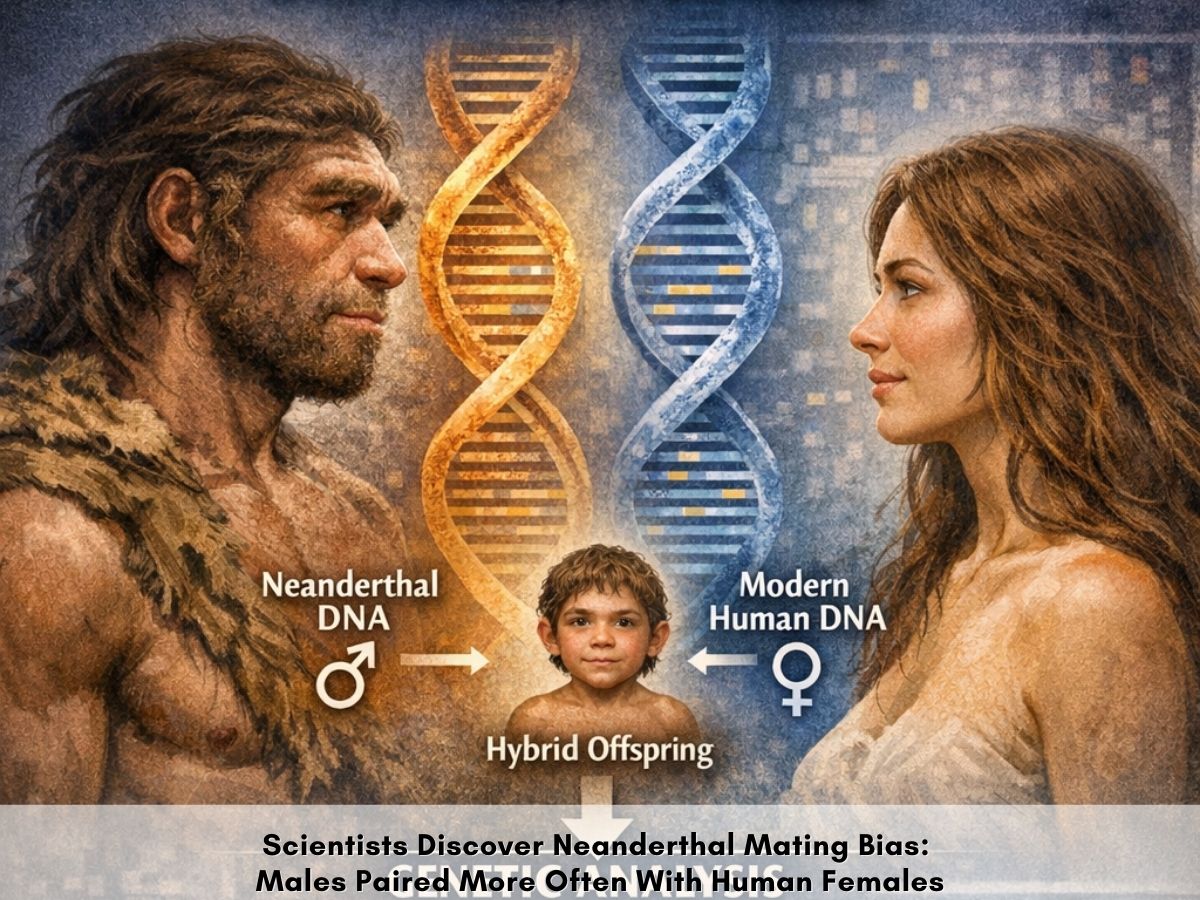
New genetic research reveals that when Neanderthals and early humans interbred tens of thousands of years ago, the pairings were predominantly between Neanderthal males and human females. The finding, published Thursday in the journal Science, explains a long-standing mystery about why Neanderthal DNA is largely absent from the human X chromosome .
What is found in the Neanderthal DNA research?
A team of geneticists at the University of Pennsylvania led by Dr. Sarah Tishkoff, the David and Lyn Silfen University professor in genetics and biology, analyzed DNA from three Neanderthal specimens—the Altai, Chagyrskaya, and Vindija—alongside genetic data from sub-Saharan African populations that lack Neanderthal ancestry .
The researchers discovered a striking imbalance: Neanderthal X chromosomes contained 62% more modern human DNA compared with their other chromosomes . This pattern is the mirror opposite of what scientists observe in modern humans, where Neanderthal DNA is largely missing from the X chromosome—a phenomenon previously described as “Neanderthal deserts” .
Why does the X chromosome show this unusual pattern?
The X chromosome’s genetic signature points directly to mating preferences, according to Dr. Alexander Platt, a senior research scientist at the University of Pennsylvania and first author of the study . Because females carry two X chromosomes and males carry only one, the direction of mating between species determines how genetic material flows .
“If Neanderthal males partnered more often with modern human females, fewer Neanderthal X chromosomes would enter the human gene pool, and more human X chromosomes would enter Neanderthal populations,” Platt explained . This bidirectional exchange explains why Neanderthals carry excess human DNA on their X chromosomes while humans lack Neanderthal DNA on theirs .
What were the previous theories about missing Neanderthal DNA?
For years, scientists assumed these “Neanderthal deserts” existed because certain Neanderthal genes were biologically incompatible with humans . “We just assumed these deserts existed because certain Neanderthal genes were biologically ‘toxic’ to humans—as tends to be the case when species diverge—so we thought the genes may have caused health problems and were likely purged by natural selection,” Platt said .
However, if biological incompatibility were the cause, modern human DNA should also be missing from Neanderthal X chromosomes . The new analysis disproves this hypothesis, showing instead that Neanderthals carry abundant human DNA on their X chromosomes .
How often did Neanderthals and humans interbreed?
The ancestors of modern humans and Neanderthals diverged approximately 600,000 years ago, forming two distinct groups . “Our ancestors evolved in Africa, while the ancestors of Neanderthals evolved in and adapted to life in Eurasia,” Tishkoff said . “But that separation was far from permanent.”
Over hundreds of millennia, human populations migrated into Neanderthal territories and back again, and when these groups met, they mated, swapping segments of DNA . Today, individuals of non-African heritage typically carry 1-2% Neanderthal DNA, while those of African heritage typically have lower proportions .
“It’s hard to say how many times these events occurred,” Tishkoff added . “But I’m just getting the sense that this was happening more than we originally speculated.”
What does this reveal about prehistoric social dynamics?
The findings do not suggest that Neanderthal males were particularly attractive to modern human females or vice versa, Platt emphasized . “It could be that everybody considered the interspecies matings as gross—or attractive,” he said . “But it seems that one direction was viewed as better, or less worse, than the other.”
The strength of the genetic signal indicates the bias persisted beyond initial encounters . “It’s something that had to continue within a population after the first mating had already happened,” Platt explained, suggesting that within predominantly modern human groups, males with Neanderthal heritage were preferred over females with Neanderthal heritage .
How does this change our understanding of human evolution?
The research resolves a decade-old puzzle about uneven distribution of Neanderthal DNA across the human genome . By demonstrating that mating patterns—not natural selection alone—shaped the genetic legacy of these ancient encounters, scientists gain clearer insight into how the two species interacted .
The study also highlights the complexity of human-Neanderthal relations . “Mating preferences provided the simplest explanation,” Platt said, though the researchers note that social structures, migration patterns, or other factors could have contributed to the observed bias .
FAQs
Q: What bias did the study find in Neanderthal-human interbreeding?
A: Predominantly Neanderthal males with modern human females.
Q: Why is Neanderthal DNA low on the human X chromosome?
A: Sex-biased mating reduced Neanderthal X entry into human gene pool.
Q: Which Neanderthals were analyzed for human DNA?
A: Altai, Chagyrskaya, and Vindija.
Q: When did human-Neanderthal ancestors diverge?
A: About 600,000 years ago.
Q: What excess of human DNA was in Neanderthal X chromosomes?
A: 62% compared to other chromosomes.
Disclaimer: This article is based on peer-reviewed research published ,and reflects the findings and interpretations presented by the study authors. TSG does not independently confirm the information provided by the relevant sources.




