
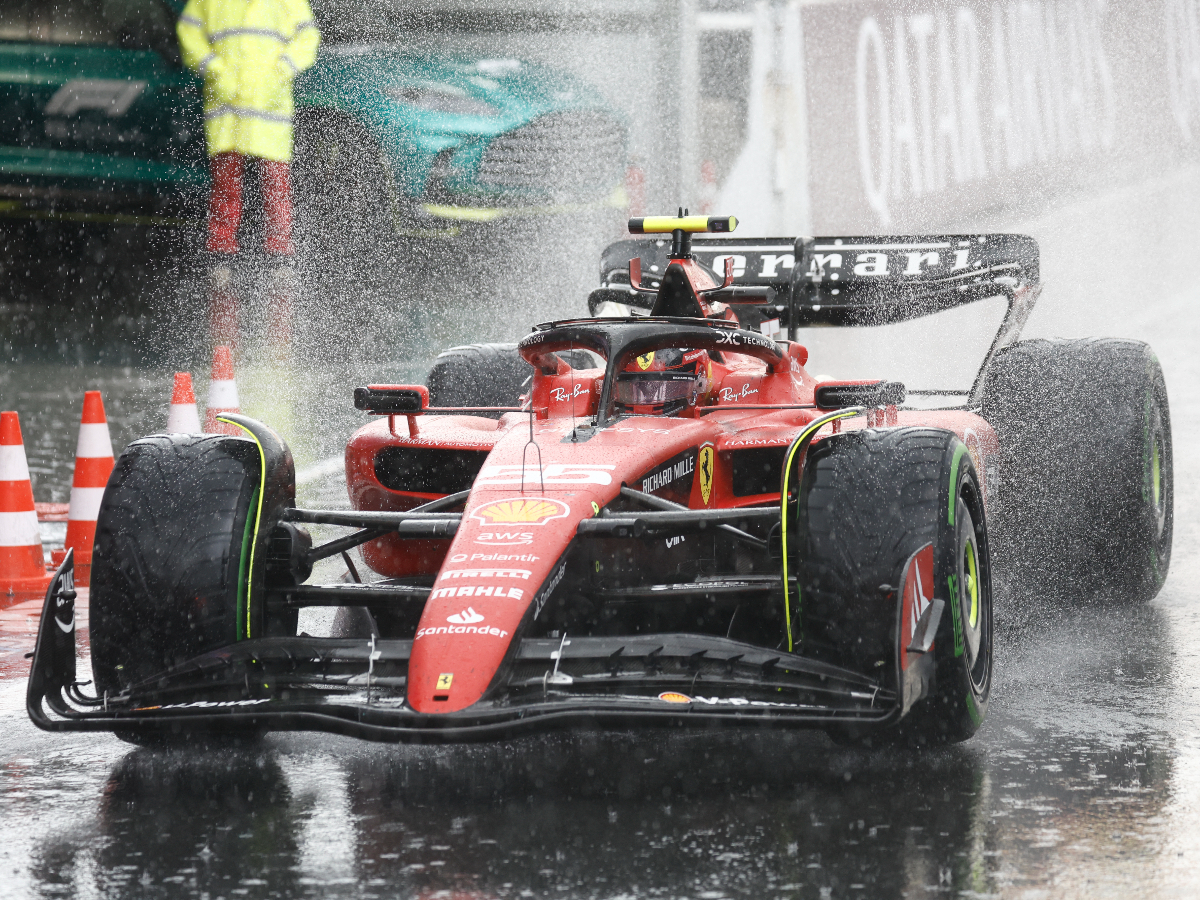
The 2026 Formula 1 season brings a completely new set of technical regulations. However, alongside these big aero changes, the FIA has also introduced a new “Rain Hazard” rule, allowing teams to adjust their cars under Parc Ferme conditions in wet-weather scenarios. Let’s explain this further.
The rule has been designed to prevent teams from facing technical disqualifications caused by unexpected rain, particularly due to the unique performance characteristics of the new 2026 cars.
According to the FIA rulebook, “If the Official Weather Service predicts that the probability of precipitation is greater than 40% at some point during the Sprint or the Race at a Competition, or at the sole discretion of the Race Director, a ‘Rain Hazard’ may be declared.”
When such declaration can be made?
During Sprint Weekend, Rain Hazard must be declared no later than two hours before the start of Sprint Qualifying, and it will remain in force until the end of the Sprint session.
For the Regular race weekends, the declaration must be made no later than two hours before the start of Qualifying, remaining in effect until the race session ends.
The FIA also clarified that when a car is under Parc Fermé conditions during a Rain Hazard, certain adjustments are allowed.
“When an F1 car is deemed to be in Parc Fermé whilst a Rain Hazard is in force, other than when the cars are sealed in accordance with Article B3.4.2 or B3.4.3, the work described in FIA-F1-DOC080 may be carried out,” the rulebook reads.
What changes teams can make
Under the Rain Hazard rule, teams are allowed to modify specific parts of the car that are normally restricted under Parc Ferme rules. This prevents them from having to start from the pit lane if conditions suddenly change.
Ride Height: Teams can increase the car’s ground clearance to avoid excessive plank wear, which could otherwise lead to disqualification. This is particularly important for the 2026 cars due to their new active aerodynamics systems.
Front Wing Angle: Teams are also permitted to adjust the front wing incidence, helping them manage downforce levels more effectively in wet conditions.
The main objective of the Rain Hazard rule is to protect teams from penalties if they set up their cars for dry conditions but are forced to race in the rain. The 2026 F1 season will also see a new amber lights located on the wing mirrors of the car.
These lights will act as hazard flashers on a road car to improve safety during low-visibility conditions like heavy rain. They allow other drivers to see a car from the front and sides, which is crucial if a car spins and is sitting sideways in water spray. Read more about the F1 new lights here.
What is Parc Ferme in F1?
Also Read: F1 Australian Grand Prix FP2 Report: Oscar Piastri Fastest as Mercedes and Ferrari Stay in the Fight




