
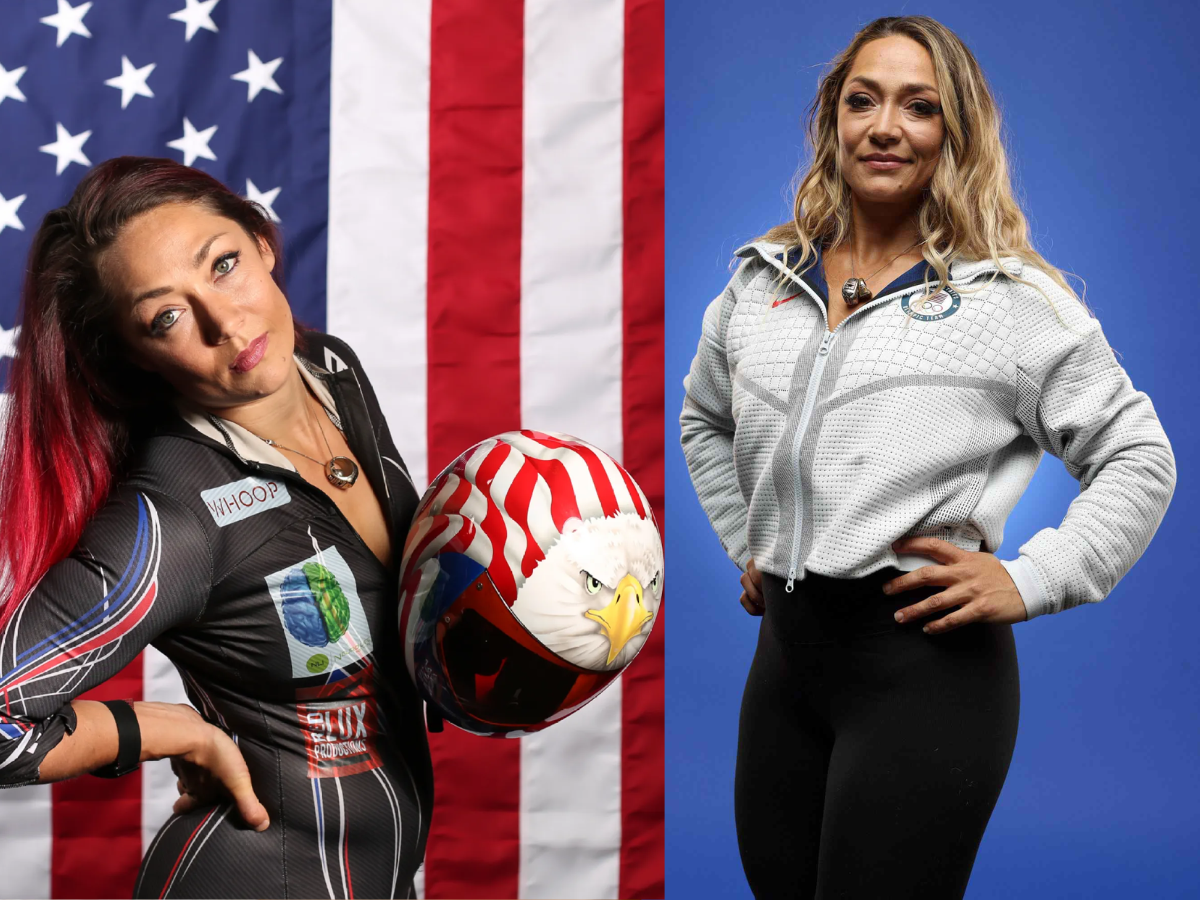
Few moments involving an Olympic dispute can feel as personal as this one over Katie Uhlaender at age 41 years, after more than two decades of competing on the ice, American skeleton racer Uhlaender isn’t just seeking a place on the team-she’s fighting a principle: that it should be based on performance, not manipulation. One event at Lake Placid has ignited an international conversation, entailed Olympic officials and led the United States Olympic and Paralympic Committee to seek extraordinary action ahead of the Milan-Cortina Winter Games.
Who is Katie Uhlaender
Katie Uhlaender has been a stalwart presence in the American sliding sports since time immemorial. Born on July 17, 1984, carrying the U.S. flag in five Winter Games and competing in the international arena since 2003, she has two world titles and six World Championships medals. She has long been viewed as one of the sport’s most consistent and reliable performers-even as new generations reshaped the field around her.
Katie Uhlaender Educational Background
Most of Uhlaender’s schooling has remained private, which is related to her early focus on high-level sport. Similar to many Olympic competitors, during those formative years, her time was split between continuous training and schoolwork. The significant takeaway isn’t a degree or an institution’s name but a robust, practical understanding of sport science, injury rehabilitation, and anti-doping policy-the fields in which she has emerged as an outspoken advocate.
Katie Uhlaender Family
Sport seems to run in the blood in the Uhlaender family. Uhlaender’s father not only made it to the Major League Baseball team but also spent a significant measure of his career as a coach in the highest echelon. After Uhlaender’s father passed away in 2009, the latter started competing in events while wearing her father’s ring from the 1972 National League Championship on a necklace. Uhlaender’s relationship with her mother, Karen, has been rather complicated. After years of alienation from each other, the latter finally made a public reconciliation at the 2018 Olympic Games.
Katie Uhlaender Husband
Uhlaender has maintained privacy when it came to her personal life; she either does not have a husband or spouse. According to Uhlaender, this fits well with her pattern of having her career define her image.
Katie Uhlaender Career
- Began competing in skeleton racing in 2003, quickly rising through the international ranks
- Won the Skeleton World Cup overall title twice in back-to-back seasons (2006–07 and 2007–08)
- Earned six medals at the FIBT World Championships, including two gold medals in 2012
- Represented the United States at five Winter Olympics: 2006, 2010, 2014, 2018 and 2022
- Finished sixth at the 2006 Turin Olympics, her first Olympic appearance
- Overcame a serious knee injury in 2009, requiring four surgeries and returned to elite competition
- Competed at the 2010 Vancouver Olympics, placing 11th despite limited preparation after surgery
- Narrowly missed an Olympic medal at the 2014 Sochi Games, finishing fourth by 0.04 seconds
- Took part in U.S. Olympic weightlifting trials in 2012, despite limited experience in the sport
- Explored track cycling after stepping away from skeleton during the 2014–15 season
- Returned to skeleton and competed at the 2018 PyeongChang Olympics
- Became a prominent anti-doping advocate, testifying before the U.S. Helsinki Commission in 2018
- Continued competing into her 40s, remaining among the world’s top-ranked skeleton athletes
- As of early 2026, actively contesting qualification for what would be her sixth Olympic Games
Katie Uhlaender Net Worth
There is no confirmed public estimate of Uhlaender’s net worth and she has earned money through prize money, national team funding, and early sponsorships with companies like Nike and Liberty Mutual. She was featured in marketing campaigns for Liberty Mutual and Nike between 2009 and 2014.
Katie Uhlaender Controversy
Essentially, the controversy is based on an event held in January during the World Cup event in Lake Placid, where Uhlaender won and was given only 90 points instead of the usual 120 due to last-minute withdrawals from competitors, which she believes was an attempt to reduce competitors possibilities to accumulate additional points from non-program competitors.
Olympic Officials warn incident damaged integrity of Qualification Process
In a letter to IOC president Kirsty Coventry, the USOPC argued that the incident undermined the spirit of Olympic qualification. While the International Bobsleigh and Skeleton Federation ruled no written rules were violated, it acknowledged ethical concerns and recommended future reforms. That acknowledgment alone signals the seriousness of the episode.
Katie Uhlaender misses Olympic cut by 18 points amid fair play dispute
The consequences were immediate. Despite winning on the track, Uhlaender fell 18 points short of overtaking teammate Mystique Ro due to national quota limits. In a sport measured in hundredths of a second, the margin was devastatingly small.
USOPC appeals for discretionary Olympic spot after disputed Lake Placid Race
The USOPC has now requested a discretionary Olympic berth for Uhlaender, arguing that exceptional circumstances warrant an exceptional remedy. The committee described her inclusion as a matter of fairness and competitive integrity, not favoritism. The case has already exposed gaps in how Olympic qualification handles strategic manipulation and it may reshape the rules long after this season ends.




