
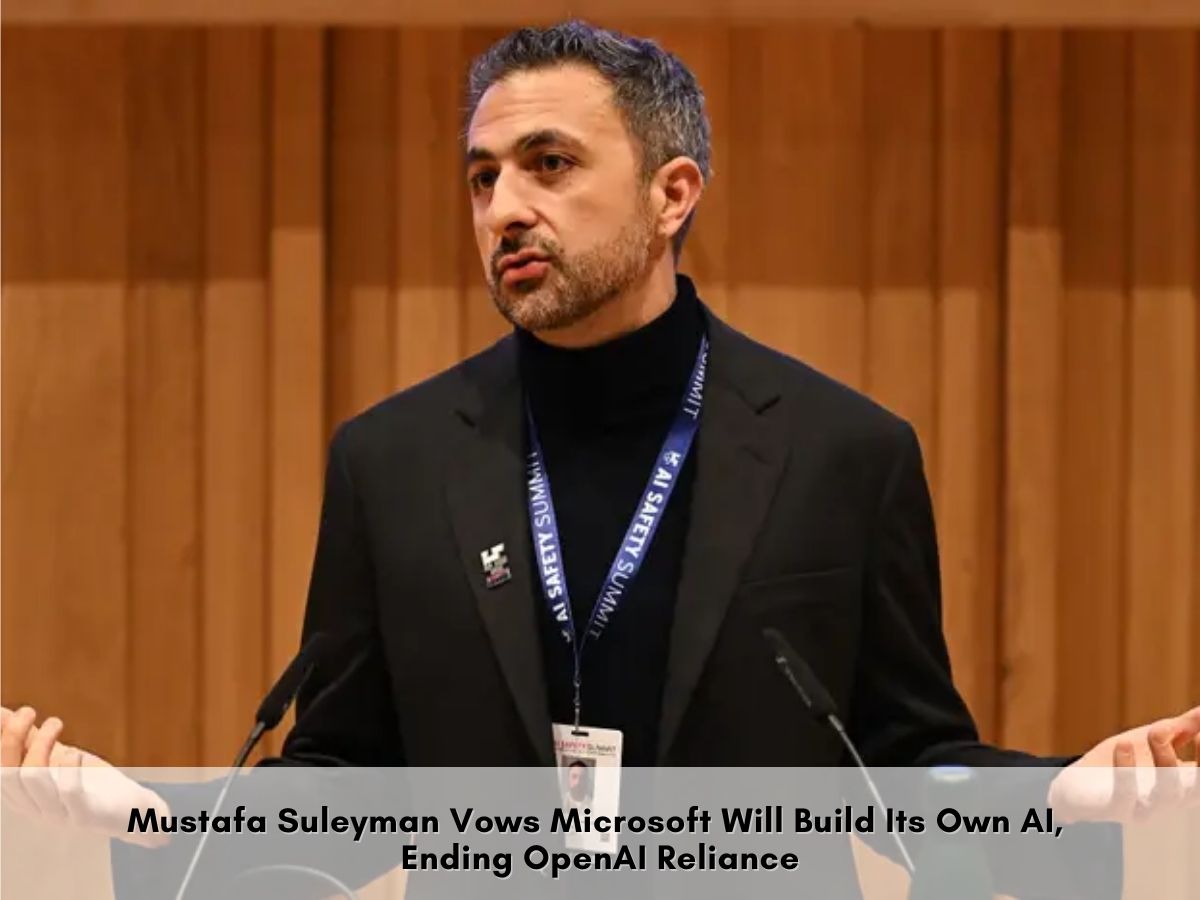
Microsoft AI chief Mustafa Suleyman has shaken the tech world by saying the company wants “true AI self-sufficiency,” showing a clear shift toward building its own advanced models and cutting dependence on longtime partner OpenAI. Suleyman, a co-founder of Google DeepMind who joined Microsoft in March 2024, told the Financial Times that creating in-house superintelligence is now his personal mission at the company right now.
Who Is Mustafa Suleyman and Why Does His Statement Matter?
At 41, Mustafa Suleyman leads Microsoft AI, a division launched in March 2024 that handles consumer tools including Copilot, Bing, and Edge. His recent claim that Microsoft needs to develop its own “frontier foundation models using gigawatt-scale computing” signals a clear break from the company’s long-standing dependence on OpenAI’s technology for advanced AI systems.
Suleyman’s credentials give his words weight. In 2010, he co-founded DeepMind Technologies with Demis Hassabis and Shane Legg, which Google acquired in 2014 for approximately £400 million. After leaving Google in 2022, he co-founded Inflection AI with Reid Hoffman before Microsoft acquired much of the team in a $650 million deal.
“My personal mission at Microsoft is to build superintelligence,” Suleyman stated, adding that the company now possesses “some of the very best AI training team in the world” to accomplish this goal.
What Does ‘True AI Self-Sufficiency’ Mean for Microsoft’s OpenAI Partnership?
The remarks come months after Microsoft and OpenAI reworked their major partnership in October 2025. The agreement turned Microsoft’s profit-sharing rights into a 27% ownership stake in the newly created OpenAI Group PBC, valued at about $135 billion, while extending IP rights to OpenAI models until 2032.
The restructuring gave both companies freedom to operate independently. Microsoft secured the right to pursue artificial general intelligence (AGI) alone or with third-party partners. Suleyman confirmed Microsoft’s in-house models will launch “sometime this year,” building on the August 2025 preview of MAI-1-preview, trained on approximately 15,000 Nvidia H100 GPUs.
Why Is Microsoft Reducing Its Dependence on OpenAI Now?
Investor concerns have accelerated Microsoft’s push for independence. During the company’s recent earnings call, Jefferies analyst Brent Thill flagged that OpenAI represents 45% of Microsoft’s backlog of future sales, calling it a “durability” and “exposure” concern. The following day, Microsoft shares lost $357 billion in market value—a historic single-day decline tied partly to these dependency fears.
Microsoft has already been quietly diversifying its AI supplier base, now hosting models from xAI, Meta, Mistral, and Black Forest Labs in its data centers.
Mustafa Suleyman’s Background
Suleyman’s path to leading Microsoft’s AI efforts is unconventional. Born in London to a Syrian taxi driver father and an English NHS nurse mother, he grew up in subsidized housing. His parents separated when he was 16, leaving him and his younger brother to live independently.
At 19, Suleyman dropped out of Oxford University’s Mansfield College, where he studied philosophy and theology, to co-found the Muslim Youth Helpline following the 9/11 attacks. The organization became one of the UK’s largest mental health support services for young Muslims.
Even with this context, Mustafa Suleyman has risen to become one of tech’s most powerful executives. He argues for “humanist superintelligence,” or AI that remains guided by humans. His 2023 book, The Coming Wave, which Bill Gates described as his “favorite book about AI,” looks closely at the dangers and possibilities of emerging technologies.
Mustafa Suleyman Wife: Is He Married?
Suleyman keeps his personal life private. There is no public record of Mustafa Suleyman being married or having a wife.
Mustafa Suleyman Net Worth
Estimates of Mustafa Suleyman’s net worth vary. In Indian Rupees, his wealth is estimated to be in the range of ₹3,600 crore to ₹4,500 crore, which translates to approximately $400 million to $500 million in US dollars.
His fortune derives from multiple sources: the £400 million acquisition of DeepMind by Google, his stake in Inflection AI which raised $1.3 billion before Microsoft’s acquisition deal, and his current compensation package as CEO of Microsoft AI. His annual salary at Microsoft is estimated at ₹90 crore to ₹160 crore ($10 million to $18 million).
Mustafa Suleyman Religion
Although Suleyman grew up in a strict Muslim household and co-founded the Muslim Youth Helpline at age 19, he describes himself as a “strong atheist.” He has stated that he became non-religious during his time at university.
Mustafa Suleyman Education
Suleyman attended Queen Elizabeth’s School, a boys’ grammar school, before enrolling at Mansfield College, Oxford, to study philosophy and theology. He dropped out in his second year at age 19 to start a non-profit organization.
Mustafa Suleyman Family: Who Are His Parents?
He was born in London to a Syrian father who worked as a taxi driver and an English mother who was a nurse for the National Health Service. His parents separated when he was 16, after which he and his younger brother lived independently.
How Will Microsoft’s Superintelligence Efforts Differ From OpenAI’s?
Suleyman has unveiled a dedicated Microsoft AI Superintelligence Team focused on building systems that can eventually outperform humans across all tasks while maintaining strict safety protocols. He emphasizes that Microsoft’s approach will prioritize “containment” and human oversight.
“We must only bring into the world systems that we are confident we can control and that serve us in a subordinate way,” Suleyman said.
Microsoft projects capital expenditures of $140 billion in the current fiscal year to expand AI infrastructure, despite investor concerns about an AI “bubble” that has pushed Microsoft shares down more than 13 percent over the past month.




