James Webb captures Helix Nebula’s intricate filaments, revealing how dying stars recycle gas and dust to form future planets.
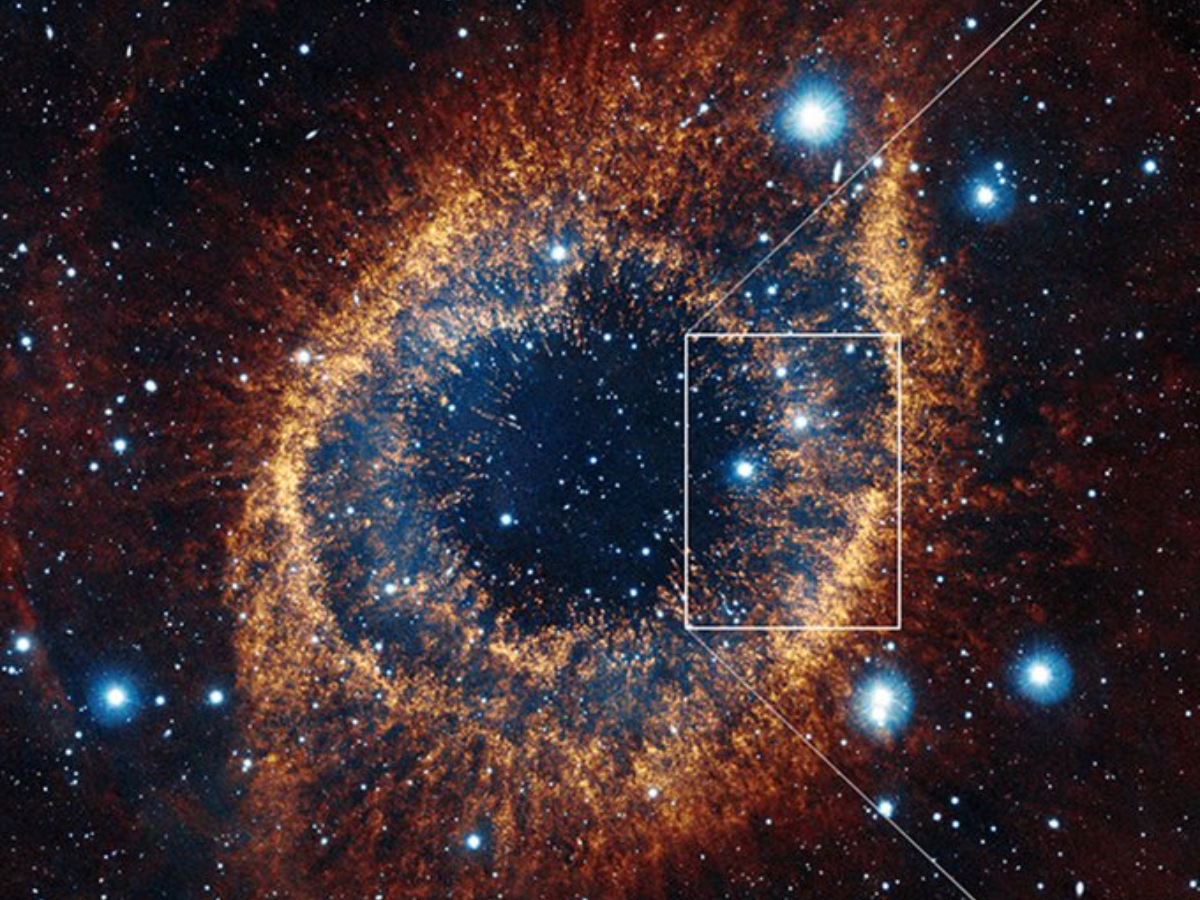
Infrared view of the Helix Nebula by JWST shows fiery filaments, cometary knots and colorful molecular clouds surrounding a dying star (Photo: X)
James Web Telescope: NASA has released a beautiful new image of a stunning vista of the Helix Nebula in infrared light from NASA’s James Webb Space Telescope. "The Eye of God" is a lovely name for this nebula, which resides 650 light-years away in planet Earth’s direction in the constellation of Aquarius. The nebula is a planetary nebula, which consists of a star to which life has been supplied on a vast scale as a grand finale to a stellar career near the end of its life cycle.
The Near-Infrared Camera of the JWST has observed that there are thousands of brighter knots of gas, which are arranged like pillars, referred to as cometic knots, which emerge from the inner ring of this nebula. The glowing feature, which encompasses high-speed winds from a dwindling star colliding with slower, colder shells that have been shed while the star was at an earlier stage, was compared to a cosmic lava lamp, as it shines a hypnotizing view of a star in its final days, where the blue indicates hotter gas close to the star, yellow indicates warmer molecular cloud, while red points to colder, dustier cloud areas.
In five billion years or so, the sun too would undergo the same change. Instead of shedding all the outer shells, the sun would transform into a dense white dwarf. The research on the helix nebula provides an insight into the re-processing of matter within the universe and how life begins again. Ultimately, the ending and beginning come within the context of the larger picture of evolution.
The center of the Helix Nebula is home to a white dwarf, a star that is hot, compact, yet dim and it is not immediately visible just outside the picture, but its power is responsible for the bright dots because of its interaction with nearby stellar material. The interaction between fast-moving stellar material, known as stellar winds and that shed thousands of years ago creates a three-dimensional dance, like the appearance of oil swirling into water.
The colors of the nebula, while aesthetically pleasing to our eyes, also reveal something of the temperature and the molecular structures present. Blue colors close to the core indicate the presence of hot gases, while the presence of the color yellow is associated with molecular hydrogen, said to be the coolest of the colors. The “knots” of dust, where these molecular structures come to clump together, also reveal where these molecular interactions occur, in the quest to create new worlds.
A cometary knot is a small dense area in the Helix Nebula full of dust and gas. It is a small column shaped like a pillar, with a long wispy cloud of gas trailing away from a star. A cometary knot forms when high-speed stellar winds impact a slower-moving previously expelled material. A cometary knot emits infrared radiation, which reveals in detail a star’s lively, active, chaotic nature as it nears the end of its lifespan, creating its appearance in the sky.
A planetary nebula breaks apart a dying star, sending it back into the universe as a mix of gas and dust an at the same time, they provide the building materials from which new life can spring. The dissemination of elements and molecules provides a crucial element to the continuous cycle of birth and transformation in the universe.
