What are the 17 rare earth elements? Why are they critical for EVs, phones, and defense? This 2026 explainer covers their uses, why supply is strategic, and the global race for new sources.
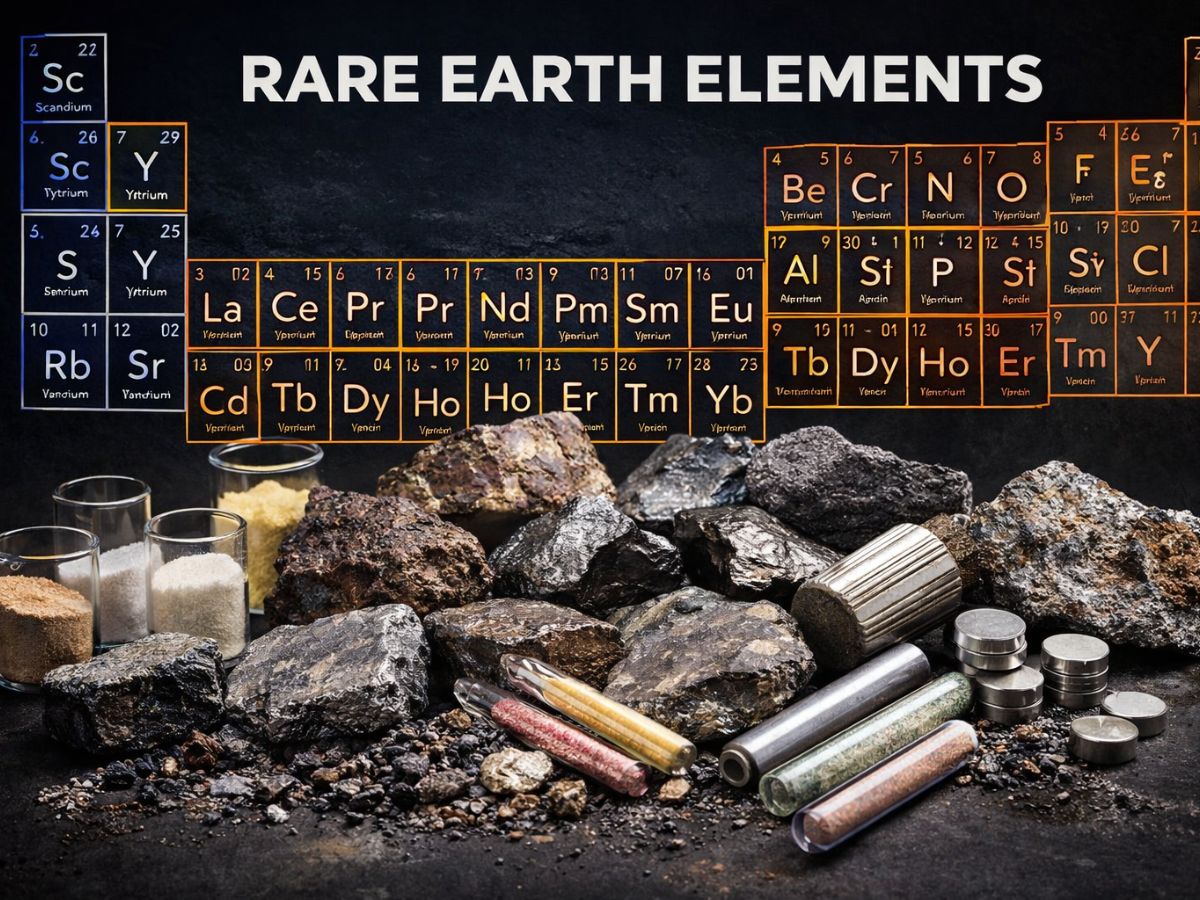
Why rare earths are not rare: The real challenge is mining and processing them (Image: Ref)
Rare earth elements are a group of 17 metals that underpin modern technology, enabling gadgets ranging from smartphones to military aircraft.Their supply is extremely concentrated despite their relative abundance, placing them at the epicenter of global geopolitical and economic conflict.
The term rare earth elements (REEs) refers to 17 metallic elements with unique magnetic, luminescent, and electrochemical properties. These elements are vital to the miniaturization and performance of modern technology. In addition to scandium and yttrium, which are grouped together because of their comparable chemical activity and frequent co-occurrence in nature, the group comprises the 15 lanthanides.
The term "rare earth" is a historical misnomer. In the Earth's crust, these elements are comparatively common—cerium is just as frequent as copper. They are deemed "rare" for three pragmatic reasons:
They are mostly used in the production of high-strength permanent magnets, which make up around 45% of the world's demand. These magnets are essential in a number of crucial industries:
Green Energy: For motors in electric vehicles and generators in wind turbines.
Electronics: In smartphones, computers, and high-definition displays.
Defense: In precision-guided weapons, radar systems, and jet engines.
Healthcare: In MRI machines and advanced medical lasers.
Their importance is twofold: technological and geopolitical. In terms of technology, they facilitate the global energy transition and the development of digital technology. Supply is highly concentrated geographically. An estimated 70–90% of the global supply chain is under Chinese control as of 2026. Due to this concentration, major economies such as the United States, Australia, Brazil, and India have launched "National Critical Mineral Missions" to develop alternative mining and processing operations.
According to 2026 estimates, China holds the largest reserves (44 million metric tons), followed by Brazil (21 million MT) and India (6.9 million MT). Major developments this year include Australia’s Lynas Rare Earths increasing output at Mt Weld, the United States moving ahead with domestic magnet manufacturing, and Japan launching deep-sea mining trials. India’s 2026 budget is also expected to support hundreds of new exploration projects to strengthen its domestic sector.
