
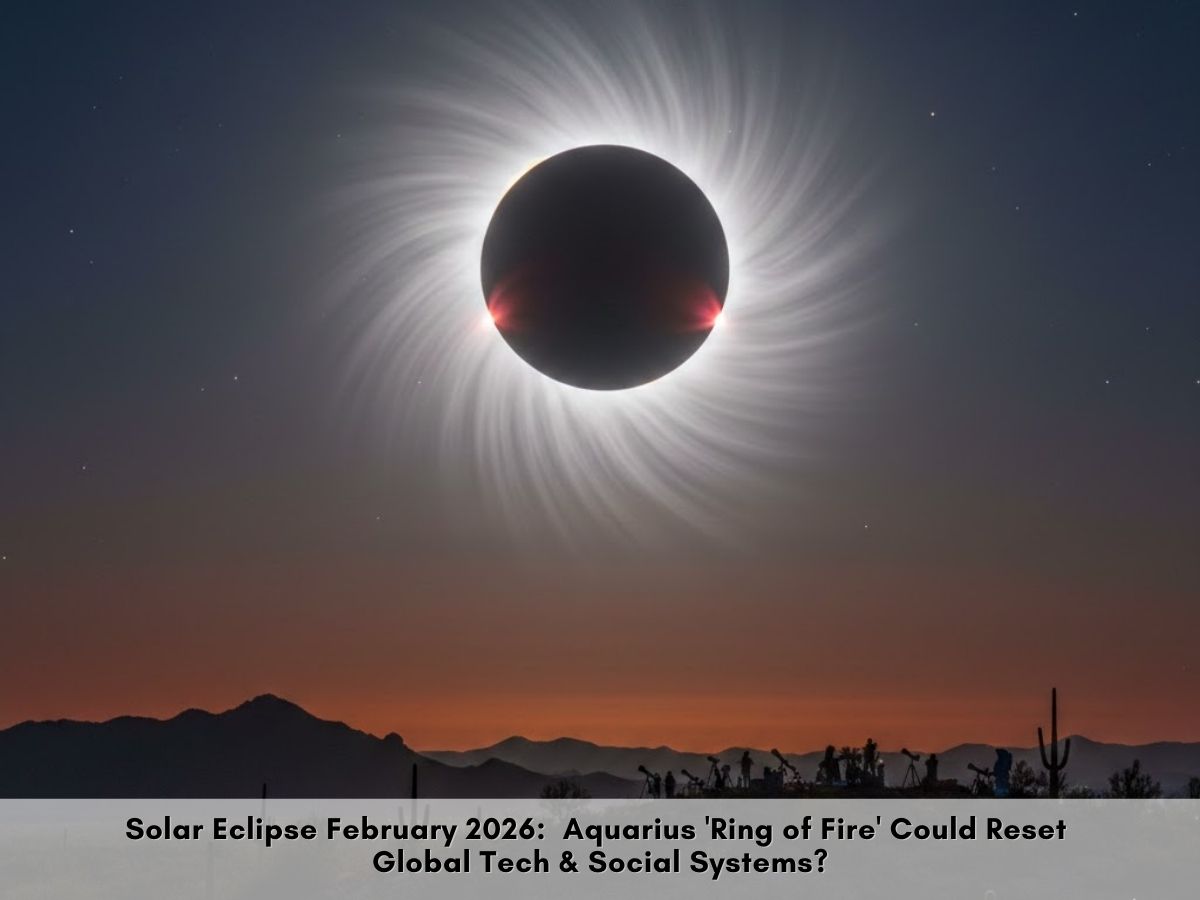
Solar Eclipse Today: Astrological experts say the powerful solar eclipse in Aquarius on February 17, 2026, could lead to worldwide reforms, major tech advancements, and the removal of outdated structures. The event is seen as a turning point for political alliances, economic changes, and innovation.
What Makes This Solar Eclipse Different From Others?
The February 17 eclipse occurs in Aquarius, the sign governing innovation, reform, and collective movements. Professional astrologer Ksenia Bazylenko told UNN that this positioning fundamentally challenges outdated structures while accelerating acceptance of new technologies.
“Aquarius is always about the future, reform, and new technologies. During this period, new things are accepted, and old systems that no longer work are destroyed,” Bazylenko said. “There may be a sharp leap forward, or revolutionary sentiments, protests, and demands for freedom may take hold.”
How Will the Eclipse Reshape International Politics?
The eclipse’s Aquarius energy emphasizes friendship, mutual understanding, and ideological unity—qualities that may manifest as unexpected international partnerships forming over the coming months.
“In the near future, new alliances and forms of cooperation may actively form in the political sphere—sometimes unexpected, sometimes very bold,” astrologer explained.
The eclipse takes place during the start of the Chinese New Year, making it particularly significant for Asia. This convergence is believed to heighten its impact, with China expected to emerge as a strong force in global politics over the next six months.
What Does the Saturn-Neptune Conjunction Mean?
A rare astrological configuration involving Saturn and Neptune meeting at the first degree of Aries adds unprecedented complexity. This conjunction occurs at the zodiac’s “zero point,” which represents new beginnings.
Saturn represents systems, laws, and structures, whereas Neptune oversees spirituality, dreams, and ideas. Their meeting in Aries, the sign of action and implementation, suggests concrete manifestations of new belief systems.
“This combination suggests that in the coming years, interesting modern ideas, built on a new ideology and a new perception of the world, can actually be implemented,” reports explained.
Where Will Financial Changes Occur Most Dramatically?
The eclipse’s karmic axis involves Rahu with Venus in Pisces, creating conditions for significant financial restructuring. This pattern predicts changes in how money moves throughout the world, with the possible rise of new affluent figures.
“Earning opportunities may change, resources may be redistributed, new wealthy figures, millionaires, and new centers of influence may appear,” reports said. Financial changes appear linked to humanitarian concerns. Charity and care become powerful factors in international decisions.
Which Technological Sectors Will Experience Acceleration?
The eclipse is believed to mainly influence countries that are actively investing in technology. Rapid growth is expected in artificial intelligence, energy solutions, defense technology, and healthcare innovation.
What Infrastructure Risks Require Attention?
The eclipse period carries warnings about specific vulnerabilities across multiple sectors.
Aviation Sector: Increased accident risks and operational tensions may affect air travel.
Information Systems: Periodic internet outages and communication failures could affect individual countries.
Energy Grids: Electricity systems, particularly nuclear facilities, may experience tension.
Water Resources: Flood risks, accidents involving water, and broader water management issues may arise.
Public Health: Epidemic themes may emerge, though medicine could simultaneously advance.
Solar Eclipse 2026: Key Dates
| Date | Type | Visibility Highlights |
|---|---|---|
| Feb 17, 2026 | Annular Solar | Antarctica, S. Africa, S. America |
| Mar 3, 2026 | Total Lunar | N. America, E. Asia, Pacific |
| Aug 12, 2026 | Total Solar | Greenland, Iceland, N. Spain |
Where Will the February 17 Solar Eclipse Be Visible?
- The annularity’s 2,661-mile course passes through Antarctica, where 96% of the sun will be hidden.
- Partial phases will be visible across southern Africa including Zimbabwe, Namibia, and South Africa.
- Southern tips of Argentina and Chile, plus islands such as Mauritius, will also see partial phases.
Will the Solar Eclipse Be Visible in India?
No, India lies completely outside the visibility path. The Southern Hemisphere dominates the shadow, and Indian viewers can tune into NASA live streams instead.
What Predictions Reveal on Major Countries?
United States: Uranus activation may make America a primary driver of global restructuring. Tax system revisions, cash flow redistribution, and financial technology development including cryptocurrencies may emerge. Internal tension between reform momentum and stability requirements is likely.
Ukraine may see wide-ranging political changes over the coming six months. While international backing is likely to continue, it may be more conditional. At the same time, energy infrastructure may face new risks, even as alternative energy alternatives emerge as export potential.
Russia may undergo power shifts, including leadership reorganization. Lawmaking is expected to move in a more conservative direction, tightening internal oversight. Meanwhile, international isolation may intensify and domestic tensions could result in protests.
Eclipse Timing Details
The eclipse begins at 4:56 a.m. EST (9:56 UTC), reaches maximum annularity at 7:12 a.m. EST (12:12 UTC), and concludes at 9:27 a.m. EST (14:27 UTC). In Indian Standard Time, this corresponds to approximately 3:26 p.m. to 7:57 p.m.
Disclaimer: The insights in this article represent collective analysis drawn from astrological forecasts, including those provided by Ksenia Bazylenko to UNN, and synthesized from multiple agency reports. TSG has not independently verified the sources or astrological interpretations presented herein.




