
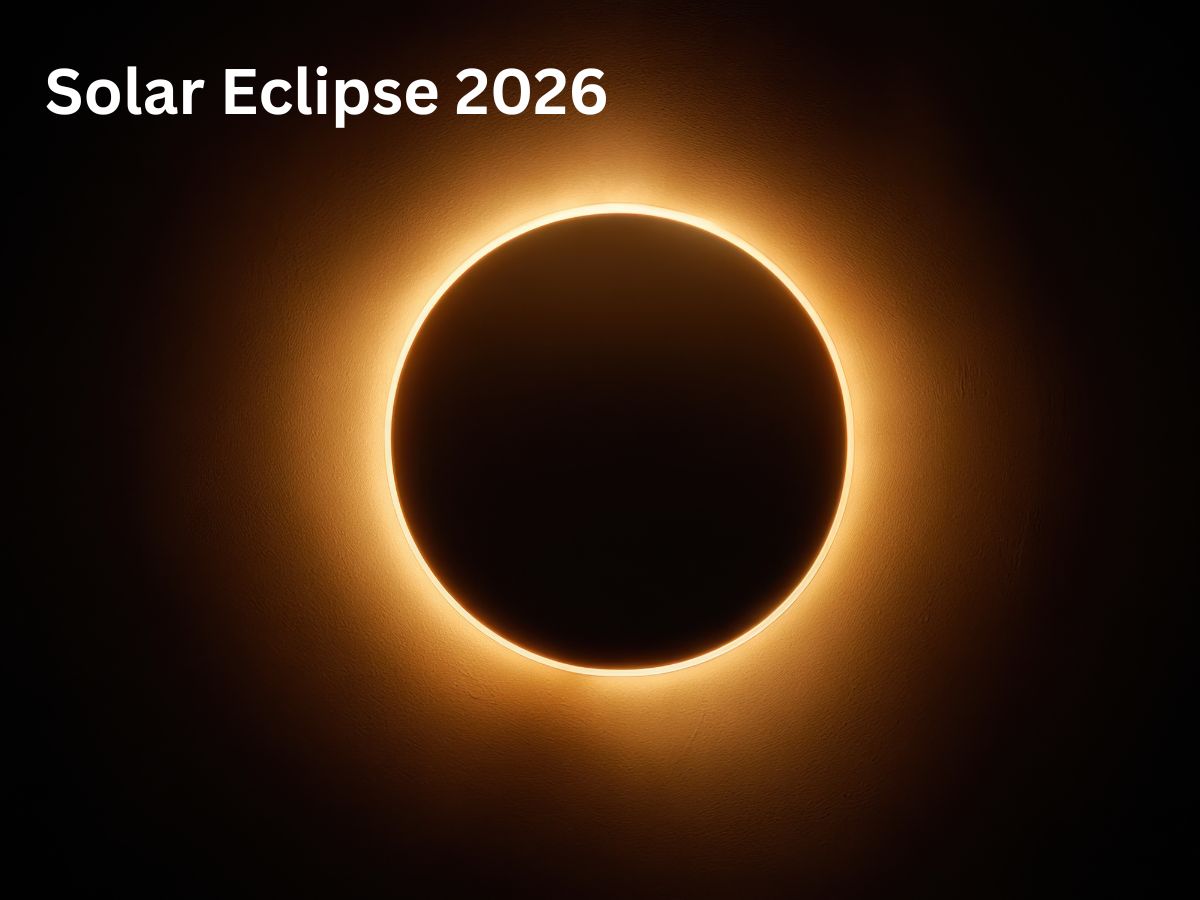
Solar Eclipse 2026: They are among the most fascinating celestial events, drawing worldwide interest from both astronomers and skywatchers. The year 2026 will feature two major solar eclipses: an annular eclipse in February and a total eclipse in August. The two events will show spectacular views that only selected areas will provide, but many Indians will question their ability to see these uncommon events.
Solar Eclipse 2026 Date
The year 2026 will present two scheduled solar eclipses.
The first event will occur on February 17, 2026, when an annular solar eclipse (popularly called the “Ring of Fire”) will take place.
The second event will occur on August 12, 2026, when a total solar eclipse will happen as one of the most awaited astronomical events of the year.
Solar Eclipse 2026 Time
The February 17 annular eclipse (GMT) has its partial phase starting at 09:56, while its annularity period runs from 11:42 until 12:41, with its maximum point occurring at 12:12 and its complete event finishing at 14:27.
The August 12 total solar eclipse (UTC) begins its partial phase at 15:34, while totality takes place from 16:58 until 18:34, with the peak occurring at 17:46 and the conclusion happening at 19:57.
Solar Eclipse 2026: Visible from India?
No. The February and August 2026 solar eclipse events will not be visible from India.
Solar Eclipse 2026: Visible from Other Countries?
The February 17 annular eclipse will be partially visible in southern Africa, far southern South America, and most of Antarctica, with annularity limited to remote Antarctic regions and the Southern Ocean.
The August 12 total eclipse will show its visibility along a path between the Arctic and Greenland, Iceland, northern Spain, and extreme northeastern Portugal, while nearby areas will show partial views.
Solar Eclipse 2026: Who Can See?
Antarctica and southern Africa and southern South America (February) and Greenland and Iceland and northern Spain and Portugal (August) present the best viewing locations, which depend on weather conditions.
Solar Eclipse 2026: Dos & Don’ts
- You should use certified solar filters, eclipse glasses, or pinhole projectors as your viewing methods. You must use trustworthy astronomy applications to determine your precise local time.
- The Sun should never be viewed without proper protective equipment, according to this rule. The traditional restrictions that India follows in this case lack a scientific basis because the eclipses are not visible.
The upcoming solar eclipses in 2026 will deliver breathtaking astronomical displays to multiple countries, but India will depend on live streams and scientific updates for information.




