Viral videos of baby monkey Punch-Kan at a Japan zoo spark outrage, sympathy and debate online after clips show maternal rejection and bullying.
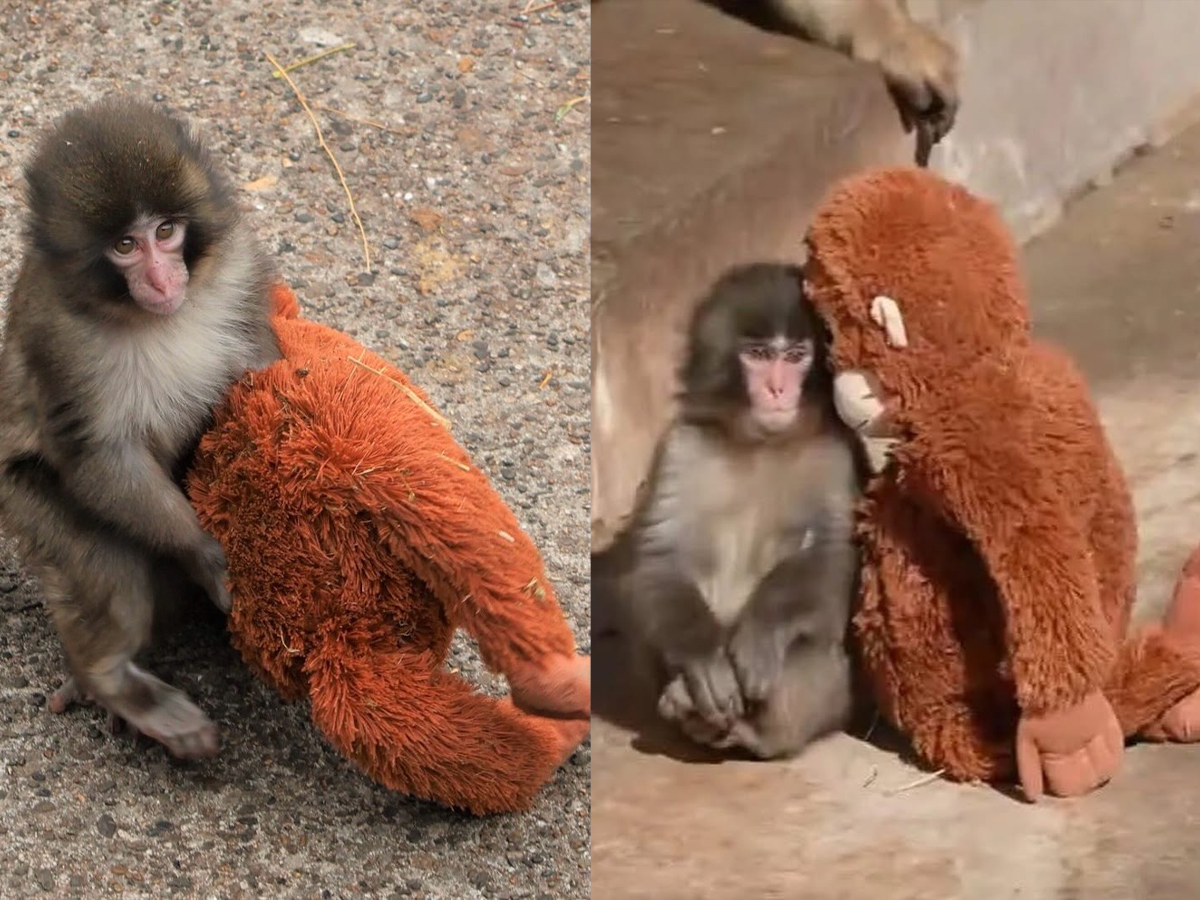
Punch-kan lives at Ichikawa City Zoo, where clips shared online captured moments that many viewers found deeply upsetting. (Photo: Social Media)
A small baby monkey in Japan has unexpectedly become the centre of a global online conversation about compassion, belonging, and care. Known as Punch-kan, the seven-month-old macaque has gone viral after distressing videos showed him facing violent rejection from his biological mother at a zoo, pushing thousands of social media users to express concern and demand action.
Punch-kan lives at Ichikawa City Zoo, where clips shared online captured moments that many viewers found deeply upsetting. In the videos, the infant monkey appears frightened as his mother drags and strangles him, prompting him to run toward a soft orange plush toy shaped like an orangutan in search of comfort.
Born in July, Punch-kan’s story spread rapidly after videos showed him clutching the toy tightly while trying to calm himself. The image of the baby macaque holding onto the plush amid chaos struck a chord with viewers, many of whom described the scenes as heartbreaking.
The story of Punch-kan, known as Punch, the baby monkey, who was rejected by his mother.
Punch, is a seven-month-old baby macaque monkey who inhabits the Ichikawa Zoo in Japan.
Born in July 2025, Punch had to swallow a harsh reality when his birth mother refused and abandoned… pic.twitter.com/DNS2LV5B7F— 👉M-Û-R-Č-H👈 (@TheEXECUTlONER_) February 19, 2026
#Baby #Punchi reminds us that even in the face of #rejection by your #tribe, there is always hope for acceptance. Even if it is by a #stuffed #monkey from #Ikea. #Punch is us, at our lowest moment.
— Olive Oil (@olivetheoil) February 19, 2026
pic.twitter.com/vQG7vO78mZ
Social media users compared Punch-kan’s situation to other viral animal moments that reflect emotional isolation. Some drew parallels with a previously viral penguin labelled “nihilistic,” whose solitary wandering sparked discussions about loneliness and escapism.
Amid the backlash, videos surfaced showing zookeepers handling Punch-kan with care. In some clips, he continues to cling to the plush toy even while being fed, suggesting it has become a source of emotional security.
Some updates claim Punch-kan has started interacting with other monkeys, though reports remain mixed. While a few adult monkeys appear more tolerant, others allegedly continue to intimidate him.
A separate wave of videos claims that Punch-kan has finally found support among other macaques. One widely shared clip shows an adult monkey embracing a younger one believed to be Punch-kan, with the caption, “Adult monkey Onsig wraps little Punch in a tight embrace.”
However, experts and users caution that several viral clips circulating online are generated by artificial intelligence, making it difficult to verify which videos reflect real events.
As the videos gained traction, calls for intervention grew louder. Many users urged zoo authorities to separate Punch-kan from his mother to prevent further harm.
“Punch’s story proves that belonging isn’t guaranteed just because you’re surrounded by your own kind,” wrote a user on X, formerly Twitter.
Others expressed emotional distress after repeatedly seeing updates about the baby monkey.
“I think I’m gonna have to mute Punch because I keep getting depressed, my heart genuinely breaks for this little monkey,” shared one user.
“I genuinely might have to put down the phone and go for a walk because I’m so overwhelmed with these developments over punch, the monkey,” felt another.
Several posts also criticised what they described as bullying behaviour from other monkeys in the enclosure, urging caretakers to take restorative steps.
Maternal rejection occurs when a parent neglects, abandons, or becomes aggressive toward their offspring. In macaques, this behaviour can arise due to evolutionary pressures, where a parent may favour a stronger or more viable infant.
Scientific research suggests that mothers who experienced abuse or rejection themselves may repeat the pattern. Studies also link such behaviour to hormonal imbalances, including low oxytocin and high cortisol levels, which can influence caregiving responses.
Punch-kan’s viral moment highlights how people connect deeply with stories of vulnerability, even across species. His struggle has triggered conversations not just about animal welfare, but also about loneliness, empathy, and the universal need for safety and care.
As debates continue online, many hope Punch-kan’s story leads to greater awareness and more humane responses — both inside the zoo and beyond it.
