
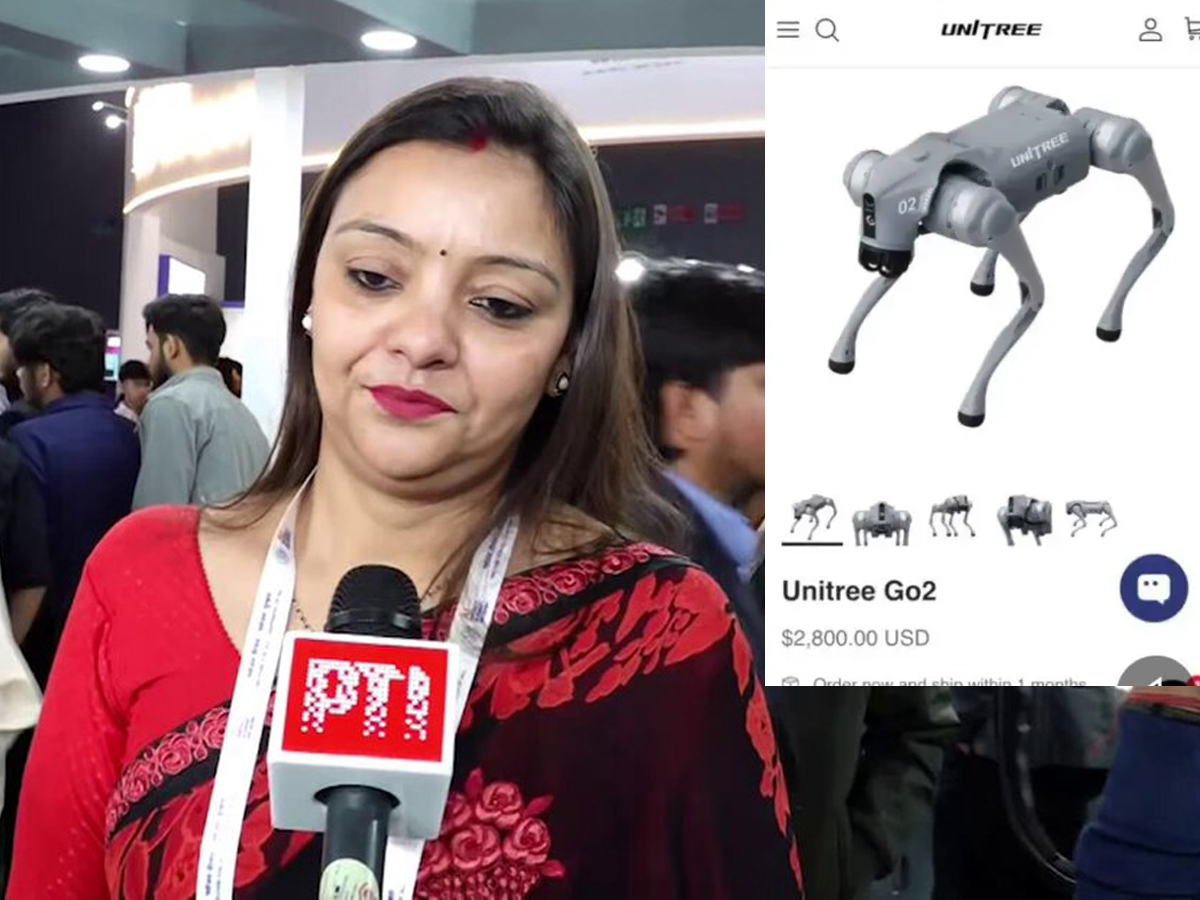
A technology showcase meant to celebrate artificial intelligence has unexpectedly turned the spotlight on an academic. After a robotic dog demonstration at the India AI Impact Summit 2026 in Delhi went viral, many people began asking one question: Who is Neha Singh of Galgotias University?
Assistant Professor Neha Singh has found herself at the centre of a national debate following allegations that a robot presented as an in-house innovation was actually a commercially available Chinese product. While the controversy continues to trend online, Singh’s academic journey tells a much deeper story.
Galgotias University AI Dog: Who is Neha Singh of Galgotias University?
Neha Singh is an Assistant Professor at Galgotias University, where she has been working since August 2023. She represents the university in artificial intelligence and robotics-related initiatives and has actively participated in academic and technology forums.
Before joining Galgotias University, she worked at Presidency University, Bangalore, and COER Roorkee, building her profile as a researcher and educator in computer science.
Her academic background reflects strong technical expertise. She completed her PhD from BITS Pilani Hyderabad Campus in 2020. Her doctoral research focused on Computational Geometry and Mesh Generation, particularly in areas like “Input Size Independent Quality Mesh Generation.” These topics play an important role in engineering simulations and scientific computing.
She also holds an MTech in Computer Science from ABV-IIITM Gwalior, one of India’s well-known technical institutes.
Galgotias University AI Dog: What Is the ‘Orion’ Robot Controversy from the AI Summit?
The controversy began at Bharat Mandapam during the India AI Impact Summit 2026. In a widely shared video, Singh introduced a four-legged robotic dog named “Orion.” In the footage, she said the robot was developed by the university’s “Centre of Excellence” and linked it to a Rs350 crore institutional investment.
Soon after the video went viral, technology experts and social media users identified the device as the Unitree Go2, a robot manufactured by the Chinese company Unitree Robotics.
The robot, which retails for around ₹2–3 lakh, is commercially available globally. Critics accused the university of presenting an imported product as a homegrown innovation.
Galgotias University AI Dog: Galgotias University’s Official Clarification
As criticism intensified, Galgotias University released an official statement distancing itself from claims that it built the robotic dog.
The university stated, “Let us be clear: Galgotias has not built this robodog, nor have we ever claimed to.” It further described the robot as a learning tool for students and called it “a classroom in motion.”
The administration defended its actions by stating that “innovation knows no borders” and dismissed the backlash as “negative propaganda.”
However, online users continued sharing the original video. A community note later labelled the university’s denial as misleading, citing the publicly available footage.
Galgotias University AI Dog: Academic Reputation and Research Work
Despite the ongoing controversy, Singh’s academic credentials remain significant. Her PhD research at BITS Pilani Hyderabad Campus focused on advanced computational methods used in simulations. Her work in mesh generation supports engineering analysis in multiple industries.
Her MTech degree from ABV-IIITM Gwalior further strengthens her profile as a technically trained computer science expert.
Colleagues describe her research domain as highly specialised and mathematically rigorous. Before the summit incident, she maintained a professional image within academic circles.
Galgotias University AI Dog: Why Is Neha Singh Trending Now?
Searches for “Neha Singh Galgotias University” and “Who is Neha Singh professor” have surged since the summit controversy. The incident has sparked debate not just about technology representation but also about academic accountability at high-profile government-backed events.
While the investigation and public discussions continue, the spotlight remains firmly on the assistant professor who became the public face of the university’s AI showcase.
The episode highlights how quickly a viral clip can reshape public perception, especially in the era of social media and fact-checking.




