
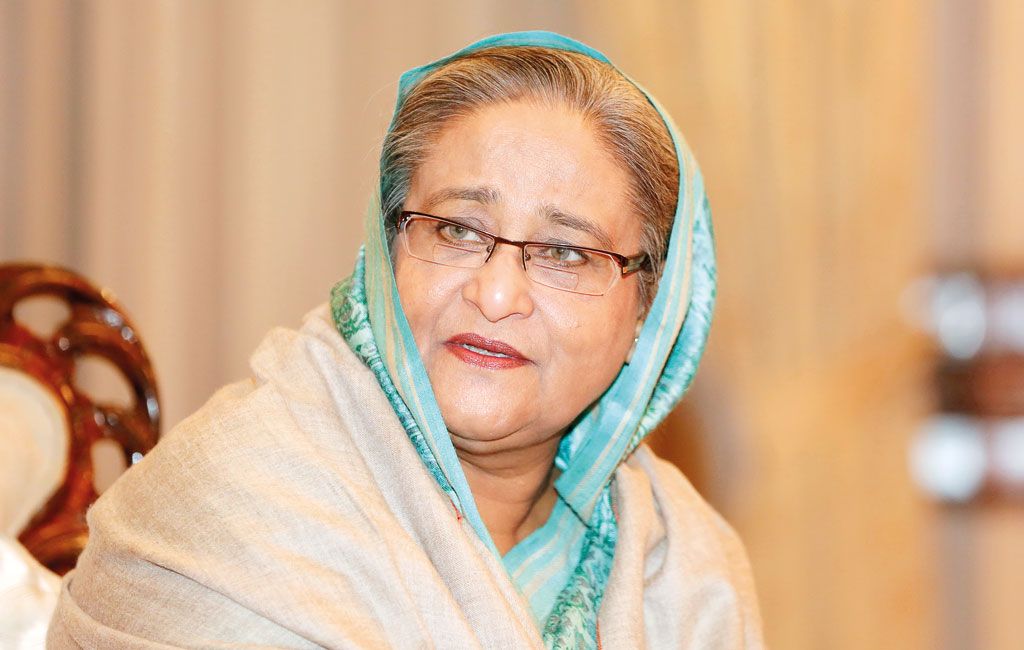
KOLKATA: A deep unease has gripped Awami League supporters living in exile after the International Crimes Tribunal in Dhaka sentenced former Bangladesh Prime Minister Sheikh Hasina to death for crimes against humanity linked to the 2024 student uprising. The verdict sparked outrage among the party’s leadership abroad, particularly in India, where several senior Awami League figures have taken refuge since August last year.
Speaking from an undisclosed location in Kolkata, Awami League general secretary and former Road Transport and Bridges Minister of Bangladesh Obaidul Quader denounced the judgment as “a travesty in the name of justice by a kangaroo court”. He said the verdict was politically motivated and aimed at permanently excluding Hasina and her party from Bangladesh’s political landscape. “The court does not have any legal sanctity. The case was built on false allegations with the sole intention to eliminate Sheikh Hasina and Awami League from electoral politics,” Quader said in a press statement issued hours after the tribunal’s announcement.
Since August last year, Awami League’s exiled leaders have built a vast underground communication network spanning India, Europe, and the United States. Using encrypted messaging platforms such as Telegram and virtual meeting tools, the network has reportedly mobilized over half a million supporters across Bangladesh. “We now have the capacity to reach five lakh party workers within an hour,” Quader confirmed, adding that the network was the result of “long, patient organizational work”. This intricate digital structure enabled the Awami League to enforce a lockdown across Dhaka last week, reportedly in response to deteriorating political conditions and arrests of party sympathizers.
“Many of us have been working from Kolkata, London, and Brussels for months,” said an Awami League organizer overseeing online coordination. “Virtual cells were created in each district to spread directives and keep morale up. The challenge now is sustaining discipline as pressure mounts,” said party activist and organiser Nayon Biswas Rocky.
On Monday, the special tribunal, headed by Judge Golam Mortuza Mozumder, found Hasina guilty on three counts: inciting violence, ordering lethal force, and failing to prevent atrocities during the 2024 student protests in Dhaka. The court, which initially considered a life sentence, later decided that “only one sentence the sentence of death would be sufficient”. Alongside Hasina, former interior minister Asaduzzaman Khan Kamal received a death sentence, while former police chief Chowdhury Abdullah Al-Mamun, who had pleaded guilty, was sentenced to five years in prison.
For many of Hasina’s allies who fled Bangladesh after August 5 last year, the verdict was anticipated but still unsettling. “It was pre-decided after Hasina went into exile. The interim Government under Muhammad Yunus has been desperate to destroy her political legacy,” a senior Awami League functionary told this newspaper after a meeting of the party’s central committee in Kolkata. “They used the judiciary as a political weapon this time. It is revenge for her efforts to uphold the spirit of 1971”.
The tribunal’s decision was immediately welcomed by the interim administration in Dhaka. In a statement, Chief Adviser Muhammad Yunus said: “The conviction and sentencing affirm a fundamental principle: no one, regardless of power, is above the law”.
Bangladesh’s foreign ministry has since asked India to extradite Hasina and Kamal under the bilateral extradition agreement. The request has placed New Delhi in a delicate position between maintaining diplomatic balance and responding to humanitarian pressures. India’s Ministry of External Affairs said it had “taken note” of the verdict and reiterated that India remains “committed to the best interests of the people of Bangladesh, including peace, democracy, inclusion, and stability”. However, Dhaka warned that granting asylum to “convicted war criminals” would be viewed as “a grave unfriendly act”.
Within hours of the court’s ruling, Awami League leaders in exile announced plans for mass protests in Bangladesh. “We are not surprised, but we reject this judgment outright,” Quader declared. “The regime in Dhaka is afraid of the people’s awakening. This desperate move to silence dissent will fail”. The exiled leadership also plans to seek Hasina’s approval to launch a “march to Jamuna” a symbolic movement aimed at “restoring democracy in the homeland”.
Hasina’s son, Sajeeb Wazed Joy, who is believed to be coordinating Awami League’s digital operations from Washington DC, called the entire process “a mockery of justice”. Speaking through a virtual broadcast, Joy accused authorities in Dhaka of engineering an illegal and biased trial. “This was done completely outside constitutional bounds,” he said. “The government is unelected and unconstitutional”. “They amended laws to fast-track this tribunal without a functioning Parliament”. “Seventeen judges were sacked and replaced, including one who had publicly made hateful remarks about my mother”. “She was denied legal representation our lawyers were barred from appearing in court. It is an absolute sham”.
As tensions rise, the atmosphere among Awami supporters in India remains tense and uncertain. “We are extremely worried. A death sentence not only targets Hasina personally but threatens our entire movement,” a Dhaka University student activist who escaped to West Bengal said. “If India agrees to extradite her, it will extinguish all hope for democratic resistance”.
Bangladeshi’s interim Government, on the other hand, insists that the case followed due process. It said that the charges against Hasina stemmed from her direct role in the “mass killings of protesters” and alleged use of drones and helicopters in crowd control operations during 2024. Human rights organizations, however, have demanded an international review of the fairness and transparency of the proceedings.
Meanwhile, sources in New Delhi suggest that India is treading carefully. While officials have refused to comment publicly on the extradition request, foreign policy experts see the decision as a defining moment in regional diplomacy. “India’s choice will have lasting consequences,” said a retired Indian diplomat. “It will determine whether Kolkata remains a political sanctuary or becomes a bargaining chip in Bangladesh’s internal turmoil”.
For Awami League’s exiled leadership, however, the message remains one of defiance. “We will not be silenced,” Quader said. “Our struggle is for democracy, and nothing can stop that not even a death sentence”.




