
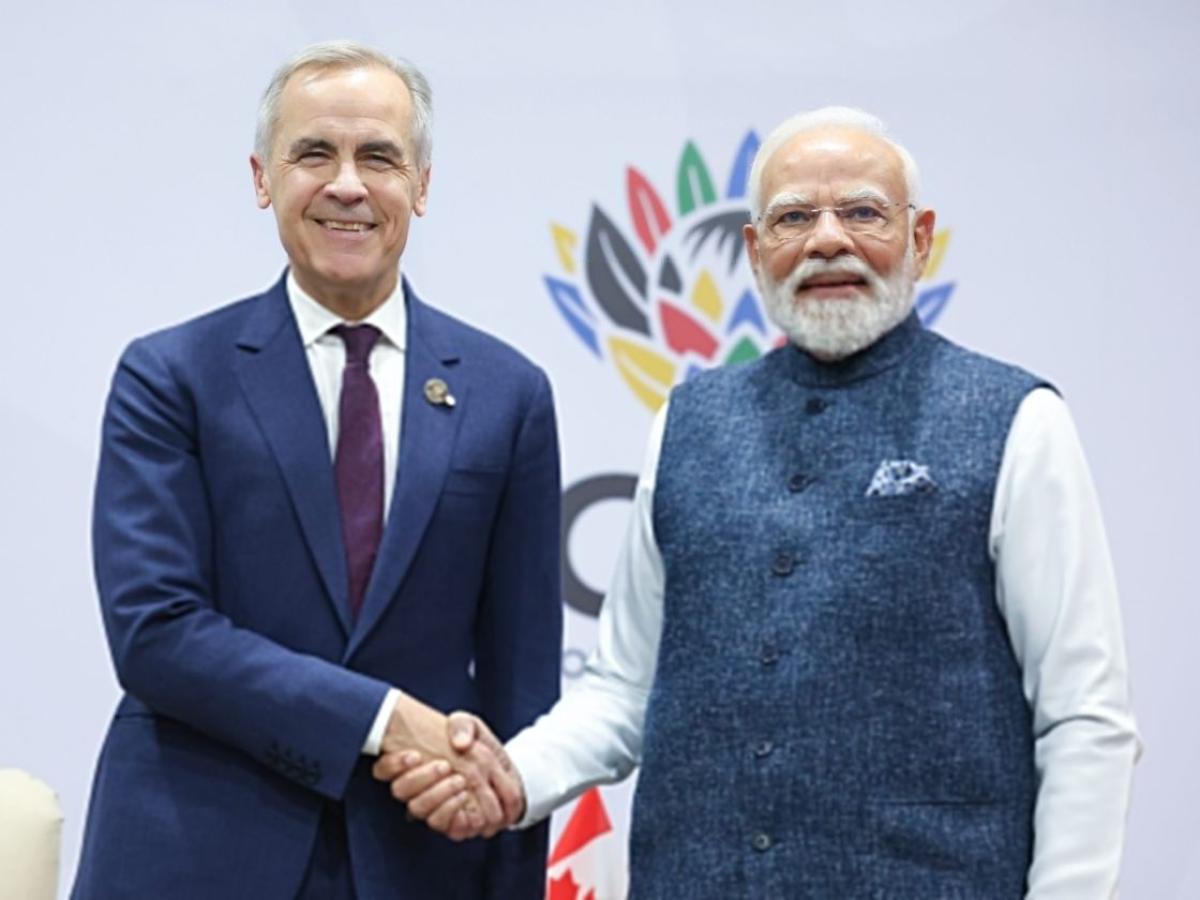
NEW DELHI: Mark Carney is visiting India for four days, and this presents a viable opportunity to reboot old ties that have come under strain in the recent past. His four-day visit may prove to be a turning point in bilateral ties between the two countries after three years. India and Canada share over 75 years of diplomatic relations. From the Colombo Plan in 1950, which set the tone for early bilateral engagement, the ties have displayed a geopolitical “Young’s Modulus” through the decades, with a sine wave characteristic.
In May 1974, India conducted peaceful nuclear tests. Consequently, both nations faced some headwinds in their relations, as Canada had supplied nuclear technology to India under a civil nuclear cooperation agreement. Ties deteriorated yet again with the ghostly Air India Flight 182 “Kanishka” bombing in 1985. This tragic event was rooted in a complex context of political and religious tensions. The bombing was further linked to separatists, with a group of conspirators also responsible for a simultaneous explosion on Canadian Pacific Flight 003 in Tokyo.
There have been numerous path breaking collaborations between the two countries in the past. While an enabling Science and Technology Cooperation Agreement was signed in 2005, the decade of 2010–2020 can be termed an era of resurgence. A Nuclear Cooperation Agreement (NCA) was signed in 2010 for nuclear energy collaboration, including trade in uranium and technology, and more can be achieved in this domain for mutual benefit. The bilateral relationship was formally designated as a “Strategic Partnership” in 2018, with a framework built around foreign policy, trade and investment, finance, and energy.
The Nijjar incident in Surrey, British Columbia, sparked tensions again in 2023. India had designated Nijjar a terrorist in 2020, but the incident was apparently handled with grave political immaturity by the then Prime Minister of Canada, who blamed India for the killing of Nijjar. Justin Trudeau publicly accused India of a role in the murder, triggering a feud with New Delhi. India, which denied the accusation, expelled 41 Canadian diplomats as part of its response, and Free Trade Agreement (FTA) negotiations were suspended. Following Trudeau’s resignation, which ended nine years of his premiership, along with appeasement politics and internal turmoil within Canada, both sides have since signalled a reset.
Prime Minister Modi and Carney met at the G7 Summit in June 2025, and several steps have since been taken. High commissioners have been reinstated, with a Trade and Investment Ministerial Dialogue held in November 2025. At the G20 Summit in Johannesburg, both countries agreed to launch negotiations on the Comprehensive Economic Partnership Agreement (CEPA) to double bilateral trade to USD 50 billion by 2030. They reaffirmed civil nuclear cooperation, including potential long-term uranium supply arrangements. In January 2026, Canada’s Minister of Energy and Natural Resources, Tim Hodgson, visited India to participate in India Energy Week 2026. Several measures to deepen bilateral energy trade, promote conventional energy investments, diversify supply chains, and enhance collaboration on energy security were discussed.
Trade and investment linkages are the very edifice of a lasting partnership between the two countries. India’s exports to Canada in 2024 were worth CAD 8.02 billion, with import metrics of CAD 5.30 billion. Bilateral trade in goods between India and Canada was worth CAD 13.32 billion in 2024. In 2025, total bilateral trade in goods in the first three quarters was approximately CAD 9.96 billion, which is significant. Portfolio investments from Canada into India stand at more than CAD 100 billion, which signifies a high-trust environment and indicates the viability of further external investments. There are around 600 Canadian companies with a presence in India, and global alternative investment majors like Brookfield Asset Management plan to invest USD 1 billion in Global Capability Centres (GCCs). More investments are in the offing in clean energy, AI, and technology as well.
While Canada is an integral part of the “Five Eyes Alliance”, its ties with the US are seemingly on a plateau. In 2025, the US imposed 25% tariffs on Canadian goods over concerns regarding fentanyl and illegal migration. While some were recently struck down by the US Supreme Court, the White House has implemented new rules as of 24 February 2026. There are notable concerns regarding loss of sovereignty issues, the Greenland quagmire, as well as navigating a complex maze of technological and defence capabilities, for which Canada is dependent on its southern neighbour.
Several collaborations, besides the Free Trade Agreement (FTA), can be part of the larger relationship calculus between the two countries. Canada can be a reliable supplier of oil, gas, LNG, LPG, crude oil, and critical minerals, with increasing demand in India and a buoyant economy. There is huge scope for both nations to collaborate in counterterrorism, particularly through the framework of the Joint Working Group (JWG) on Counter Terrorism, set up as early as 1997 and further enhanced in 2018.
There can be significant traction in the space sector. The Indian Space Research Organisation (ISRO) and the Canadian Space Agency (CSA) aligned in the field of exploration and utilization of outer space in 1996 and again in 2003. ISRO and CSA signed an MoU on Space Cooperation in Ottawa in 2015, which envisaged deeper cooperation. There can be meaningful collaborations in industrial research, cold climate studies, biotechnology, health care, and waste management through joint programmes already in operation.
Education is a key enabler of India-Canada relations, besides being a harbinger of people-to-people contact. This engagement has evolved into a multifaceted relationship encompassing institutional linkages, joint research, and academic mobility initiatives over the years. Indian students represent the largest group of international students in Canada. While there is an MoU on Higher Education, signed in 2010 and renewed in February 2018, much more can be done through the streamlining of student visas and joint skilling initiatives for the future talent workforce.
As the world turns increasingly transactional, India’s intensive strategic outreach to Europe as well as the Middle East, in parallel with its pursuit of deeper ties with Australia, Japan, and the United States, is treading two paths with clarity. Mark Carney is also visiting Australia and stopping over in Japan during this trip. India seems more willing than ever to abandon its old hesitations and work with Canada, besides addressing the central issue of fictional Khalistan extremism and fringe elements. India also brings clear political legitimacy for a new Indo-Pacific balance of power, and both countries can be very valuable partners to one another. Building trust, while deftly balancing trade with geographic power dynamics, could carve a promising path for both nations. “Rifts to Resets” throughout history have been a norm, and this visit has the potential to do exactly that.
*Anurag Awasthi is a veteran, and CEO of Escape Velocity Mediaworks. He is a known policy expert and a columnist who writes extensively on critical technologies, security and geopolitics. Views are personal.




