
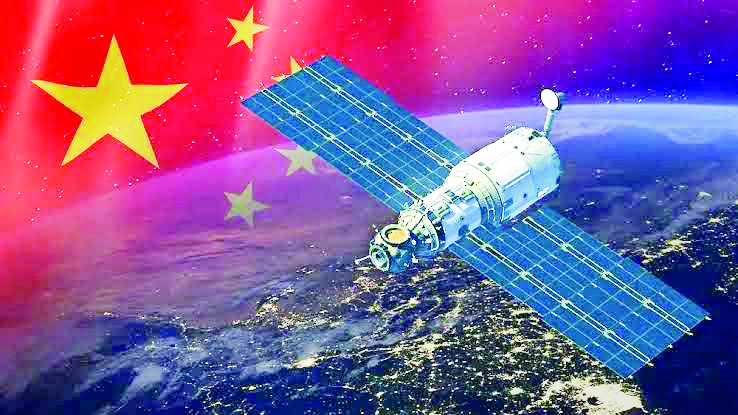
NEW DELHI: China’s total number of operational satellites crossed 1,060 by July 2025, up from around 900 earlier this year, marking a sharp acceleration in launches driven by both state and private entities. This surge—making China the second-largest satellite operator globally after the United States—follows a sustained campaign of orbital deployments, with over 140 payloads launched in the first half of 2025 alone, underscoring its expanding investments in military, commercial, and dual-use space infrastructure.
A significant portion of this expansion is attributable to the growth of commercial megaconstellations such as Thousand Sails (also known as Guowang), which has launched 90 satellites out of a proposed 14,000, and the G60 constellation, which has placed 72 of its intended 648 satellites into orbit by mid2025. In 2024, China had already conducted 68 orbital launches, deploying 260 payloads, with 26% dedicated to intelligence, surveillance, and reconnaissance (ISR) purposes.
That pace has doubled in 2025. By March 2025, global active satellites numbered 14,904—a 31.54% increase since mid-2023—fueled in part by China’s aggressive program. Among the total, 157 satellites are formally designated for military use, placing China behind only the United States and Russia in this metric. Its principal military satellite series, Yaogan, controlled by the People’s Liberation Army (PLA), spans platforms equipped with optical, radar, and electronic intelligence capabilities. Notably, Yaogan-41, launched into geostationary orbit in December 2023, delivers high-resolution persistent imaging, while Yaogan-43, deployed in 2024, supports multi-role ISR tasks.
In March 2025, U.S. Space Force personnel reported Chinese satellites simulating on-orbit interception maneuvers—suggesting rapidly evolving offensive capabilities. Additionally, China controls over 500 satellites with dual-use purposes. The Gaofen Earth-observation constellation, officially under the civilian China High-resolution Earth Observation System (CHEOS), serves environmental monitoring functions but also contributes to strategic reconnaissance. As of July 2024, the fleet includes at least 32 satellites, the latest being Gaofen-11-05.
The Jilin-1 constellation, run by Chang Guang Satellite Technology, has launched dozens of highresolution imaging satellites, with plans to reach over 300 by 2025. Though positioned as commercial, these systems produce sub-meter imagery that is highly valuable for military targeting and terrain analysis. Satellite broadband constellations have also expanded dramatically. While marketed as tools for communication, G60 and Thousand Sails offer persistent, high-capacity connectivity that can be redirected for defense communications and battlefield command. These constellations mirror Western pLEO (proliferated Low Earth Orbit) models like SpaceX’s Starlink, but with Chinese strategic intent.
Meanwhile, Beidou, China’s global navigation satellite system with about 50 active satellites, offers high-precision positioning and time synchronization used extensively by PLA forces. Meteorological satellites under the Fengyun series—nine of which are in operation—add environmental surveillance support to China’s military apparatus. A key enabler of this growth is China’s civil-military fusion doctrine. It blurs the line between civilian and defense applications, enabling shared technological bases and allowing repurposing of assets in crisis or wartime conditions. This makes it difficult for adversaries to assess whether a satellite serves scientific, economic, or military objectives.
For instance, in November 2024, two Earth-observation satellites were launched with international cooperation, but experts believe they carry capabilities suitable for surveillance. Five more satellites launched on July 25, 2025, reportedly involved European components, highlighting China’s growing collaboration footprint. From 2022 to 2025, China signed bilateral space cooperation agreements with 26 countries, many of which permit or encourage joint work on dual-use technologies.
These pacts signal Beijing’s intent to use space not only for national development but also as an instrument of geopolitical outreach. China’s upcoming Tianwen-2 asteroid samplereturn mission demonstrates this dual ambition—scientific leadership paired with strategic presence. In an April 2025 testimony to the U.S.-China Economic and Security Review Commission, General B. Chance Saltzman, Chief of Space Operations at the U.S. Space Force, laid bare American concerns over China’s rapid space militarization. He noted that since declaring space a combat domain in 2015, Beijing has prioritized developing capabilities ranging from anti-satellite weapons to ISR constellations.
“In 2023 alone, China conducted 66 space launches, placing 217 payloads into orbit, with over half serving ISR missions. That brings the PLA to approximately 510 Earth-observing satellites,” Saltzman stated, highlighting the sensors’ ability to detect and track U.S. carriers and expeditionary forces. He cited the Yaogan-41 launch and 36 G60 satellites as tools enabling China to exert surveillance and digital reach across oceans and continents. These assets will be joined by hundreds more as the G60 network grows toward its 648-satellite target by end-2025, and to a projected 14,000 by 2030. He further warned of Beidou-3’s military utility: “It enables precision maneuvering and time-coordinated strikes.
In 2021, China even demonstrated a fractional orbital launch of a hypersonic glide vehicle—the longest and farthest any PLA-developed land attack system has ever flown.” China’s kinetic and nonkinetic anti-satellite arsenal also includes ground-based lasers and electromagnetic jammers. “By the mid-tolate 2020s, we expect them to deploy space-directed energy weapons capable of permanently damaging satellite structures,” Saltzman added. PLA exercises now routinely include jamming of radar, communications, and navigation satellites—raising alarms in New Delhi and Washington alike.
Indian intelligence circles have also tracked reports of new jamming technologies tailored to interfere with EHF-band military communications. With an annual increase in both satellite count and sophistication, China’s space strategy appears clear: dominance through quantity, versatility, and civil-military synergy. The implications for global security, orbital traffic management, and commercial competition are profound. Analysts expect China’s space footprint to triple by the end of the decade—reshaping the strategic calculus in Earth orbit and beyond.




