Donald Trump’s 2026 Davos address triggered global debate with controversial claims on Greenland, NATO funding, the economy, and wind energy, drawing reactions from leaders and fact-checkers alike.
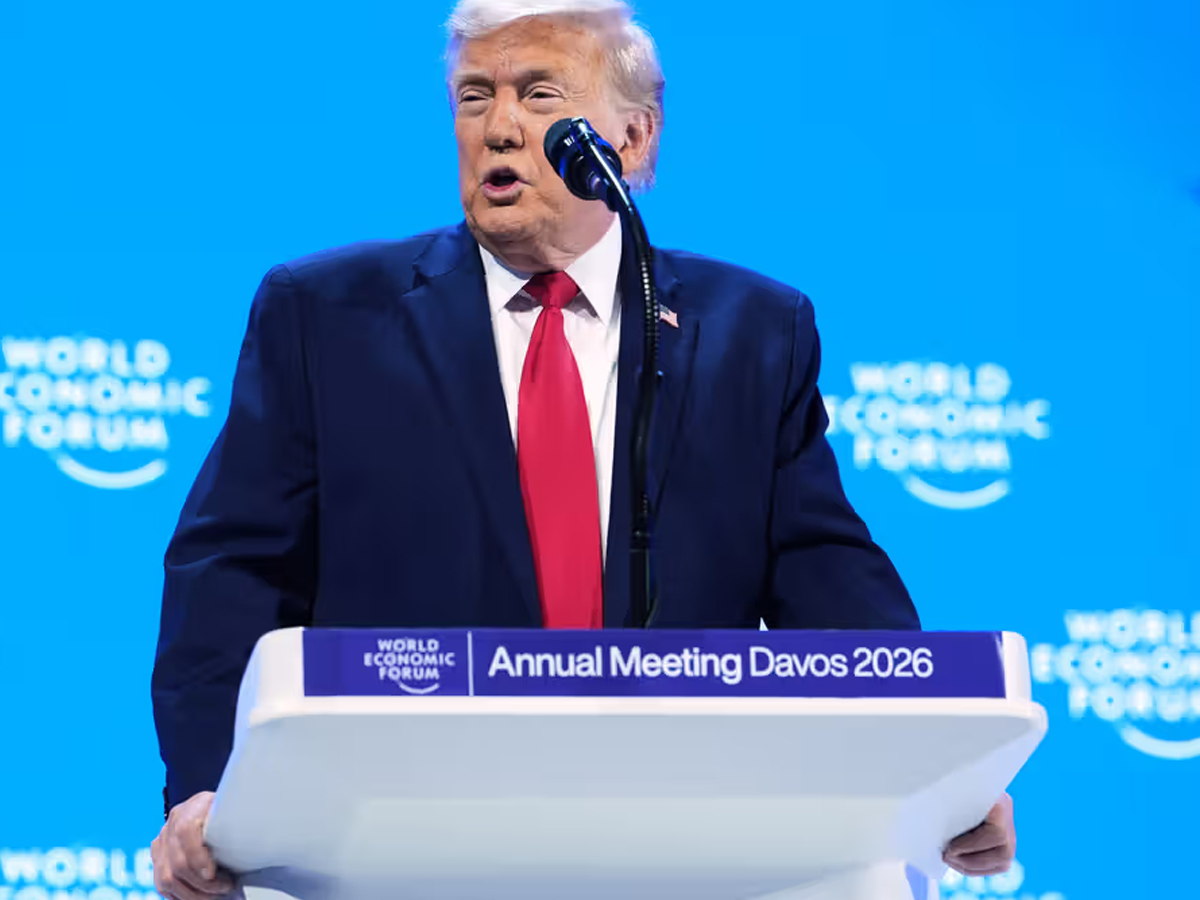
Trump also insisted the U.S. would not use force to take Greenland, marking a softer tone compared to previous comments. (Photo: AP)
U.S. President Donald Trump delivered a headline-grabbing speech at the World Economic Forum in Davos, Switzerland, on January 21, 2026, prompting strong reactions from world leaders, analysts, and fact-checkers.
Trump mixed assertions about U.S. strength, economic performance, and international relations with controversial remarks that many experts say were inaccurate or misleading.
In one of the most striking moments of his speech, Trump reiterated his long-standing desire to acquire Greenland, a large island in the Arctic that is part of the Kingdom of Denmark. He said it would be important for “world protection,” and pressed for negotiations.
Trump also insisted the U.S. would not use force to take Greenland, marking a softer tone compared to previous comments.
However, Trump’s notion that the U.S. once owned Greenland and “gave” it back to Denmark contradicts history. The United States never had ownership of Greenland, only military agreements during World War II, and Denmark’s sovereignty has been long established under international law.
Danish lawmakers and NATO officials emphasized that Greenland is not for sale, and that any “framework deal” must respect sovereignty.
Trump sharply criticized NATO, claiming the United States bore nearly all costs and received little in return. “We pay for Nato. We paid for many years… 100 per cent of Nato,” he said.
But NATO budget data tells a different story: the U.S. contributes about 16% of the alliance’s common funding, with many member states meeting defense spending targets.
He also questioned whether current NATO allies would defend the U.S. if America were attacked, touching on the collective defense principle of Article 5, a fundamental yet rarely invoked treaty provision.
Trump presented a positive view of the U.S. economy, saying growth and investment were soaring and consumer prices were falling.
Many of those claims, though, drew scrutiny:
These nuances suggest the economy is growing — but not at the level of boom conditions that Trump described.
Trump made broad statements about windmills, especially that China “makes almost all of the windmills… but they don’t use them,” a claim that fact-checkers labelled “Pants on Fire!” because China is actually the world’s largest wind power market with far more installed capacity than the U.S. or Europe.
He also repeated critical views on renewable energy in Europe, arguing that wind turbines were losers and burdensome for national economies. These comments deepened divisions over climate and energy policy between the U.S. and trading partners.
Trump used the Davos platform to frame U.S. global leadership in stark contrasts:
European leaders and allies responded cautiously, with some welcoming Trump’s clarification on not using force but warning that focusing on territorial acquisitions could strain diplomatic ties.
Fact-checkers from major news organisations described the speech as containing a “barrage of false claims” and noted confusion in Trump’s narrative, especially when he mixed up geographic references like Greenland and Iceland.
The overall reception mixed economic confidence at home with unease abroad, highlighting big differences between Trump’s rhetoric and independent data.
