
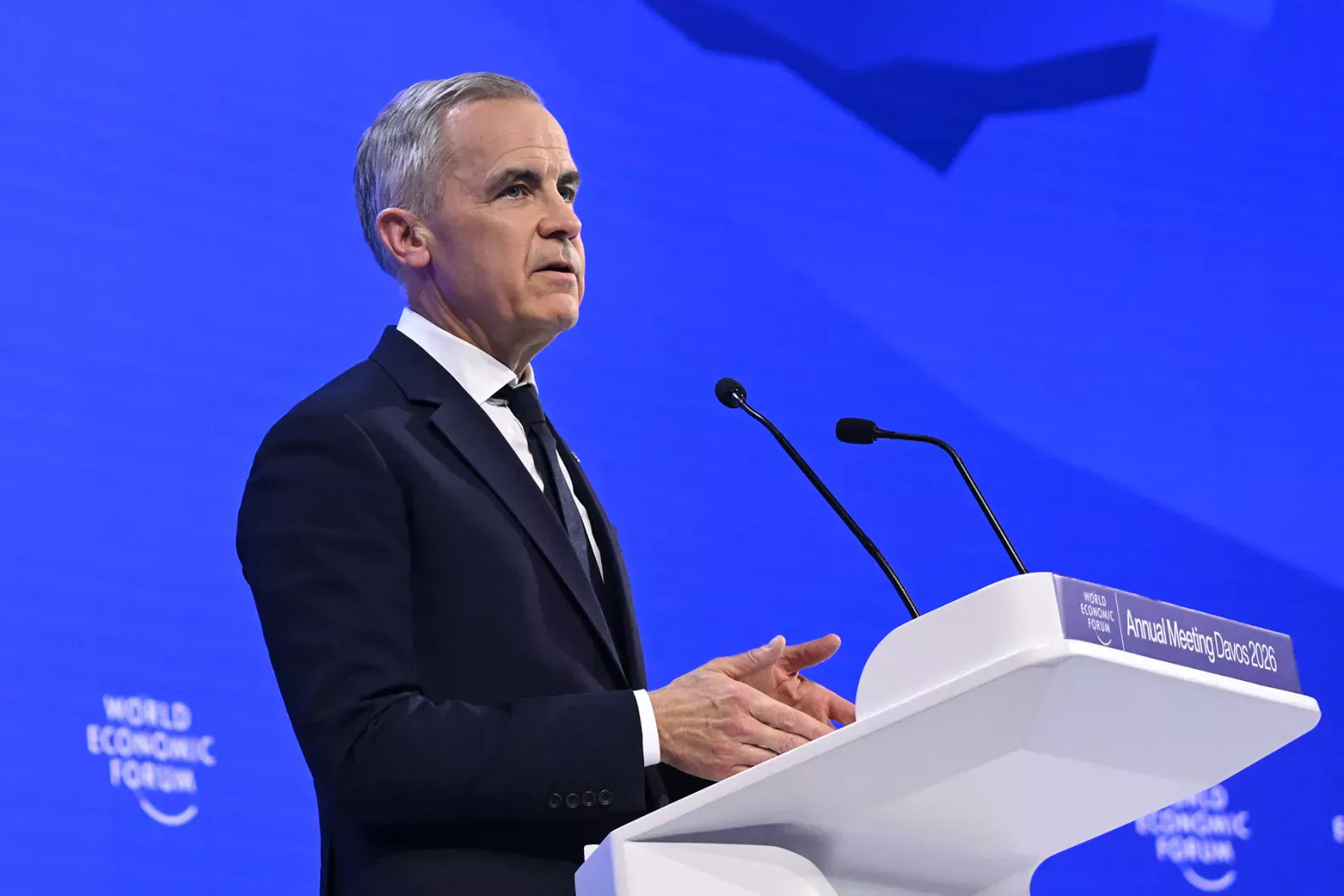
OTTAWA: At the World Economic Forum in Davos, Prime Minister Mark Carney delivered a speech that was widely praised as forward-looking, principled, and strategically mature. Global commentators lauded his call for middle powers to build “coalitions for subsectors of the world” and for democracies to cooperate in reshaping international norms. In a moment of crisis fatigue and geopolitical rupture, Carney offered what appeared to be vision. The centralized media applauded.
Yet the accolades missed the deeper warning embedded in the Prime Minister’s remarks. This was not a speech celebrating Canada’s position in the world; it was a requiem for a rules-based order that no longer exists. Carney invoked Thucydides, warned of the collapse of consensus governance, and admitted that the international system is now held together by the strategic ambitions of the powerful and the fragmented resilience of the rest. It was, if one listened closely, not optimism but realism.
Canada is not immune. If anything, we are exposed macroeconomically, strategically, and politically. At Davos, Carney’s analysis of a fractured global architecture was intellectually rigorous. But the implications for Canada are not abstract. They are domestic. And they are urgent.
Canada’s most enduring alliance with the United States is now deeply strained. While shared values endure, the Trumpian era has recast the bilateral relationship as conditional and transactional. Canada has faced tariffs on steel, aluminium, and autos; threats to agricultural access; and open disdain from political figures who once viewed this country as a reliable partner. But let there be no illusion: hedging is not severing. Diversification does not mean abandoning the United States. Turning our back on our largest trading partner would not be strategic autonomy; it would be economic suicide and we trust the Liberal party and the Prime Minister understand this.
The economic, defence and cultural ties between Canada and the United States are not optional as over 150 years of being neighbours has proven. Whatever the tensions of the current political cycle, the United States remains Canada’s indispensable partner. China may provide markets, but it does not offer protection. It may pursue agreements, but it does not operate on trust. The notion that Beijing could serve as a panacea to resolve Canada’s frustrations with the United States is not a strategy, it is capitulation dressed in pragmatism.
Canada must manage its relationship with the U.S. with resilience and clarity, and not by seeking to mirror or appease Washington, as PM Carney makes clear, but by reinforcing shared democratic principles, and speaking the truth about our interdependence. It is in this context that Carney’s Beijing visit and the new trade agreement with China must be understood. Tariff reductions on canola, renewed market access for electric vehicles, and agreements on energy and agricultural cooperation are not signs of ideological alignment with Beijing.
The shift carries its own dangers. China’s commercial diplomacy is never just about trade. It is about influence, compliance, and strategic depth. The “coalitions” Carney referenced—those forged among like-minded nations in subsectors of the global system—are antithetical to China’s unitary model. Beijing seeks partners, not peers, as it is clear America is taking the same approach and that bothers the PM and other world leaders.
Canada’s new trade opening with China, while rational, must be bounded by clear red lines. There are at least three such lines that must be publicly and politically enforced. First, Canada must not allow policing, law enforcement, or national security cooperation with Chinese state actors beyond tightly limited, reciprocal mechanisms—especially where China continues to deny its own role in exporting synthetic drug precursors that fuel the North American opioid crisis.
Second, Ottawa must condition any expanded economic ties on the immediate and verifiable cessation of precursor chemical exports linked to fentanyl and other synthetic opioids. The human cost of these flows is measurable: tens of thousands dead, and a laundering ecosystem that exploits Canadian regulatory weakness. Third, Canada must commit—clearly and without exception—to rejecting all forms of transnational repression. The Chinese Communist Party’s operations in Canada have included diaspora surveillance, intimidation, influence operations in media and academia, and elite capture through investment vehicles. These cannot be treated as unfortunate side effects of prosperity. They are statecraft by other means.
Any failure to enforce these red lines would not be strategic ambiguity; it would be strategic capitulation. Over the past two decades, foreign capital flowed into Canadian real estate, farmland, and shell companies with minimal oversight. Our beneficial ownership registries remain porous. Investigative reporting, law enforcement briefings, and allied warnings have all documented how organized crime—including Chinese triads and Mexican cartels—use our financial systems not because they are clever, but because Canada is permissive.
As we have long warned, fentanyl overdoses are not only a public health emergency. They are a form of financial crime, a national security breach, and a policy indictment. Canada has become a preferred destination for laundering synthetic drug profits. Our response has been incremental, cautious, and politically managed while lives are lost and trust erodes. The problem is not just external. It is domestic. Ottawa has, again and again, chosen optics over enforcement, consultation over action.
Whether in failing to confront Iranian regime proxies, delaying a meaningful foreign agent registry, or treating international student visas as economic tools rather than immigration pathways, Canada has embraced a philosophy of denial. The applause Carney received at Davos was genuine. But it was also a measure of distance between how Canada is seen abroad and how it is governed at home. The speech projected calm leadership. But the country it represents is increasingly adrift. Foreign influence is not theoretical. Hostile regimes from Beijing to Tehran to Moscow are not content to influence from afar. They exploit real estate, immigration, disinformation, and institutional weakness to soften Western democracies from within. This is hybrid warfare, executed without declaration, but not without damage.
The path forward is not isolation. Nor is it naïve globalism. It is vigilance. Canada cannot claim strategic autonomy or domestic resilience while failing to enact the very laws designed to protect its sovereignty. The Foreign Transparency Registry Act, passed unanimously in June 2024, remains unenforced. Without it, there is no meaningful barrier to foreign infiltration of Canada’s political and economic systems. This legislative inaction is more than a policy delay. It is a security breach.
Key structural vulnerabilities persist: ineffective beneficial ownership transparency, minimal penalties for non-compliance, and weak anti-money laundering enforcement. These gaps continue to be exploited by hostile foreign regimes, transnational criminal syndicates, and authoritarian proxies. As external threats become more aggressive and sophisticated, domestic safeguards have not kept pace. No agreement with the PRC should include cooperation on law enforcement or national security, except under rigorously verified and reciprocated terms.
At minimum, future engagement must be contingent on a verifiable halt to the export of fentanyl precursors, the dismantling of diaspora repression networks, and demonstrable adherence to international obligations. Diplomatic credibility abroad depends on institutional integrity at home. Without robust enforcement, legislative implementation, and a posture rooted in transparency and rule of law, Canada risks being perceived not as a sovereign state navigating great power rivalry, but as a soft target within it. Sovereignty is defended not by aspiration but by action. In an era of economic coercion, disinformation, and hybrid influence campaigns, inaction will not preserve the national interest—it will compromise it. The moment demands more than strategy. It demands resolve.
Dean Baxendale is publisher and author; Garry Clement is the former Director of the Integrated Proceeds of Crime Division, Royal Canadian Mounted Police and author of “Under Cover”.




