A US report reveals China weaponised the Sindoor conflict for global propaganda.
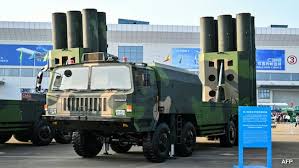
China reportedly used India–Pakistan clashes as a “real-world” test for HQ-9 and J-10 systems, while spreading disinformation on Indian Rafales (Photo: File)
New Delhi: A major new report submitted to the US Congress al-leges that Beijing opportunistically leveraged the May 2025 India–Pakistan conflict to test and advertise the sophistication of its latest military hardware, turning the four-day confrontation into a real-time laboratory to advance its expanding defence industry goals.
The US–China Economic and Security Review Com-mission (USCC) concluded that the hostilities triggered by the Pahalgam massacre and followed by India’s Operation Sindoor were used by China as a strategic opening. Ac-cording to the USCC, this was the first instance where China’s modern systems, including the HQ-9 air de-fence system and J-10 fighter aircraft, were deployed in active combat conditions, serving as a “real-world field experiment.”
In tandem with this apparent combat testing, the USCC report details how Chinese intelligence-linked networks, working with Pakistan’s propaganda eco-system, ran a coordinated disinformation campaign.
The explicit aim was to damage the reputation of India’s Rafale fighters and promote China’s rival aircraft fighter in export markets.
According to the report, Chinese operatives used fake social media accounts to circulate AI-generated images and video-game clips as “debris” of Indian Rafales supposedly destroyed by Chinese-supplied Pakistani weapons. This campaign sought to “hinder” Rafale sales by flooding online spaces with fabricated visuals and misleading commentary. Chinese embassies later amplified the narrative, publicly celebrating the alleged “successes” of Chinese platforms in the clash as a sales pitch to prospective buyers.
This entire incident is a textbook example of grey-zone warfare, where peace-time influence tools were used to achieve military and commercial objectives without firing a shot.
These Chinese narratives did not circulate in isolation. They landed in an information space already saturated with Pakistani claims that its air defence network had “dominated” the skies during Operation Sindoor and shot down multiple Indian jets, including Rafales.
An article shared on a prominent Pakistan’ media site even quoted a French naval officer as confirming Pakistan’s air superiority and vouching for claims about Rafale losses.
That narrative collapsed swiftly. In an unusually sharp statement, the French Navy publicly dismissed the Pakistani reports as “misinformation and disinformation,” made it clear that the officer in question had not endorsed any such claims and said the comments attributed to him were fabricated. French officials also pointed out that even the officer’s name was misreported, underlining the ex-tent of falsification.
Crucially, taken together, the USCC findings and France’s rebuttal have strengthened assessments in New Delhi that what played out after Operation Sindoor was not random social-media noise, but an orchestrated campaign: Chinese state-linked actors generating and seeding content designed to undercut India’s frontline fighter, and Pakistan-based outlets, influencers and sock-puppet accounts amplifying those claims to give them apparent authenticity.
Senior Indian security officials say this model Pakistan’s Inter-Services Intelligence (ISI) providing the conflict theatre and lo-cal narrative, and Chinese information-operations cells weaponising it for global effect fits a pattern that has been building for several years.
That pattern first surfaced clearly in official paper-work in December 2021, when India’s Ministry of Information and Broad-casting (MIB) announced the blocking of 20 YouTube channels and two websites that it described as part of “a coordinated disinformation network operating from Pakistan” and pushing fake news on sensitive issues including the Indian Army, Kashmir and India’s foreign relations.
The government said intelligence agencies had worked with the ministry to map linkages between the channels and the sites, and found that they routinely cross-promoted each other’s content while posing as in-dependent news platforms. The following year, the MIB undertook a series of similar actions, blocking another set of Pakistan-based YouTube “news” channels for monetised fake content related to India’s national security and foreign policy.
While those operations were formerly attributed to Pakistani networks, analysts noted that the narratives they pushed often aligned closely with Beijing’s talking points: portraying India as unstable, militarily incompetent or internationally isolated, while normalising China’s positions on border disputes and regional security.
By 2024, open-source re-search had begun to document the Chinese half of this equation in far greater detail. A study by the Australian Strategic Policy Institute (ASPI), conducted with Taiwanese partners, tracked coordinated social-media campaigns that sought to amplify communal ten-sions in Manipur and attack the Indian government and ruling party in the run-up to the general election. The campaigns, which ASPI linked to Chinese influence networks, ran in parallel with other operations targeting the global Sikh diaspora and pushing hostile narratives about India’s treatment of minorities.
Separately, Indian and international researchers have warned that Beijing is increasingly using information operations including covert social-media assets, state media, proxy influencers and selective leaks – as a deliberate instrument of statecraft.
A 2024 paper on Chinese information warfare noted that the People’s Republic of China treats control over narratives as a strategic do-main in its own right, integrating propaganda, cyber activity and psychological operations into broader military planning.
In South Asia, these tools blend into existing ISI-run propaganda networks that have long targeted India on Kashmir and terror-ism. Officials in New Delhi point out that each major India–Pakistan flashpoint in recent years has been ac-companied by a digital “fog” manipulated videos, mis-captioned photos and coordinated hashtag campaigns pushing exaggerated Indian losses or alleged atrocities.
During the Ladakh crisis and the Galwan clashes with China in 2020, Indian cyber-security firms reported hundreds of Pakistan-origin accounts activating to boost Beijing-friendly narratives about Indian casualties and military incompetence. Since then, every major terror incident or cross-border strike has seen similar surges in Pakistani and anonymous accounts pushing content designed to inflame anger at India domestically, and to depict it as reckless and oppressive abroad. Al-though the attribution to specific agencies is rarely made public, Indian officials say the fingerprints of ISI media cells are visible in the speed, coordination and language of these campaigns.
The Rafale episode, how-ever, marks a significant escalation because of its explicit commercial and diplomatic objectives. Un-like earlier waves that largely played to domestic or regional audiences, this campaign was designed to influence defence buyers in third countries in favour of Chinese platforms, using India’s combat experience as a billboard.
The recent disinformation effort was designed to push Indonesia away from a near-final Rafale deal and towards Chinese fighters, with Chinese embassies touting the “performance” of Chinese-supplied systems in Pakistani hands.
For Indian policymakers, that reinforces the sense that New Delhi is now the target of a joint information strategy: Pakistan uses the battlefield and its media to attack India’s military credibility; China feeds off those claims, dresses them up with AI-generated imagery and coordinated online campaigns, and then re-packages them for a global audience as evidence that Western partners and plat-forms cannot be trusted.
The French Navy’s unusually blunt intervention calling out “fake news” and “disinformation” in Pakistani reports on Operation Sindoor has given India rare public support from a major Western military in that fight. But officials and experts warn that the underlying problem will persist. Even when falsehoods are debunked, they say, the corrections rarely travel as far or as fast as the original lie.
With the US report now formally flagging China’s post-Sindoor campaign and France publicly naming Pakistani media for spread-ing fabricated Rafale claims, New Delhi is expected to step up its own counter-disinformation capabilities, which so far, have not been fully effective.
That is likely to mean closer coordination between intelligence agencies, the I&B minis-try and foreign partners including France and the US.
