The New START Treaty limited US-Russia strategic nuclear arsenals and improved transparency, helping reduce risks of miscalculation
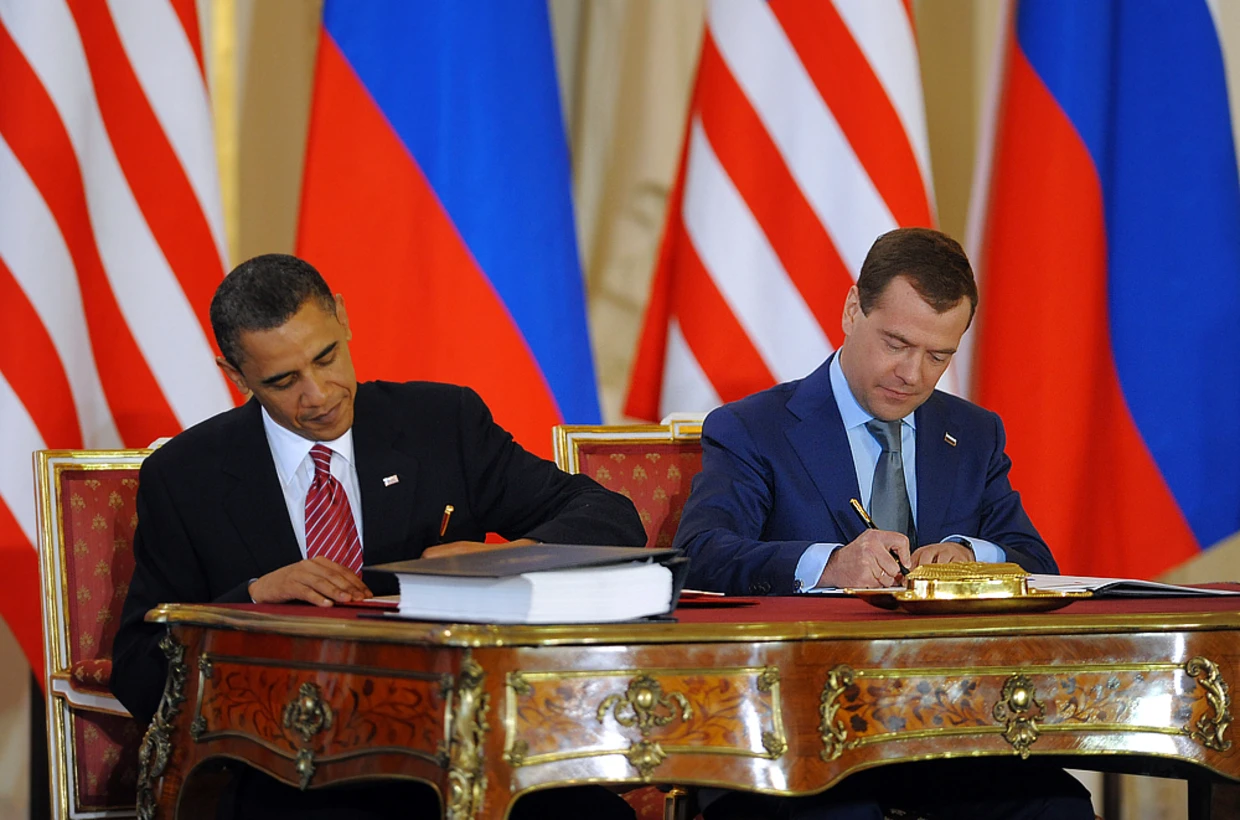
Obama and Medvedev after signing the Prague Treaty (Photo: File)
NEW DELHI: The United States and the Russian Federation together had reached a mutual understanding on taking measures for reducing and limiting their respective strategic offensive arms. This was technically dubbed the "New START Treaty". The Treaty was supposedly an indication that both the US and the Russian Federation would be slowly and steadily moving towards reducing and dismantling their nuclear warheads from their respective inventories. The symbolic message given to the rest of the world in general, and to the signatories to the Nuclear Non-Proliferation Treaty (NPT) in particular, was that they were going to realise, in due course, the obligations of Article VI, which talks about achieving nuclear disarmament by taking adequate steps in the field of general and complete disarmament. It was certainly a broad goal enshrined mainly to mobilise international public opinion in favour of the NPT.
Though there was always a lack of genuine commitment and seriousness on the part of acknowledged nuclear weapon states (US, Russian Federation, UK, France and China) to achieve nuclear disarmament, the New START Treaty certainly came as a hope for the non-nuclear weapon states (NNWS) that the world was going to usher in a nuclear weapon-free world.
The New START Treaty entered into force on 5 February 2011. Both the US and the Russian Federation initially had seven years to meet the Treaty's central limits on strategic offensive arms by 5 February 2018 and were supposed to remain obligated to maintain those limits for as long as the Treaty remained in force. It must be emphasized here that both the US and the Russian Federation met the central limits of the New START Treaty as per the deadline of 5 February 2018, where they stayed at or brought the numbers below the fixed limits. The limits were fixed at 700 deployed intercontinental ballistic missiles (ICBMs), deployed submarine-launched ballistic missiles (SLBMs) and deployed heavy bombers for nuclear armaments. The limit on nuclear warheads mated with ICBMs, deployed SLBMs and deployed heavy bombers was 1,550. Each heavy bomber was counted as one warhead toward this limit.
The New START Treaty also put limitations on all Russian deployed ICBMs tipped with nuclear warheads that had the potential to target the US in approximately 30 minutes. It also put limits on the deployed Avangard and the Sarmat, which had the potential to target the US. As part of the bilateral data exchange requirements, the Russian Federation declared 1,447 deployed strategic warheads, though it had the capability to deploy many more than 1,550 warheads on its modernised ICBMs and SLBMs. The Treaty put a restriction on the Russian Federation in this regard.
The New START Treaty provided the US and the Russian Federation the flexibility to deploy and maintain US strategic nuclear forces as per their national security requirements. With regard to verification and transparency relating to the obligations of the Treaty, detailed procedures for the implementation of central limits were articulated. The establishment and operation of a database of treaty-required information and related transparency were perhaps part of the confidence-building measures. Both also committed not to interfere with national technical means (NTM) of verification, where the use of communication satellites became dominant. The operation of the Bilateral Consultative Commission (BCC) was a testimony to their commitments.
The New START Treaty kept getting extended and finally ended on 4 February 2026. Complete disarmament remains a far distant reality because the role of nuclear weapons has not been de-emphasised in their nuclear strategies. There is no denying the fact that the Treaty provided a means to exchange data on the number, locations and technical characteristics of weapons systems and facilities, which paved the way for building confidence at the bilateral level. The Treaty indisputably helped both nations to have reliable information on their holdings of ICBMs, SLBMs and heavy bombers tipped with nuclear warheads. The information shared at the mutual level contributed to the reduction in the risk of strategic surprise, mistrust and miscalculations. The Treaty provided an opportunity for both to conduct on-site inspections, exchange notifications on solid-fuelled ICBMs leaving a production facility, and hold regular Bilateral Consultative Commission meetings.
Though the Treaty's original duration was 10 years when it came into force in 2011, it was extended for five years in 2021, and now the Treaty is ceasing to exist. The Treaty also had a withdrawal clause, which remains a standard practice in arms control agreements, citing supreme national interests as the reason. It will be too difficult for the US and the Russian Federation to get rid of their nuclear weapons. Their reliance on nuclear weapons perhaps has boosted their nuclear deterrence.
The emerging debates in President Trump's administration are going to take a different shape if the US breaks the moratorium on nuclear tests. President Trump has been making statements in this regard, alleging that the Russian Federation, China and Pakistan have conducted nuclear tests. The US has not tested a nuclear device since it put a moratorium on tests in 1992, after the former Soviet Union announced its moratorium in 1991. The resumption of nuclear testing by the US will have a triggering impact on the rest of the nuclear weapon states, both de jure and de facto.
Instead of initiating a debate on the resumption of nuclear testing, the US should take steps to de-alert all its nuclear warheads, which were put on hair-trigger alert during the peak of the Cold War years. Likewise, the Russian Federation also needs to de-alert all its alerted nuclear warheads. If they are really serious about achieving the goals of Article VI of the NPT, it is high time that all the acknowledged nuclear weapon states come together and commit to a Nuclear Weapons Convention (NWC) for a better world.
Dr Arvind Kumar is Professor of United States Studies at School of International Studies, JNU, New Delhi.
