
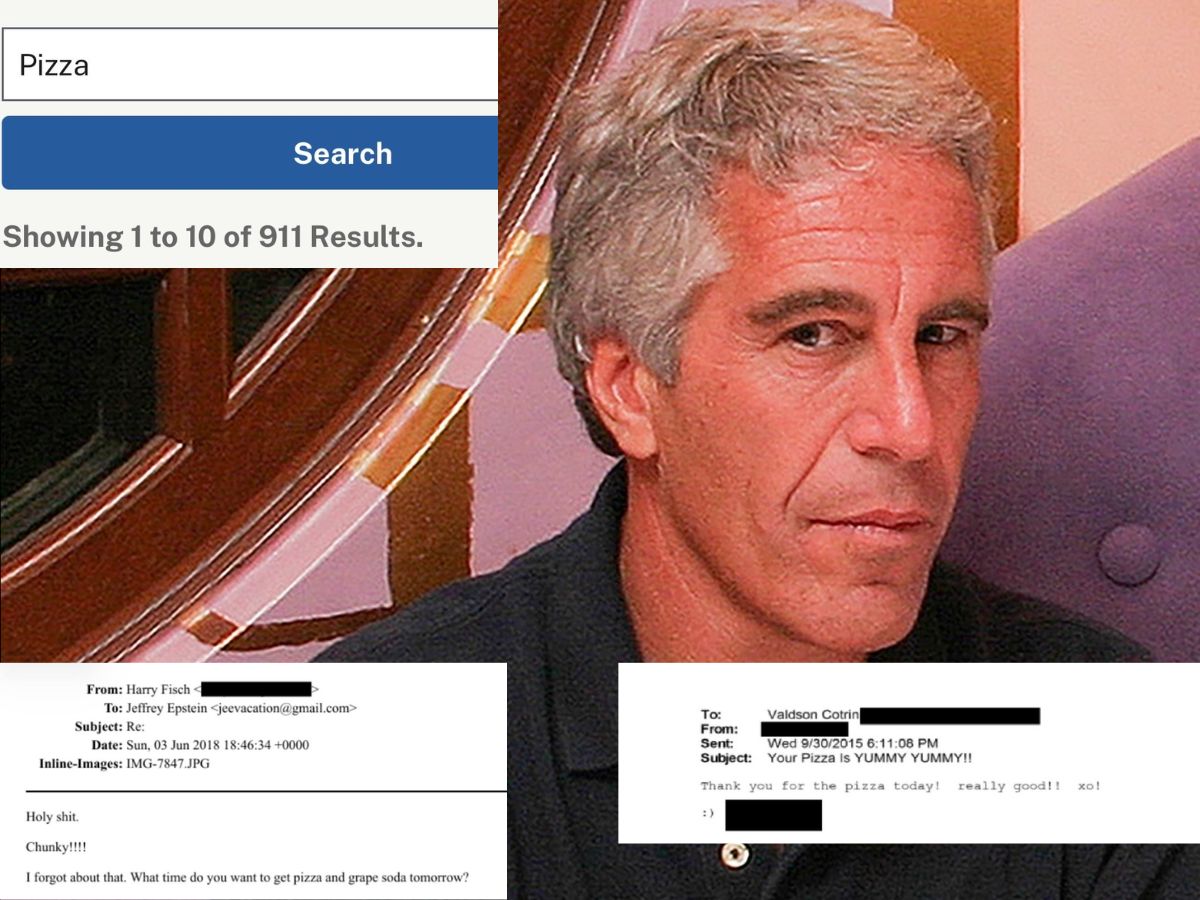
If you hear words like pizza, hotdog, or ice cream in conversations tied to the Epstein Files, investigators say it may be worth paying closer attention- but not jumping to conclusions. Newly released documents linked to Jeffrey Epstein have reignited online debate after repeated mentions of seemingly ordinary food-related terms.
While social media users are drawing links to old conspiracy theories, officials and experts urge restraint, stressing that context matters more than viral interpretations. The latest disclosure has reopened questions about coded language, digital speculation, and how misinformation can spiral from partial data.
Epstein Files Code Words Used for Human Trafficking
The release of nearly 3 million pages of documents connected to Jeffrey Epstein has brought renewed focus on certain recurring words found in emails and messages.
Among them, pizza, hotdog, cheese, pasta, ice cream, walnut, map, and sauce have drawn attention after an image circulating online claimed these words were once described as coded terms in an old FBI intelligence bulletin. According to the viral image, these alleged meanings included:
- “hotdog” = boy
- “pizza” = girl
- “cheese” = little girl
- “pasta” = little boy
- “ice cream” = male prostitute
- “walnut” = person of colour
- “map” = semen
- “sauce” = orgy
Investigators have not confirmed that such meanings apply to the Epstein Files. Authorities caution that lists circulating online often lack verified context and are frequently reused in misleading narratives.
Epstein Files: Mention of ‘Pizza’ 1000 Times? What the Documents Show
One detail has especially fueled speculation: the repeated appearance of the word “pizza” across Epstein-related correspondence. As of February 2, the term reportedly appeared 911 times, though around 60 references were later removed.
The mentions span several years and appear in ordinary contexts, including emails about meals, social plans, and casual exchanges—many dating to periods before the “Pizzagate” theory even existed.
Examples include:
“What time do you want to get pizza and grape soda tomorrow?”
“Your Pizza Is YUMMY YUMMY!!”
“This is better than a Chinese cookie!… let’s go for pizza and grape soda again. No one else can understand”
Officials say repetition alone does not indicate wrongdoing.
Newly Released Epstein Files: Who is Erin Ko & Why Her Name is Trending?
The documents include iMessage exchanges involving a person named Erin Ko, which have triggered confusion online. Some users falsely linked the name to a 13-year-old girl who died in a 2025 sailboat collision in Biscayne Bay near Miami Beach.
However, the messages date back to 2016, when that child would have been only four or five years old. Investigators say there is no evidence connecting the two individuals, warning against reckless online speculation.
Similar attention has fallen on Roy and Stephanie Hodges, whose conversations also included references to “pizza,” further amplifying online theories without substantiated links.
Epstein Files: What is ‘Pizzagate’ Theory & Why Officials Reject the Comparison?
The Pizzagate theory is a debunked conspiracy narrative that emerged in the final months of the 2016 US presidential election. It falsely claimed that a group of powerful political figures and business elites were running a child abuse out of a Washington, DC, pizza restaurant called Comet Ping Pong.
The theory originated on anonymous online message boards such as 4chan and later spread across Reddit, YouTube and social media platforms. Users began analysing emails from WikiLeaks that contained ordinary references to food items such as pizza, hot dogs and cheese. These words were isolated, screenshotted and reinterpreted as alleged “code” for illegal activity without any evidence.
One frequently cited claim suggested that “cheese pizza” or “CP” was code for child pornography. Others argued that references to food orders hinted at criminal meetings. These interpretations were never supported by law enforcement, courts or credible investigations.
The conspiracy escalated into real-world violence in December 2016, when Edgar Welch, a 28-year-old man from North Carolina, entered Comet Ping Pong armed with an AR-15 rifle and a revolver. Believing children were being held captive in the restaurant’s basement, he fired multiple shots. No one was injured. Investigators later confirmed the restaurant had no basement and no evidence of criminal activity.
The incident exposed how online misinformation can translate into physical harm. Since then, Pizzagate has been widely cited by experts as an example of conspiratorial thinking, where unrelated details are forced into a narrative driven by distrust, political polarisation and viral amplification.
Authorities have repeatedly stated that Pizzagate has no factual basis and that linking it to later cases—including the Epstein investigation—is misleading.
Why Authorities Warn Against Drawing Conclusions From the Epstein Files?
Investigators and legal experts warn that the Epstein Files include millions of pages of mixed material, ranging from routine emails and casual messages to verified evidence, making selective interpretation risky. They stress that repeated words or familiar phrases, when stripped of context, can easily be misread and turned into misleading narratives.
Authorities also warn that viral speculation can unfairly target individuals whose names appear in the documents without any proof of wrongdoing. Drawing parallels with past conspiracy theories such as Pizzagate, officials underline how misinterpretation of partial information has previously led to misinformation and real-world harm.
As a result, law enforcement urges the public to rely on verified findings, corroborated evidence and judicial conclusions rather than social media-driven assumptions.
Disclaimer: The content on this page is provided for general informational purposes only and reflects publicly available discussions and reports about social media trends and online speculation. We do not endorse or promote conspiracy theories, and we do not guarantee the accuracy, completeness, or reliability of any information presented. Readers are advised to see reliable primary sources and exercise critical judgment.




