
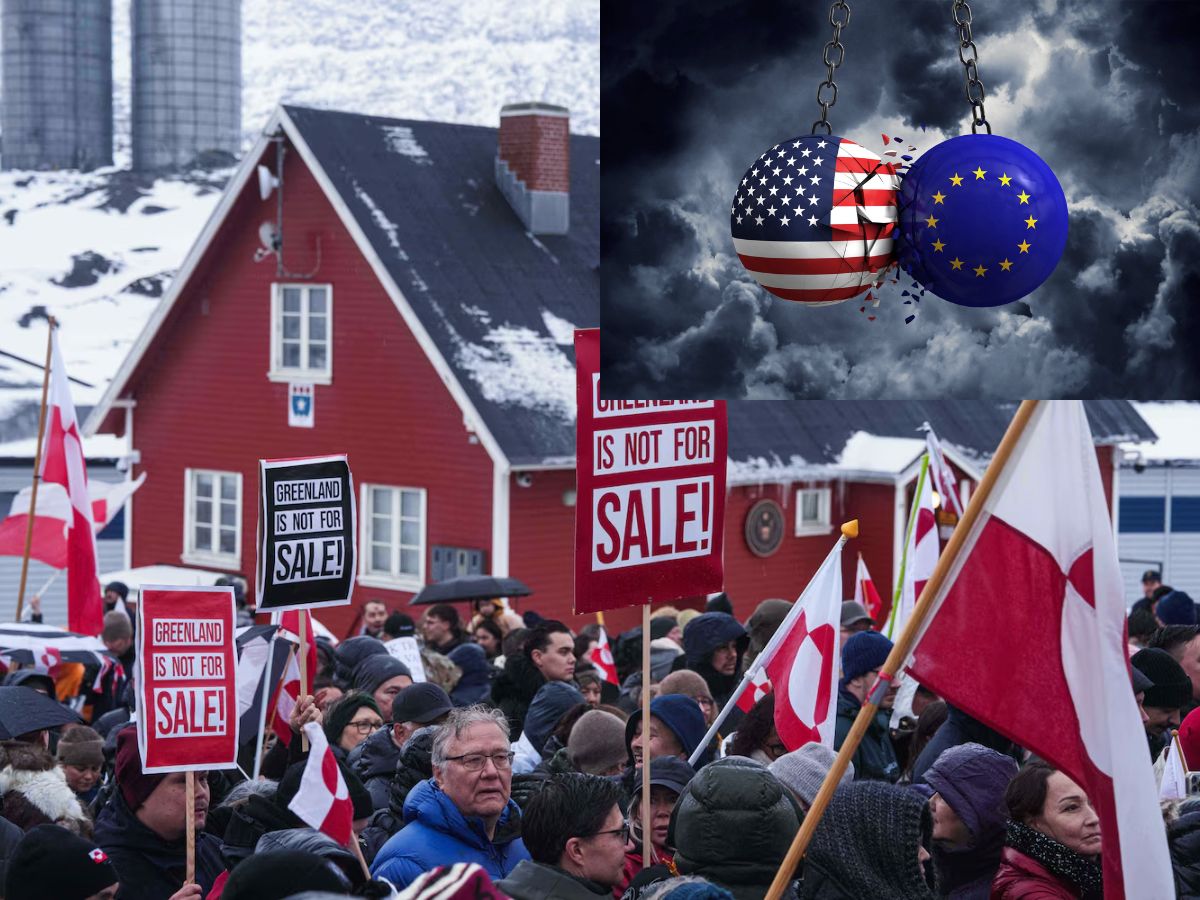
NEW DELHI, January 19 – U.S. President Donald Trump has connected his aggressive pursuit of Greenland to his omission from the Nobel Peace Prize, a linkage that has pushed transatlantic relations to a breaking point. The European Union is now preparing potential trade countermeasures, fearing a renewed tariff war that could destabilize the NATO alliance.
What Sparked the EU-US Crisis?
The immediate trigger was a written message from Trump to Norway’s Prime Minister, Jonas Gahr Stoere. In it, Trump stated that since Norway “decided not to give me the Nobel Peace Prize for having stopped 8 Wars PLUS, I no longer feel an obligation to think purely of Peace.” This direct reference followed the 2025 Nobel Peace Prize being awarded to Venezuelan opposition figure Maria Corina Machado instead of Trump. Machado later gave her medal to Trump in a White House visit, an act the Nobel Committee said does not transfer the prize.
What Actions is Trump Threatening?
President Trump has moved from rhetoric to concrete economic threats. On Saturday, he vowed to impose escalating tariffs starting February 1 on multiple European nations. The list includes EU members Denmark, Sweden, France, Germany, the Netherlands, and Finland, as well as Britain and Norway. The goal is to pressure Denmark into allowing the U.S. to purchase Greenland. Trump argues that global security requires the U.S. to have “Complete and Total Control of Greenland,” questioning Denmark’s “right of ownership” and its ability to protect the island.
How is Europe Responding to the Tariff Threat?
The European Union is mobilizing for a firm response. EU leaders have called an emergency summit in Brussels for Thursday to decide on retaliation. They are considering two main tools. The first is a pre-approved package of tariffs on 93 billion euros ($108 billion) worth of U.S. goods, which could take effect automatically on February 6. The second is the never-before-used “Anti-Coercion Instrument” (ACI), designed to target U.S. access to EU public contracts, investments, and services trade. The EU confirmed this powerful option remains “on the table.”
Are There any Diplomatic Efforts in Queue?
High-level diplomatic meetings are being arranged hastily. Both Norway’s Prime Minister Stoere and German Chancellor Friedrich Merz altered their schedules to attend the World Economic Forum in Davos, where Trump is also speaking. Chancellor Merz stated that while a trade war is unwanted, Europe is “capable of responding” to unreasonable tariffs. Meanwhile, Greenland’s own leader, Prime Minister Jens-Frederik Nielsen, asserted the territory’s autonomy, posting, “We will not let ourselves be pressured. We stand firm on dialogue, on respect and on international law.”
What is the Impact on Markets and NATO?
The threat has immediately shaken financial markets and strained the core Western military alliance. European stock markets fell and the U.S. dollar weakened as investors sought safety, fearing a return to last year’s trade volatility. Analysts warn the crisis threatens to unravel recent trade deals and NATO cohesion. British Prime Minister Keir Starmer called for calm, doubting military action over Greenland, while Russia remarked that Trump would “go down in… world history” if he succeeded in taking control of the island.




