
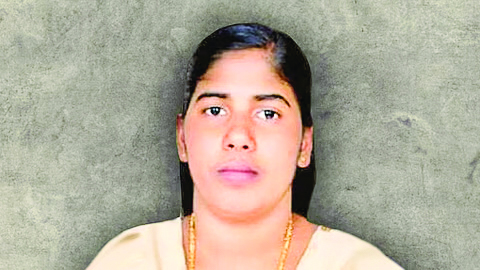
KERALA: Even as Indian nurse Nimisha Priya’s execution date has been set aside indefinitely, her chances of escaping the gallows at Yemeni capital Sanaa’s Central Prison have turned bleak as family members of the murdered victim have conveyed through social media that they refuse all offers of reconciliation including blood money.
They are insisting on “Qisas”, which is retributive justice as per Sharia (Islamic law). In an Arabic worded Facebook post, murdered victim Tala Abdo Mahdi’s brother, Abdelfattah Mahdi has stated that the family has turned down every effort of reconciliation, including the blood money. Translated into English from Arabic, the post reads: “What is happening today, and all talks of mediation and reconciliation attempts, is neither new nor surprising. Over the years, there have been covert efforts and serious attempts at mediation and that is natural. But the pressure has not changed us. Our demand is clear: Qisas, and nothing else, no matter what.” The post adds, “Unfortunately, we did not expect this (execution set aside for another date), especially since those who delayed it know full well that we reject all reconciliation.
What comes after an execution date is always harder. We will follow through with it—no postponement will stop us. No pressure will shake us. Blood cannot be bought. Justice cannot be forgotten. Qisas will be done, no matter how long it takes. With God’s help.” Tala’s brother has also dismissed allegations made by Nimisha to the law enforcement agencies in Yemen that Mahdi abused her, embezzled funds, forged marriage documents, and confiscated her passport, and thus trapped her in Yemen. “These baseless allegations have also made our family grow stronger in demanding the execution of the convict,” Abdelfattah Mahdi states.
SNAPSHOTS FROM KERALA
According to Nimisha Priya’s husband, Tommy Thomas, every effort has been made b y b o t h the Union government and the state government to save his wife from the gallows. Tommy also lauded the “Save Nimisha Priya International Action Council”, which was formed in 2020 and which led the negotiation efforts, raised millions (in USD), arranged visits, and sought to persuade the victim, Talal Abdo Mahdi’s family through intermediaries, including tribal leaders into accepting “Diyah”, the blood money and pardoning his wife. Born in Kollengode village in Palakkad district of Kerala, Nimisha Priya moved to Sanaa, Yemen in 2008 and later opened a 14-bedded clinic in 2015 with local Yemeni partner, Talal Abdo Mahdi, as required by their local law.
The Sunday Guardian visited the Kollengode village in Kerala and spoke to Nimisha Priya’s family friends at her church, school and her neighbourhood. People out there are still wishing that they (Yemenis) don’t execute her. A family friend of Nimisha Priya, Tambi said that it was he who had helped the family sell some property so that Nimisha could arrange money to set up her clinic in Yemen, but he wished this would not end like this. “She was a smart kid. She had learnt karate and driving in the village and she took initiatives for every activity,” said Tambi. Nimisha’s immediate neighbour Vineeta Radhakrishnan remembers her as a little girl walking with her mother. “We wish that they would not hang her. Let her be alive in jail,” said Vineeta. Nimisha’s husband Tommy Thomas said that he was busy running between Kerala’s capital, Thiruvananthapuram and his hometown Idukki. “With the help of Chandy Oommen, I had got to meet the Governor of Kerala and had apprised him of the developments. The Governor also spoke on a video conference with Nimisha’s mother, at present in Yemen with an activist who has the power of attorney there in Yemen, Samuel Jerome. The Governor said that he would take it through diplomatic channels and assured his help,” Tommy told this newspaper. As the scheduled execution date (July 16th) was about to arrive, the Grand Mufti of India, from Kanthapuram in Kerala, A.P. Aboobacker Musliyar, and Sufi scholar Sheikh Habib Umar bin Hafiz became involved, facilitating fresh negotiations with Yemeni religious authorities and the Mahdi family.
The duo intervened into the matter and took it up also with influential leaders in Yemen. Musliyar, who is one among the most 500 influential Muslim leaders in the world, had written to the Mahdi family that according to Sharia law, pardon can be granted after accepting the Diyah. Meanwhile, Nimisha’s mother and Samuel Jerome had met with the judicial officials in Yemen and had requested for the postponement of the execution date. In a temporary respite, on July 15, the Yemeni authorities postponed the execution scheduled for July 16, giving negotiators more time to convince the victim’s family.
THE MURDER AND LEGAL COURSE
In July 2017, Nimisha reportedly sedated Mahdi to retrieve her passport, resulting in his death by overdose. She and a colleague then allegedly dismembered Talal’s body and disposed of it in a water tank, before she was arrested while attempting to flee the country. Nimisha was convicted of murder and sentenced to death by a Yemeni court in 2020. Her appeals including to Yemen’s Supreme Judicial Council were rejected by November 2023, leaving only one remaining option: a pardon via blood money from the victim’s family under Sharia law.
Under Yemeni Islamic law, the victim’s family can pardon Nimisha in exchange for diyah. If the family refuses, the execution stands. In April 2024, Nimisha’s mother, Prema Kumari, travelled to Sanaa (with special permission from the Ministry of External Affairs, despite a travel ban) and briefly met her daughter, but direct contact with the victim’s family remains mediated and highly sensitive due to the civil war situation.




