Iran reportedly uses Fattah-2 hypersonic missile for first time against US forces, escalating Iran–Israel war and raising fears over regional security.
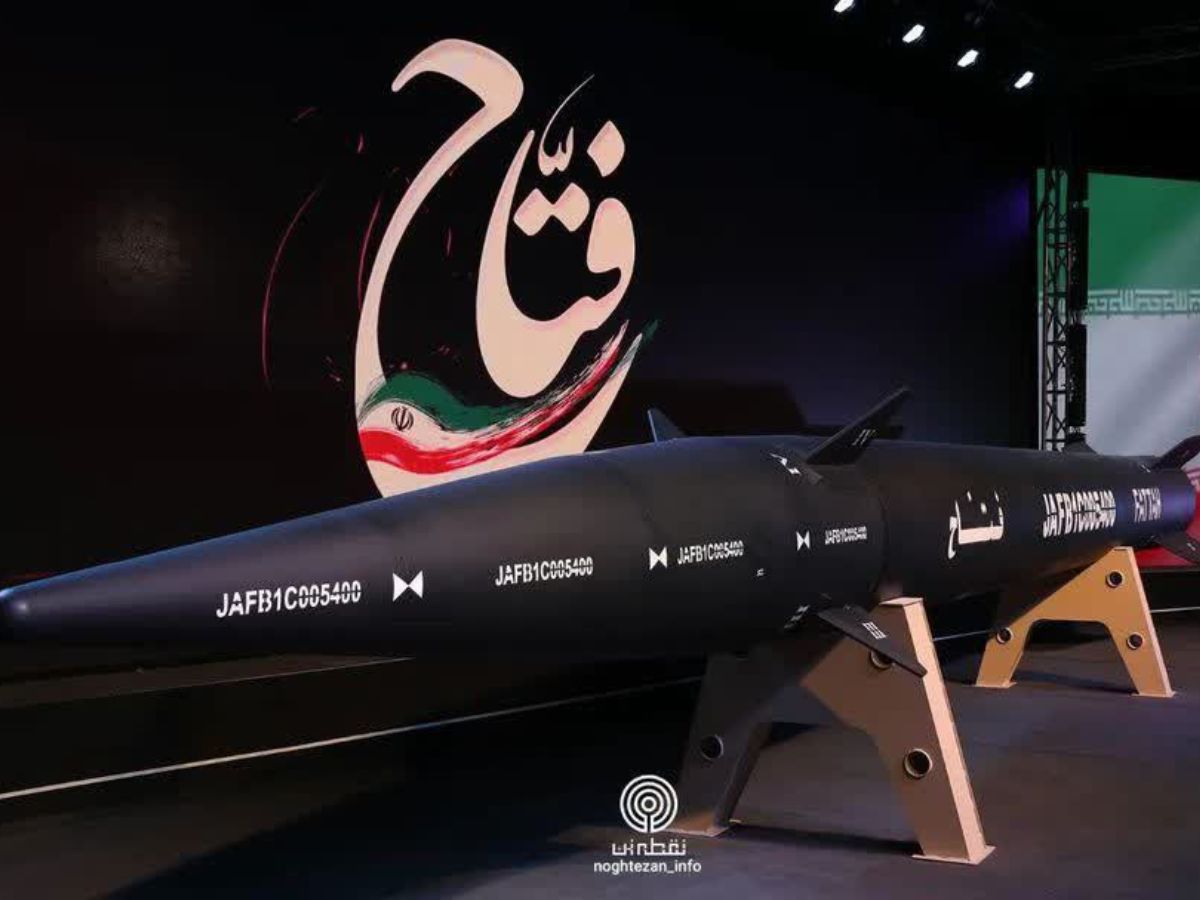
Iran reportedly uses Fattah-2 hypersonic missile for the first time against US forces [Photo: X]
Iran has reportedly used its Fattah-2 hypersonic missile for the first time in combat, targeting US forces amid intensifying hostilities in the region. An Iranian military source told Al Ghad that the advanced missile system was deployed during the latest wave of retaliatory strikes following coordinated US–Israel attacks on key Iranian facilities.
The development marks a significant escalation in the ongoing confrontation, as Tehran signals it is ready to use its most advanced strategic weapons. The reported deployment of the Fattah-2 adds a new dimension to the conflict and raises concerns about the vulnerability of US military assets stationed across the Middle East.
Iran unveiled the Fattah-2 in November 2023 as the upgraded version of its earlier Fattah-1 missile. The Islamic Revolutionary Guard Corps (IRGC) described it as a next-generation hypersonic weapon equipped with a hypersonic glide vehicle (HGV).
Iran claims the missile can travel at speeds up to Mach 15 and has a range of approximately 1,500 kilometres. Unlike traditional ballistic missiles, a hypersonic glide vehicle can manoeuvre unpredictably during flight, making it far more difficult to intercept.
The Fattah-2 reportedly carries a 200 kg explosive payload and is designed to strike both land-based and naval targets. Iranian officials have repeatedly described it as a “game-changing” addition to the country’s missile arsenal.
An Iranian military source told Al Ghad that the Fattah-2 hypersonic missile was used for the first time in attacks targeting US forces in the region. While Tehran has not officially released full operational details, the claim suggests Iran has moved beyond deterrence messaging to actual battlefield deployment.
If confirmed, this would represent the first known combat use of Iran’s hypersonic technology. Military observers say such a step indicates that Tehran is willing to escalate technologically in response to what it calls aggression by Washington and Tel Aviv.
The US Department of Defence has not yet confirmed whether hypersonic missiles were used in the reported strikes.
Iran owns and operates the Fattah-2 hypersonic missile. The Islamic Revolutionary Guard Corps (IRGC) developed and unveiled the missile as part of Iran’s expanding ballistic and hypersonic weapons program in November 2023.
The IRGC Aerospace Force oversees the country’s missile operations and strategic deterrence systems. Iranian officials have described the Fattah-2 as an indigenous weapon built with domestic technology, aimed at strengthening national defence and countering regional adversaries.
No other country operates the Fattah-2 missile. While several global powers, including the United States, China and Russia, are developing their own hypersonic systems, the Fattah-2 specifically belongs to Iran’s military arsenal.
Iran has maintained a self-imposed limit on its ballistic missile range of 2,000 kilometres. Within that range, all of Israel, US military bases in the Gulf region, and parts of Eastern Europe fall within potential striking distance.
Experts note that hypersonic weapons pose a serious challenge to modern air defence systems. Traditional missile defence platforms rely on predicting a ballistic trajectory. A hypersonic glide vehicle changes direction mid-flight, making radar tracking and interception significantly more complex.
Analysts have also pointed out that such capabilities could threaten US naval assets, including aircraft carriers operating in the region.
Iranian officials have issued strong warnings following recent US–Israel strikes on strategic Iranian sites. Tehran has framed its missile capabilities as part of its broader deterrence doctrine.
“We warned you! Now you have started down a path whose end is no longer in your control,” said Ebrahim Azizi, head of Iran’s National Security Commission, in a statement to Reuters.
Iranian leaders continue to insist that any attack on the country will trigger a decisive and powerful retaliation. The reported use of Fattah-2 appears to align with that messaging.
In a related development, the Israeli military confirmed that it detected additional missile launches toward Israeli territory after announcing its own strikes on targets inside Iran.
"An additional barrage of missiles was launched towards the State of Israel," the military said. "The public is requested to continue to follow the instructions of the Home Front Command. The public is requested to stay in protected spaces until official notice."
The exchange of missile fire underscores the rapid escalation and raises fears of a broader regional conflict.
The reported first use of the Fattah-2 hypersonic missile signals a potentially dangerous shift in the conflict’s technological landscape. Hypersonic weapons reduce reaction times and complicate defence planning, increasing the risk of miscalculation.
Military analysts warn that if both sides continue expanding the scope of operations, the confrontation could spill beyond current theatres. The involvement of advanced missile systems also places neighbouring countries and international shipping routes under heightened risk.
As tensions remain high, global powers are closely monitoring developments to assess whether this escalation will lead to sustained military engagement or renewed diplomatic efforts.
