New York mayoral win highlights ethical politics confronting Trump’s decade-long populist revolution.
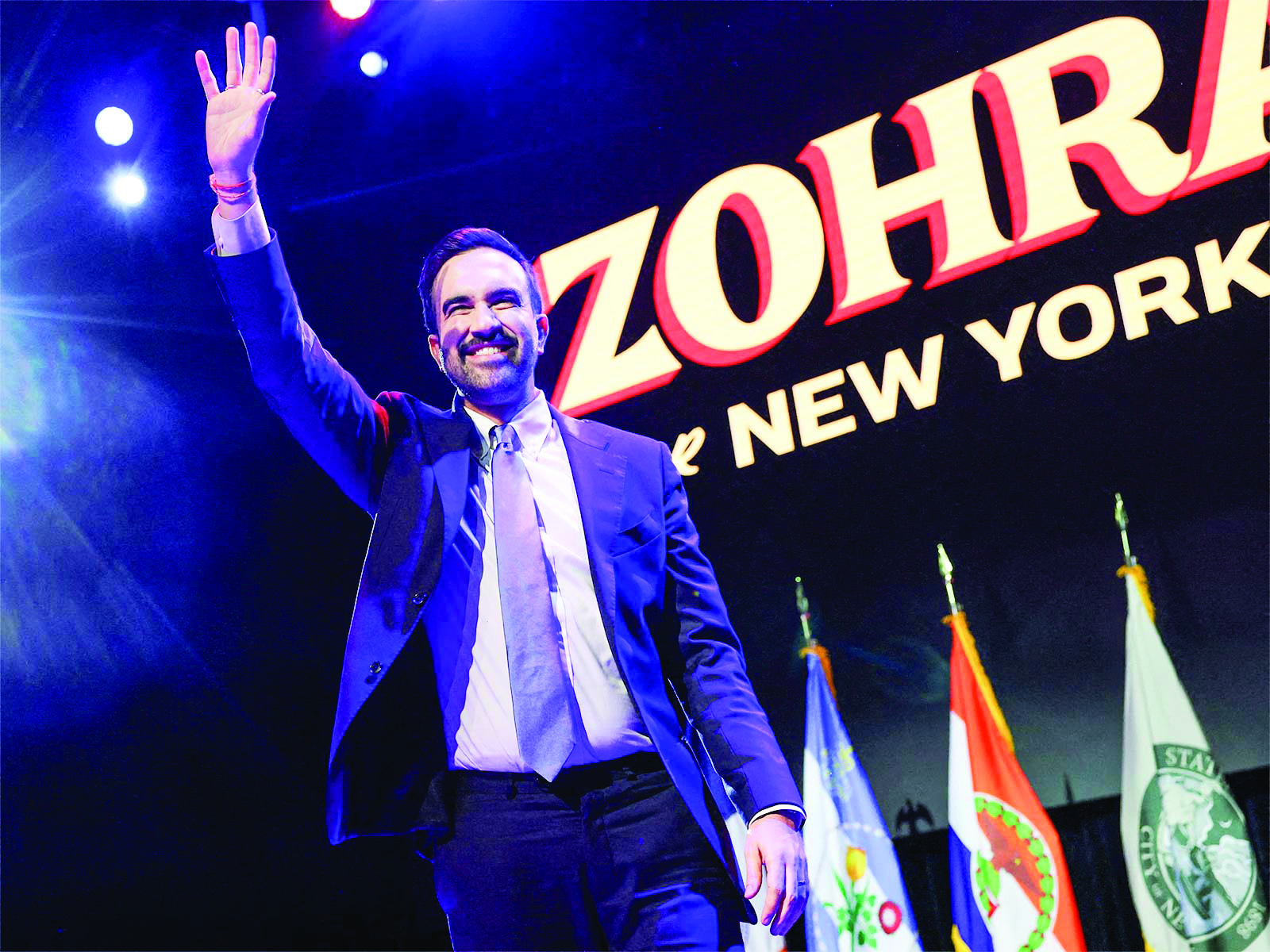
Zohran Mamdani celebrates his historic New York City mayoral victory, marking a progressive challenge to Donald Trump’s political influence (Photo: File)
LONDON: Tuesday was a stunning night for the Democrats in America. Their candidates swept key elections across the country, delivering a rebuke to Donald Trump's second term so far and boosting the party's hopes ahead of the midterms next year. Republican leaders were shocked. "A disaster", said the Republican Senator from Texas, Ted Cruz. "It was a shellacking", said Thomas Massic, the Representative from Kentucky. The Democrats tried to make the election a referendum on Trump and they clearly succeeded, winning in New Jersey and California, while sweeping the board in Virginia, traditionally a bell-weather state in the year after a presidential election.
But the most stunning victory of all went to New York's Zohran Mamdani, a 34-year-old state lawmaker who won more than two-thirds of voters under 45, the first time since 1969 that more than 2 million New Yorkers voted in a local election.
Such was the scale of Mamdani's victory, political pundits are questioning whether he has halted Trump's political revolution in its tracks.
When Donald Trump declared ten years ago that he was leading a "revolution", it was more than a campaign bluster. Across rallies, courtrooms and cable-news screens, Trump waged an all-out campaign to remake America's political order. Trump's movement, wrapped in the familiar "Make America Great Again" slogan, upended traditional party lines, blending economic nationalism, cultural grievance, and deep distrust of institutions. Supporters framed it as a people's revolt against a corrupt elite, a backlash against social change, immigration and globalisation.
Political scientists hesitated to call it a "revolution" in the classical sense, as revolutions usually overturn entire systems. Trump's revolution operates within one. After all, the Constitution still stands, elections still occur and the courts still function albeit under intense pressure. "It's a revolution in rhetoric and disruption," one analyst told The Atlantic Council, "but not yet in structure."
Still, the Trump phenomenon is revolutionary in scale. No US political figure since Ronald Reagan has commanded such loyalty or such fear. Trump has turned the popular message into a lasting political identity that transcends policy specifics. He has recast the Republican Party in his image and inspired a global wave of nationalist leaders who echo his playbook.
There is a certain irony that in a city where skyscrapers still bear the gold letters of Donald Trump's name, another New Yorker has begun to cast a long shadow across the national political skyline. Zohran Mamdani, the democratic socialist and son of Ugandan-Indian immigrants, now the newly elected mayor of New York City, is being hailed as the man who finally cracked the code to countering Trumpism. But has Mamdani truly stopped Trump's political revolution, or merely provided a brief metropolitan antidote to it?
The answer, as with most things in American politics, is more complicated than the headlines suggest. Just five years ago, Zohran Mamdani, whom Donald Trump calls "a stupid person", was a first-term assemblyman from Queens, known mainly among progressives for his work on tenant rights and transit reform. His background a Muslim immigrant family, an upbringing in Kampala and New York, and a sharp intellect honed at Bowdoin College gave him an easy authenticity in a city of contradictions. He was a different kind of leftist: less ideological firebrand, more community organiser with a poet's pulse. "Politics isn't about purity," Mamdani told supporters at a rally in Union Square this autumn. "It's about power who has it, and what they do with it."
When he announced his bid for mayor last year, few believed the city that had twice elected billionaire Michael Bloomberg and banker-friendly Eric Adams, would hand the keys to a socialist. But by fusing the message of economic fairness with an unapologetically moral critique on inequality "a city for the many, not the money," as he put it Mamdani tapped into a restless energy among younger, multiracial voters. His victory, clinched in a record youth turnout, was not just a municipal upset, it was a cultural moment, one that seemed to speak directly to the disillusionment with politics as usual, from Washington to Wall Street.
To understand the significance of Mamdani's rise, one must appreciate the shadow he is operating under, Donald Trump's political revolution, the populist nationalistic grievance-driven movement that reshaped American conservatism, began quite literally in New York. From the golden escalator descent in 2015 to the post-presidency rallies, Trump's brand of politics has blended celebrity, resentment, and spectacle into a durable political identity.
Trump may have lost the White House in 2020, a defeat he repeatedly rejects, but in the period out of power his influence remained woven in the national fabric. His endorsement remains gold within the Republican community, and his political vocabulary the "forgotten American", the "fake news", and "America first" still defines the emotional grammar of US politics. Against that backdrop, Mamdani's rise feels almost poetic a socialist mayor from Queens challenging the capitalist icon who once ruled from the same skyline. Yet symbolism is one thing; structural change, quite another.
For progressives, Mamdani's win represents more than a local triumph, it's the latest flare of a broader urban counter-revolution, where left-wing leaders have harnessed frustration over housing, policing, and climate change. In this vision, cities are not merely administrative units but moral projects, places that prove that a different America is possible. In his victory speech, Mamdani invoked the language of international solidarity more than municipal management. "We reject the politics of fear and division," he said. "We are building a city that belongs to everyone, no matter where you come from, what you believe, or how much you earn." His rhetoric, soaring and global, could not contrast more sharply with Trump's hyper-nationalist appeal. Trump's revolution was built on border walls and nostalgia; Mamdani's on inclusion and forward motion.
Nevertheless, even Mamdani's allies admit, reversing the tide of Trumpism requires more than a moral vocabulary: it demands material results. The real question then, is not whether Mamdani can stop Trump's political revolution, but whether he can outlast it. Both men, in their own ways, channel a deep dissatisfaction with the political centre. Trump did it by weaponizing anger, Mamdani by dignifying it. Trump promises to restore a mythical past: Mamdani to invent a fairer future. They are mirror images, each presenting himself as the authentic voice of "the people" against an indifferent establishment. Their respective followers speak different languages but share a similar hunger to be seen, heard, and counted. In that sense, Trumpism and Mamdanism are not opposites but dialectical partners—forces shaping a nation caught between cynicism and hope.
So, will Mamdani halt or even reverse Trump's political revolution? Possibly, but it will clearly be some time before the jury can come to a conclusion. Mamdani's approval ratings are high in New York, but largely untested beyond the five boroughs. Trump remains a polarising national figure, gearing up for yet another electoral push in 2026, buoyed by resentment and the politics of defiance. Yet something has shifted. For the first time in a decade, America's political energy—its moral gravity—is no longer flowing only right-ward. In classrooms, labour unions, and city councils, young voters are rallying behind ideas that would have been dismissed as fringe a generation ago, ideas such as public housing, wealth taxes, climate reparations, and debt forgiveness. It may be too early to declare victory, but it's clear the debate has changed. Trump's revolution made politics emotional: Mamdani seeks to make it ethical. Whether ethics can beat emotion is the defining question of this new era.
John Dobson is a former British diplomat, who also worked in UK Prime Minister John Major's office between 1995 and 1998. He is currently a visiting fellow at the University of Plymouth.
