The banned Islamist group regains visibility post-Hasina, attacking India and urging caliphate rule.
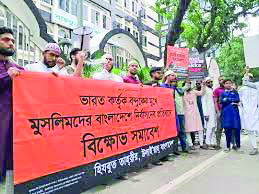
Hizb ut-Tahrir openly promotes anti-India messaging in Bangladesh, leveraging the post-Hasina political transition to expand its domestic influence (Photo: File)
NEW DELHI: The Bangladesh branch of the banned Islamist organisation Hizb ut-Tahrir (HuT), which had gone underground in 2009, is now operating openly and aggressively putting out its propaganda, calling for action against India and for the establishment of Islamic rule in the state.
Since the ouster of Sheikh Hasina in July 2024 in a color revolution and the installation of the US-backed interim government led by Muhammad Yunus, the group has become significantly more vocal, signalling the kind of confidence and informal patronage it appears to be receiving from sections within Dhaka's political and bureaucratic establishment. This is support it did not enjoy during Hasina's tenure, when its cadres were under constant surveillance and arrests were frequent.
In September 2025, the group staged a high-visibility online political conference, marking the latest step in a months-long campaign of public messaging that represents a calculated attempt to reclaim ideological space in Bangladesh's fluid post-Hasina political landscape. The conference, promoted under the banner "Bangladesh 2.0: Subservience or Liberation?", was streamed live on its YouTube channel and was advertised in both Bengali and English.
The programme promised three segments: allegations of US-UK-India interference in the July 2024 transition, a HuT blueprint for rejecting "secular-capitalist" governance, and guidance for pushing the uprising toward what the organisation calls a "comprehensive change of the state".
The explicit use of Bengali on the group's official website and the decision to run a public livestream are deliberate signals that HuT is testing and seeking to widen its public footprint after years of operating largely through encrypted networks and diaspora media. The move to bilingual, public-facing outreach suggests the group is not merely preaching to external supporters but trying to rebuild domestic networks. The open nature of its activities and the absence of any immediate state response has led analysts to believe that HuT is exploiting a permissive political environment, using the transition period to test how much space it has gained since Hasina's fall.
The September conference followed a markedly more aggressive text HuT released on 6 December 2024, which analysts view as the point at which the organisation sharpened its posture. That December statement, circulated in Bengali on the group's site and Telegram channels, moved beyond ideological exhortation to make explicit strategic demands and threats.
It called for Bangladesh to "declare India an enemy state," alleging that New Delhi was actively destabilising Bangladesh after the fall of Sheikh Hasina and equating India's treatment of Muslims with Israel's conduct in Palestine. It accused India of engineering the 2009 "Pilkhana Conspiracy" with Hasina to weaken Bangladesh's military and claimed that India had long used water and border disputes to pressure Dhaka. The Pilkhana tragedy was a mutiny staged on 25 and 26 February 2009 in Dhaka by a section of the Bangladesh Rifles (BDR), a paramilitary force mainly tasked with guarding the borders of Bangladesh.
The December document also denounced the Citizenship (Amendment) Act (CAA) in India and framed Hindutva organisations, specifically naming ISKCON, as proxies or pawns of Indian communal policy language that the statement used to justify confrontation.
More significantly, it made an explicit appeal to the Bangladesh military to "hand over power to establish a caliphate," invoking nusrah (elite or military support) and early Islamic precedent to argue that military-assisted regime change is legitimate. The statement asserted that the "caliphate" would align Bangladesh with neighbouring Muslim countries including nuclear-armed Pakistan to resist India and Western interests.
Taken together, the December messaging marked a clear departure from the more symbolic, campus-focused communications that characterised HuT before its 2009 ban. For the first time in recent memory, the organisation directly urged mobilisation of the military and named specific external targets India and Hindutva organisations as enemies to be severed from diplomatic ties. By co-opting the slogan "Bangladesh 2.0" and presenting the July 2024 events as an unfinished uprising, HuT is seeking to claim revolutionary legitimacy and to present itself as the corrective force to an allegedly compromised interim government.
Analysts and security observers say the group's current actions indicate a renewed confidence in testing the limits of state scrutiny. Publishing content in Bengali, openly streaming events, and invoking popular nationalist and anti-Western themes are tactics aimed at re-establishing its influence among disillusioned youth, professionals, and sections of the political class. They note that HuT's invitations now explicitly mention politicians, journalists, intellectuals and young generations—a shift from its earlier focus on student recruitment. The group's sudden boldness, analysts believe, stems from a perception that parts of the interim administration are willing to tolerate Islamist activism as long as it helps counter secular or nationalist political forces.
Hizb ut-Tahrir has been banned in Bangladesh since 2009 under anti-terrorism laws. The group has faced repeated crackdowns that disrupted its university-based networks, yet it continued to operate discreetly. The organisation's international leadership is centred in Jordan, with additional headquarters in London. Globally, Hizb ut-Tahrir (meaning "Party of Liberation") is an international pan-Islamist political organisation whose stated aim is the re-establishment of the Islamic Caliphate to unite the Muslim community, or ummah, and implement Sharia law worldwide. HuT is banned not only in Bangladesh but also in China, Russia, Pakistan, India, Germany, Turkey, the United Kingdom, Kazakhstan, across Central Asia, Indonesia, and all Arab countries except Lebanon, Yemen, and the United Arab Emirates. In July 2017, the Indonesian government revoked its legal status, citing incompatibility with national ideology and extremism laws.
