A comparative analysis of regime change, legitimacy, and contrasting military strategies in global power politics.
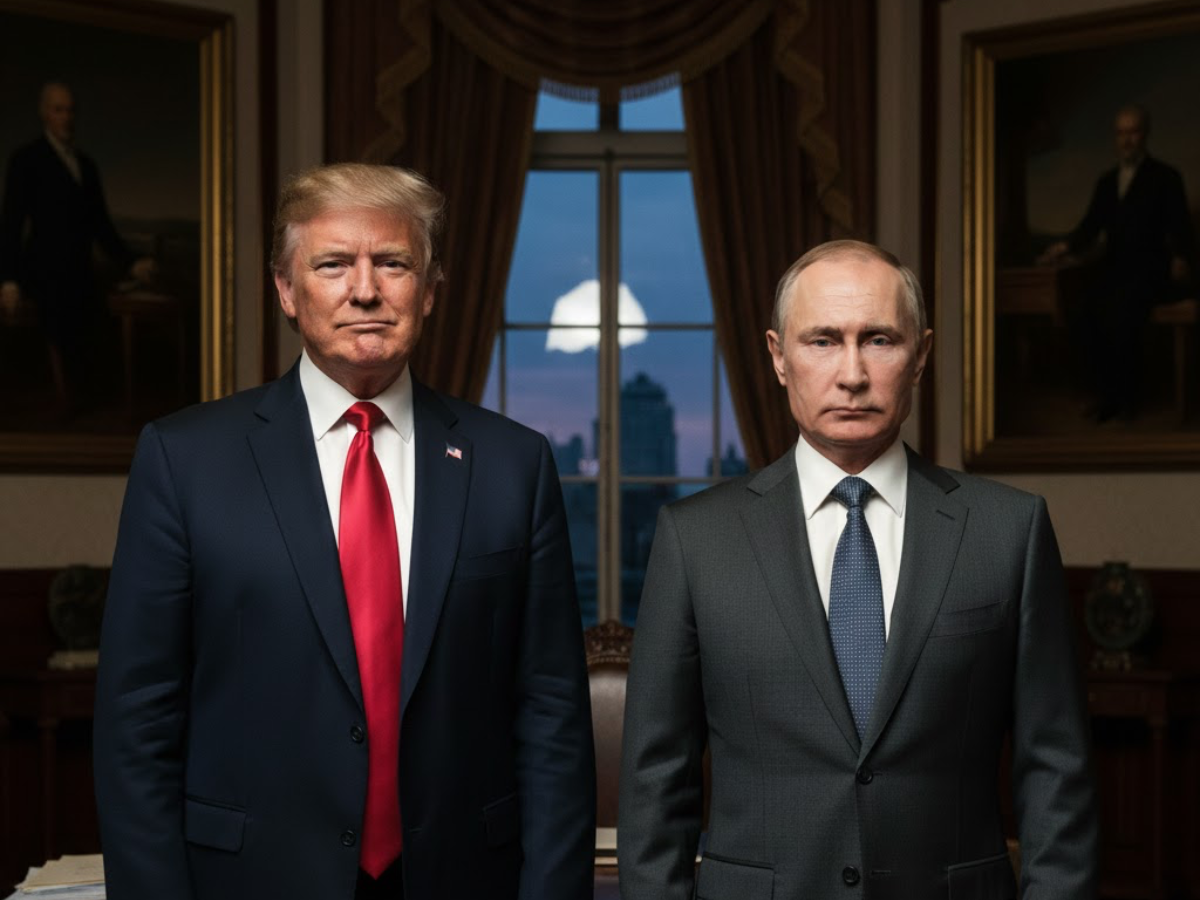
Donald Trump Succeeded And Vladimir Putin Failed (Photo: File)
LONDON: By comparison, almost four years earlier and thousands of miles away, Russia's President Vladimir Putin had seen his own ambitious plan to remove a foreign head of state crumble as Ukraine's defences held firm. Putin had planned to install his close friend, Ukrainian oligarch Viktor Medvedchuk, as Ukraine's new president after a campaign lasting no more than a few days. Putin is the godfather of Medvedchuk's daughter, Daryna. Despite an invasion launched with force and hubris in February 2022, Russia never succeeded in capturing or killing Ukraine's President Zelenskyy, whose survival has become one of the defining narratives of the war.
Call it Gunboat Diplomacy or Yankee Imperialism, it was an extraordinary achievement. When U.S. President Donald Trump stood before a throng of reporters at his Mar-a-Lago estate last week to announce that American forces had carried out a military strike deep inside Venezuela and had succeeded in capturing and exfiltrating the country's president Nicolas Maduro and his wife Cilia Flores, shockwaves echoed around the world.
Trump was on a sugar rush when he told Fox News "If you could see the speed, it was amazing, amazing work by our military. No one else could do something like this". He confirmed that both Maduro and Flores would face criminal charges and that the United States would "temporarily run" Venezuela until a transition could be arranged, hinting at deeper American involvement in the country's oil sector and political future. Donald Trump wants and needs quick victories and, in his mind Venezuela is the quick decisive victory that he has craved.
These two dramatic episodes, one an acclaimed surgical extraction of a sitting president, the other a botched decapitation strategy embedded in full scale warfare, offer a stark contrast in tactics and military capability between the United States and Russia.
In the pre-dawn hours of 3 January, U.S. military aircraft and special operations forces struck multiple targets in Venezuela's capital, Caracas, and elsewhere. Low-flying aircraft and explosions were reported at around 2 am, followed by reports of Maduro's capture, along with his wife. Trump claimed the operation, executed without prior congressional approval, was carried out with precision and without US casualties. From his vantage point at Mar-a-Lago, Trump framed the raid as both a culmination of months of pressure on Maduro's regime and a prelude to an audacious new chapter in U.S. foreign policy. He pledged to "run" Venezuela until a transition was possible and suggested that US oil companies would invest heavily in rebuilding Venezuela's dilapidated oil infrastructure.
When Russia invaded Ukraine, analysts quickly identified Russia's clear objectives in the assault on Kyiv to remove Ukraine's government and decapitate its leadership, particularly its president, Volodymyr Zelenskyy. Russian airborne forces parachuted into the Ukrainian capital in an attempt to seize strategic points and eliminate Zelenskyy, but Ukrainian resistance was swift and fierce, thwarting those efforts within days. In the ensuing years of conflict, Russian security services, mercenary groups and intelligence networks repeatedly attempted to target Zelenskyy, but none succeeded.
Ukrainian officials have documented a litany of assassination and kidnapping plots that were foiled by Kyiv's security forces. Presidential adviser Mykhailo Podolyak as well as Ukrainian State Intelligence have confirmed that Zelenskyy has survived more than a dozen attempts on his life since the invasion began, with sabotage and reconnaissance groups repeatedly intercepted before reaching him.
Russia's efforts to achieve their goal included plans orchestrated by the Kremlin's Federal Security Service to recruit insiders within Ukraine's protective units to capture or kill the president. In one case, two colonels in Ukraine's State Guard were arrested for allegedly collaborating with Russian operatives in a plot to abduct Zelenskyy and other senior officials. Zelenskyy himself has spoken publicly about surviving multiple assassination attempts, likening the experience to dealing with a recurring infection, a grim testament to the relentless danger he has faced.
Yet, against all odds, Zelenskyy not only escaped death or capture, but also maintained the cohesion of Ukraine's government and armed forces throughout a brutal and illegal ongoing war. His refusal to flee Kyiv in the first days of Russia's invasion became emblematic of Ukraine's determination to resist, and helped galvanize Western support, material, diplomatic and moral, that has sustained Kyiv's fight.
One of the most striking contrasts between the Maduro and Zelenskyy cases lies in Washington and Moscow's strategic approach. The U.S. operation in Venezuela was a focused, one-off raid aimed directly at removing a head of state with what was described as overwhelming force and precision. The operation was a combination of intelligence, suppression of air-defence and Delta Force commandos playing in harmony. Its legality and ethics are widely debated, but the intended objective, seizing Maduro as a discrete target, was successful.
Russia, however, pursued Zelenskyy's removal as part of a broader conventional invasion that sought to roll over Ukrainian defences, occupy territory and install a pro-Moscow regime. Assassination or capture of Ukraine's president was one component within a large, chaotic military campaign that faltered and came close to an ignominious fiasco in 2023. Russia's failure to take Kyiv outright and decapitate its leadership early in the war ensured that Zelenskyy remained the legitimate face of Ukrainian resistance.
In military jargon, the U.S. endeavour in Venezuela was a targeted operation that involved elite units and careful planning, while the Russian approach relied on a sprawling invasion force complemented by covert irregular elements. The latter proved overextended, inadequately supplied and unable to secure the rapid decapitation that Putin's strategy envisioned.
The contrasting outcomes also highlight fundamental differences in political legitimacy and international response. Trump's justification for the Venezuela action was framed around longstanding U.S. allegations against Maduro's regime, including accusations of drug trafficking and corruption, and by invoking a controversial claim that the US now had authority to intervene especially as evidence revealed that Maduro lost the 2024 presidential election by more than 40 percent of the votes cast but still insisted that he had won. Critics compared the move to past U.S. interventions such as the 1989 Panama invasion or the 2003 Iraq war, warning of the risks of occupation and regional instability.
International outcry was swift. Nations large and small condemned the strikes as a violation of Venezuela's sovereignty and a dangerous precedent for militarized foreign policy. Many Latin American leaders spoke out, even as some US allies weighed the claims with caution.
By contrast, Russia's attempted removal of Zelenskyy was condemned from the outset as an illegal act of war. Zelenskyy, the former comedian, had won the 2019 presidential election with 75 percent of the valid vote, according to Ukraine's Central Election Commission. But Moscow's failure to capture him and Ukraine's sustained resistance has helped rally broad international support for Kyiv. Countries across Europe, North America and beyond have provided military aid, sanctions against Russia, and diplomatic backing, in part because the conflict was understood as a full-scale invasion, not a narrowly defined decapitation attempt.
Finally, the stories of Maduro and Zelenskyy diverge not only geopolitically but also personally. Maduro's capture, and the narrative around it, has left Venezuela in a power vacuum fraught with uncertainty. Whether U.S. claims hold up under independent scrutiny, or whether Maduro's removal stabilizes or further destabilizes the country, remains uncertain. Zelenskyy, on the other hand, has emerged from repeated threats with enhanced stature at home and abroad. His survival through countless attempts has become symbolic of Ukrainian defiance in the face of aggression, a living testament to a government in exile on its own soil.
The capture of Nicolás Maduro by U.S. forces and the Kremlin's failed attempt to eliminate Volodymyr Zelenskyy, two seminal events in early 21st-century geopolitics, reveal the complexities of regime change, the limits of military power, and the enduring importance of legitimacy and resilience. What happened in Caracas in January 2026 may have seismic consequences for Venezuela and U.S. relations in the Western Hemisphere. But the story of Kyiv, where a democratically elected leader has withstood unrelenting pressure and survived numerous plots against his life, stands as a powerful counterpoint, reminding the world that force alone does not guarantee victory, and that the will of a people and the legitimacy of leadership can shape history in profound ways.
John Dobson is a former British diplomat, who also worked in UK Prime Minister John Major’s office between 1995 and 1998. He is currently a visiting fellow at the University of Plymouth.
