
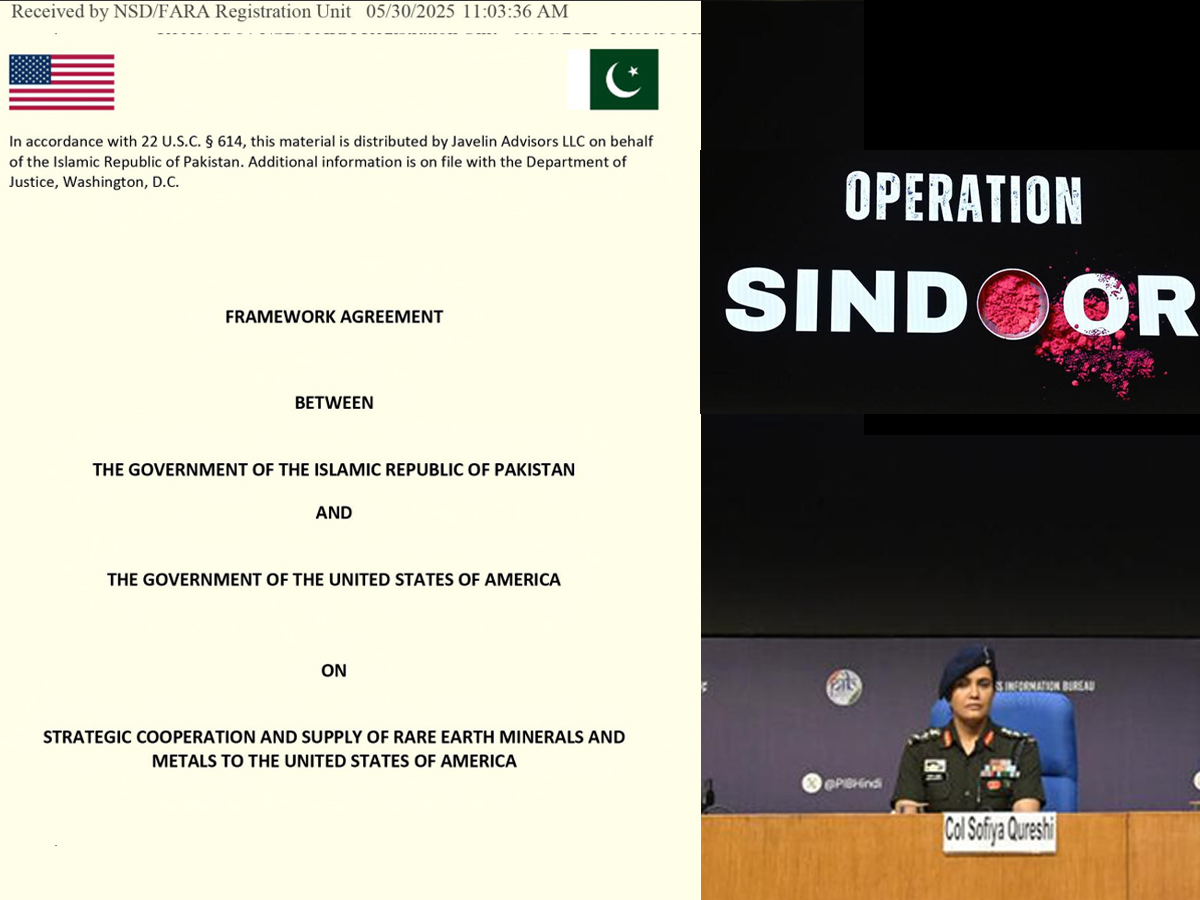
New Delhi: Documents uploaded to the U.S. Department of Justice (DoJ) Foreign Agents Registration Act (FARA) eFile system don’t just show Pakistan “lobbied”; they reveal an influence-to-supply-chain mechanism: a lobbyist-distributed, non-binding “government-to-government” minerals framework whose only binding clause is confidentiality, engineered to move discussions behind NDAs within 30 days, routed through Pakistan’s nominated entity, the Frontier Works Organization and paired with an explicit Kashmir/India narrative mandate.
The documents are not merely selling ore; they are selling a channel—mining, logistics and implementation—through a military-linked institutional vehicle. Public profiles describe FWO as a military engineering organization and a major command of the Pakistan Army’s engineering ecosystem, deeply embedded in strategic infrastructure and logistics.
That has obvious implications for oversight, transparency, and how “economic cooperation” can blur into strategic leverage.
The kinetic phase ended at 1700 hours. The influence phase ran all night.
In May 2025, India fought a time-bound military crisis after the Pahalgam terror attack. The visible end of the kinetic phase came on May 10, 2025: India recorded that Pakistan’s DGMO called at 1535 IST and that both sides agreed to stop all firing and military action from 1700 IST.
But disclosures-based reporting in early January 2026 argues Pakistan ran a parallel surge in Washington during the same window—pressing the U.S. to intervene and “somehow stop” India’s operation, alongside outreach to media targets.
Those headlines—50+ meeting requests, 60+ contacts—are now being widely circulated. However, the deeper story, and the one that matters for India’s future crisis-readiness, lies in what the primary documents reveal about how Pakistan sought to package itself in Washington during a crisis: not only through urgent outreach, but by circulating a structured minerals “framework” designed to move quickly into protected, NDA-bound negotiation space.
WHY FARA MATTERS: POWER LEAVES PAPERWORK
The U.S. Foreign Agents Registration Act (FARA) is a disclosure regime. It does not prove that a foreign principal achieved its political aims, but it does create a public record of declared relationships, declared activity, and declared financial arrangements.
For India, the value is not scandal; it is diagnosis. When a crisis unfolds, these filings help identify the messaging lanes, the intermediaries, and the “speed architecture” through which pressure can be applied.
THE OUTREACH SURGE: WHAT HAS ALREADY BEEN REPORTED
It has already been reported that FARA disclosures indicate Pakistan’s objective was to press Washington to intervene and “somehow stop” India’s campaign, describing interactions that spanned themes including Kashmir, regional security and rare earth minerals.
Reports have described an “extraordinary lobbying blitz,” stating that Pakistani diplomats and defence officials sought more than 50 meetings and reached out to over 60 officials/intermediaries, including U.S. administration figures, lawmakers and major media outlets.
The precise count matters less than the operational signal: Pakistan treated influence as a rapid-response capability during a crisis measured in hours.
THE MINERALS DOCUMENT MOST PEOPLE CITE, BUT FEW READ PROPERLY
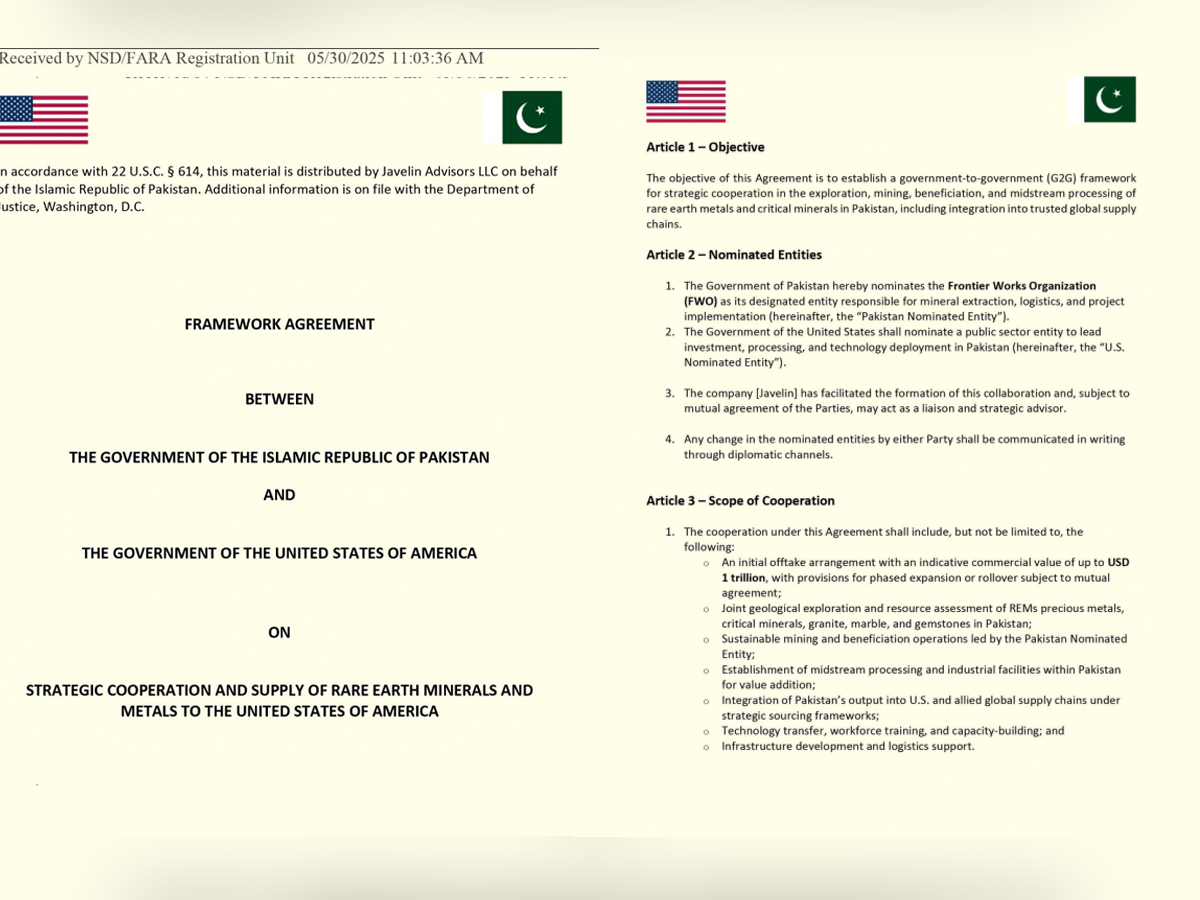
A five-page PDF filed as “informational materials” in DOJ’s FARA eFile system is titled “FRAMEWORK AGREEMENT … STRATEGIC COOPERATION AND SUPPLY OF RARE EARTH MINERALS AND METALS.” It states plainly it is distributed by Javelin Advisors LLC on behalf of the Islamic Republic of Pakistan.
Here is the first point that changes how the document should be understood: it is explicitly non-binding. The text describes itself as an expression of “good faith and strategic intent” and says it does not constitute a legally binding commitment—except as provided under the confidentiality clause.
The signature blocks are also left blank (“Executed on this _ day of 2025”), consistent with a circulated template rather than an executed agreement.
This matters because it reframes the “deal” narrative. The framework’s primary function is not execution. Its primary function is conversion—to convert crisis-time attention into a fast-moving, confidential lane.
“NEW POINTS” FROM THE FARA PRIMARY DOCUMENT THAT CHANGE THE READING OF THE WHOLE BLITZ
Here’s what the May 30, 2025 DOJ-filed framework text actually contains (and why it matters):
Pakistan’s pitch explicitly ties mineral supply to U.S. national security and energy transition. It frames rare earths, precious metals, critical minerals—and even granite/marble/gemstones—as strategically important for “energy transition” and “national security.”
It asserts a sweeping inventory of Pakistan’s mineral endowment—186 billion tons of coal, 6 billion tons of copper, and 1.4 billion tons of iron ore—citing a 2015 Pakistani government overview.
Most crucially, it nominates FWO as Pakistan’s designated entity responsible for “mineral extraction, logistics, and project implementation,” while stating the U.S. government “shall nominate a public sector entity” to lead investment, processing and technology deployment.
It proposes an “initial offtake arrangement” with an “indicative commercial value of up to USD 1 trillion,” alongside integration into “trusted” supply chains.
It describes Javelin not merely as a messenger, but as an active facilitator: “The company [Javelin] has facilitated the formation of this collaboration and… may act as a liaison and strategic advisor.”
And it makes the legal posture explicit: the “Agreement constitutes an expression of good faith and strategic intent” and—except for confidentiality—“shall not constitute a legally binding commitment.” It then mandates an NDA within 30 days and a Joint Steering Committee within 30 days, with a five-year term and 90-day termination notice.
Pakistan’s lobbying push was not only about “stopping” India’s operation; it was also about inserting Pakistan into America’s critical-minerals supply anxiety—precisely the kind of strategic commodity narrative that can change the tone of high-level conversations in Washington.
HOW PAKISTAN’S REPRESENTATION IS STRUCTURED IN THE FILINGS
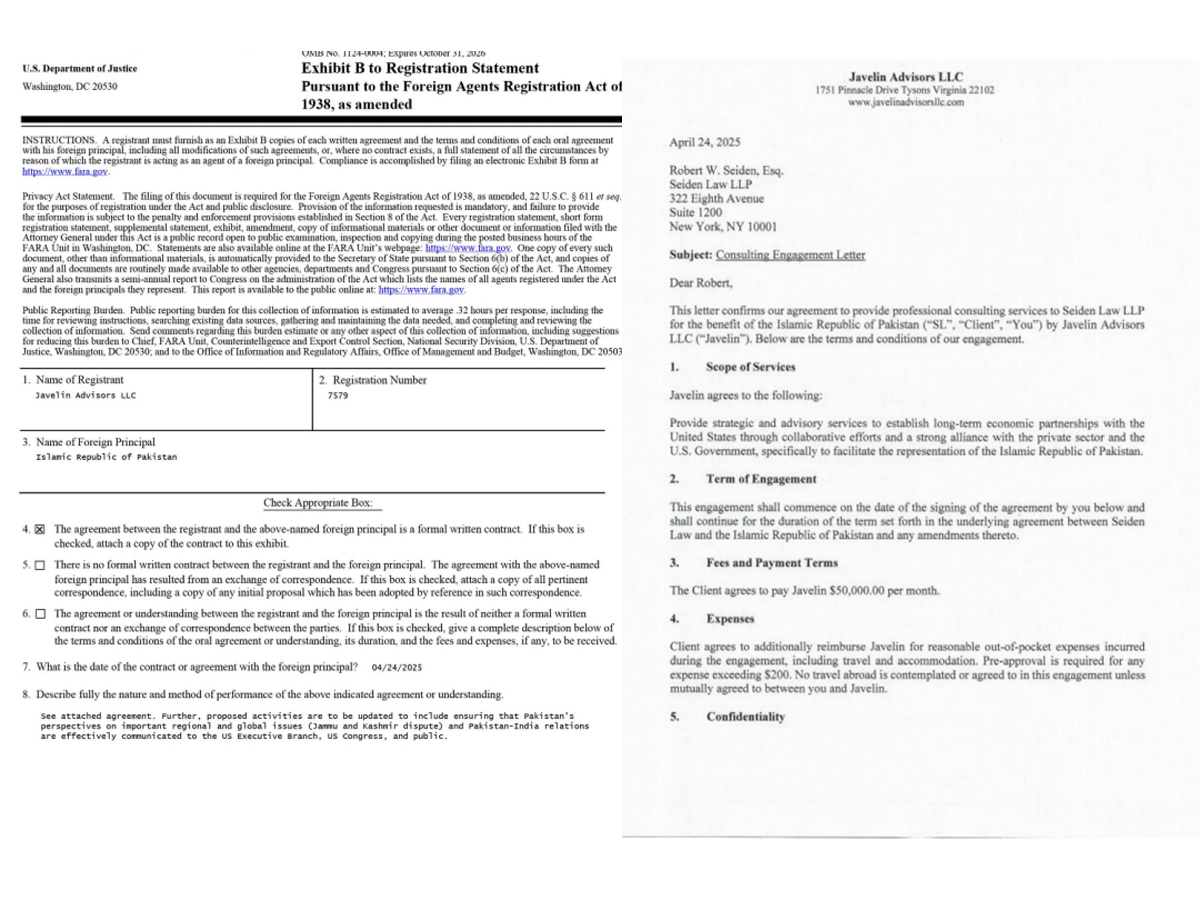
Another primary filing connects Pakistan’s representation to a formal FARA registrant: Seiden Law LLP. In its DOJ registration statement (Registration No. 7570), the foreign principal is listed as the “Islamic Republic of Pakistan” with an address in Washington, D.C. The same filing indicates the registrant’s informational materials dissemination includes email, and identifies services being rendered in furtherance of Pakistan’s interests.
Stepping back, the significance is not partisan or performative: FARA’s purpose is transparency—agents must register to disclose relationships, activities, and receipts/disbursements connected to foreign principals.
So when the registry shows a “rare earth minerals” framework distributed under the statute, it is evidence of an influence strategy designed to travel through policy channels—because it is meant to.
THE 30-DAY FUSE: CONFIDENTIALITY AS THE REAL MECHANISM
Two triggers are embedded in the document.
First, it calls for a Non-Disclosure Agreement (NDA) within 30 days, and second, that it proposes a Joint Steering Committee within 30 days.
In plain terms: the framework is designed to move quickly from public crisis to private negotiation, before global attention shifts and the pressure window closes.
THE HEADLINE LURE: “UP TO USD 1 TRILLION” AS OFFTAKE, NOT INVESTMENT
The document references an “initial offtake arrangement” with “indicative commercial value of up to USD 1 trillion,” with an expandable/rollover logic.
This is not evidence of a signed trillion-dollar pact. It is a persuasion signal: a scale figure intended to open doors in a Washington environment where critical minerals are increasingly framed as national-security infrastructure.
THE NOMINATED ENTITY CLAUSE: FWO IS WRITTEN INTO THE PITCH
The framework states Pakistan “hereby nominates” the Frontier Works Organization (FWO), assigning it responsibility for mineral extraction, logistics and project implementation.
FWO’s publicly available profile describes it as raised as an organisation of Pakistan’s Army engineering ecosystem.
That turns the “minerals lane” into something structurally strategic, not merely commercial: the execution channel sits inside a military-linked infrastructure and logistics ecosystem.
THE INTERMEDIARY’S FINGERPRINT: THE BRIDGE-BUILDER CLAIM
The framework says Javelin “has facilitated the formation” of the collaboration and may act as liaison/strategic advisor. This is not incidental. It shows how private intermediaries can position themselves as architects of a policy-to-commercial lane—especially valuable during a crisis when attention is scarce and time is short.
THE CONTRACT TRAIL: KASHMIR AND PAKISTAN–INDIA RELATIONS ARE EXPLICITLY IN SCOPE
A filed engagement document describes proposed activities updated to ensure Pakistan’s perspectives on Jammu & Kashmir and Pakistan–India relations are communicated to the U.S. executive branch, Congress and the American public. The same filing specifies a $50,000 per month retainer for Javelin. Taken together, the documents show a fused approach: a narrative mandate (Kashmir/India framing) operating alongside a supply-chain pitch (minerals), within a disclosed intermediary-driven architecture.
What is new here: the method, not the meeting count The documents, read carefully, show something more durable: an attempt to pair crisis-time narrative pressure with a structured economic proposition, and then move that proposition quickly into NDA-bound lanes through nominated entities and steering committees.
For India, the implication is institutional. Crisis response can no longer be treated as separate compartments—military operations in one file, diplomacy in another, minerals and trade in a third, media in a fourth. Influence campaigns are designed to exploit seams between desks and delays between facts and frames.
WHAT INDIA SHOULD DO NEXT: FAST, IMPLEMENTABLE, MEASURABLE
India should build a standing crisis influence and disclosures capability focused on major capitals, beginning with Washington, tasked with monitoring open disclosures (including FARA eFile) and issuing a timestamped evidence bundle during crises—official statements, escalation ladders, and document excerpts—so facts travel at the speed of narrative.
It should deepen narrative readiness with Congressional staff, key think tanks and editorial boards through recurring briefings, so crisis-time claims are evaluated against an established baseline of context.
And India should treat critical minerals as strategic diplomacy with credibility and transparency—becoming a preferred trusted node through processing capacity, predictable policy and verifiable partnerships, rather than crisis-time opacity.
CONCLUSION: SOVEREIGNTY IS DEFENDED TWICE
Operation Sindoor was fought on the border. But the filings show the parallel contest: a rush of crisis-window outreach combined with a circulated, non-binding minerals framework whose enforceable core is confidentiality, with a 30-day NDA fuse, a nominated execution arm in FWO, and an explicit Kashmir/India narrative mandate.
The battlefield may end at 1700 hours. The influence campaign does not.




