
A careful look at Pakistan’s political history leaves no room for doubt: the reins of power have consistently rested in the hands of those who, while appearing to operate behind the scenes, have in practice overseen every decision, every crisis, and every major shift. Politicians, regardless of era, have donned the trappings of democracy, yet beneath the changing faces and attire, they have continued to perform on the same stage, following the same script a script never authored by the civilian leadership.
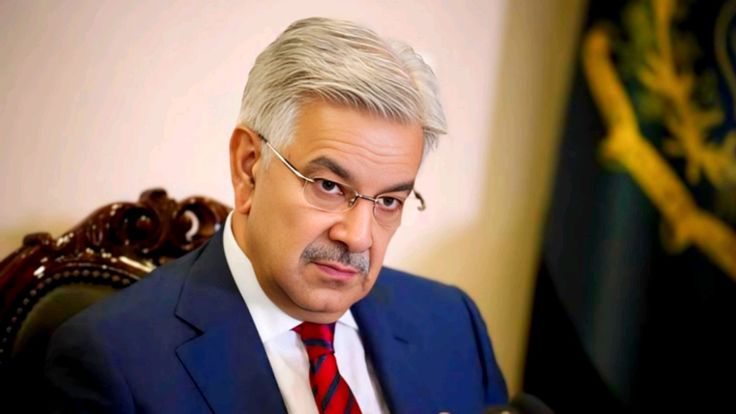
To grasp the reality of civilian supremacy in Pakistan, the example of the nominal Defence Minister, Khawaja Asif, is far more telling than any extended debate. Outwardly, he is the head of the country’s defence affairs; in practice, he wields neither decision-making power nor any meaningful authority before the military hierarchy. His recent sharp and provocative statements on Afghanistan are nothing more than the echo of a loudspeaker, broadcasting the directives emanating from the GHQ. He does not set policy, and his words do not alter the state’s strategic course. The office of the Defence Minister, which constitutionally should be powerful, has in Pakistan been reduced to a ceremonial and symbolic role.
The depth of this impotence is illustrated by an incident recounted by a Pakistani journalist. On a street in Islamabad, the Defence Minister found himself stalled in the protocol of his own subordinate, Army Chief General Asim Munir. He had to wait on the roadside for nearly an hour as the convoy of the very officer technically under his command passed by. This was not mere protocol mismanagement; it was a vivid demonstration of the imbalance of power between civilian offices and military authority in Pakistan. This episode lays bare the symbolic truth that even the highest-ranking civilian officeholders are subordinate to the truly powerful branches within their own ministries. Authority, governance, and decision-making reside where power has always concentrated—not by constitutional design, but through the sheer force of entrenched might.
From the outset, the state’s institutional framework was designed to centralize real power around the bureaucracy and the military. The mandates of nominally elected leaders were conditioned, questioned, or systematically undermined.
Pakistan’s Constitution has been suspended repeatedly, each time justified as essential for the nation’s survival. In reality, these interventions were meant to ensure that the true source of power remained unchanged, no matter how many times new plaques had to be placed on democracy’s grave. The first martial law in 1958 was not simply a military takeover; it marked the first major burial of civilian supremacy. Zia ul-Haq’s 11-year rule left behind a legacy of political engineering, social control, and the subjugation of state policies to military interests—a legacy whose impact still threads through the fabric of national politics. Decisions regarding the Afghan jihad, foreign policy, and the dismantling of political parties were all made not by elected institutions, but by unelected circles. Pervez Musharraf’s era was another chapter, demonstrating that elected governments are allowed to function only so far as they remain acceptable to the true centres of power. Between 1999 and 2008, everything from constitutional amendments to foreign policy—followed the directions of military leadership. Parliament existed, but its powers were largely ceremonial, mere paper exercises.
After 2008, democracy appeared restored, yet the underlying stage remained unchanged—only the actors shifted. Elections, parliament, cabinets, and the prime minister’s office continued, but control over major decision-making circles remained firmly where it had always been. Foreign affairs, security policies, regional decisions, and major strategic matters—civilian input was often limited to formal approvals. Political parties were manipulated, media pressured, judicial independence questioned, and electoral processes interfered with. These patterns demonstrate the persistent structure of power in the country.
These historical trends have effectively confined politicians to the role of puppets, whose strings are pulled elsewhere. They are granted authority, yet wield little real power; entrusted with responsibility, yet excluded from decision-making; burdened with crises, yet the source of these crises remains deliberately obscured. This is the backdrop that has rendered Pakistan a state where democracy exists in name and form, yet its essence is repeatedly violated.
Recent conflicts with Afghanistan, and the ensuing negotiations, once again highlight that real decision-making authority lies not with the civilian government, but with the military and intelligence agencies. This explains why the negotiating team contains no ministers, elected representatives, or civilian experts; it consists entirely of military officers. This composition underscores the enduring reality core decisions on foreign policy and security remain beyond civilian authority.
Complex and sensitive negotiations require diplomats, legal experts, elected representatives, and policymakers with a deep understanding of the region. Yet in Pakistan’s current system, these civilian dimensions are absent. The result is a negotiation process that appears one-sided, with little room for political flexibility, diplomatic insight, or mutual confidence-building the very elements essential for meaningful resolution.
Negotiations led by Pakistan’s military delegations often rely on rigid, uncompromising demands, lacking the political acumen necessary to reduce tensions and resolve conflicts. Such an approach risks widening divisions, exacerbating an already tense environment, and pushing disputes toward confrontation rather than resolution.
This situation exposes not only the weakened position of civilian institutions, but also raises a profound question: if foreign policy, security, and sensitive regional matters are always decided within military circles, what is the purpose of the elected political leadership? When state decisions are made by non-political forces rather than by representatives chosen by the people, the legitimacy of negotiations is undermined, and their outcomes are unlikely to endure.
Ehsanullah Ehsan is a former spokesperson of Tehrik-e-Taliban and sometimes also referred to as “Ethno Fascist”.




