Mark Carney’s meeting with Narendra Modi was more than a photo-op. It signalled a strategic pivot: Canada is re-entering the Indo-Pacific with clarity.
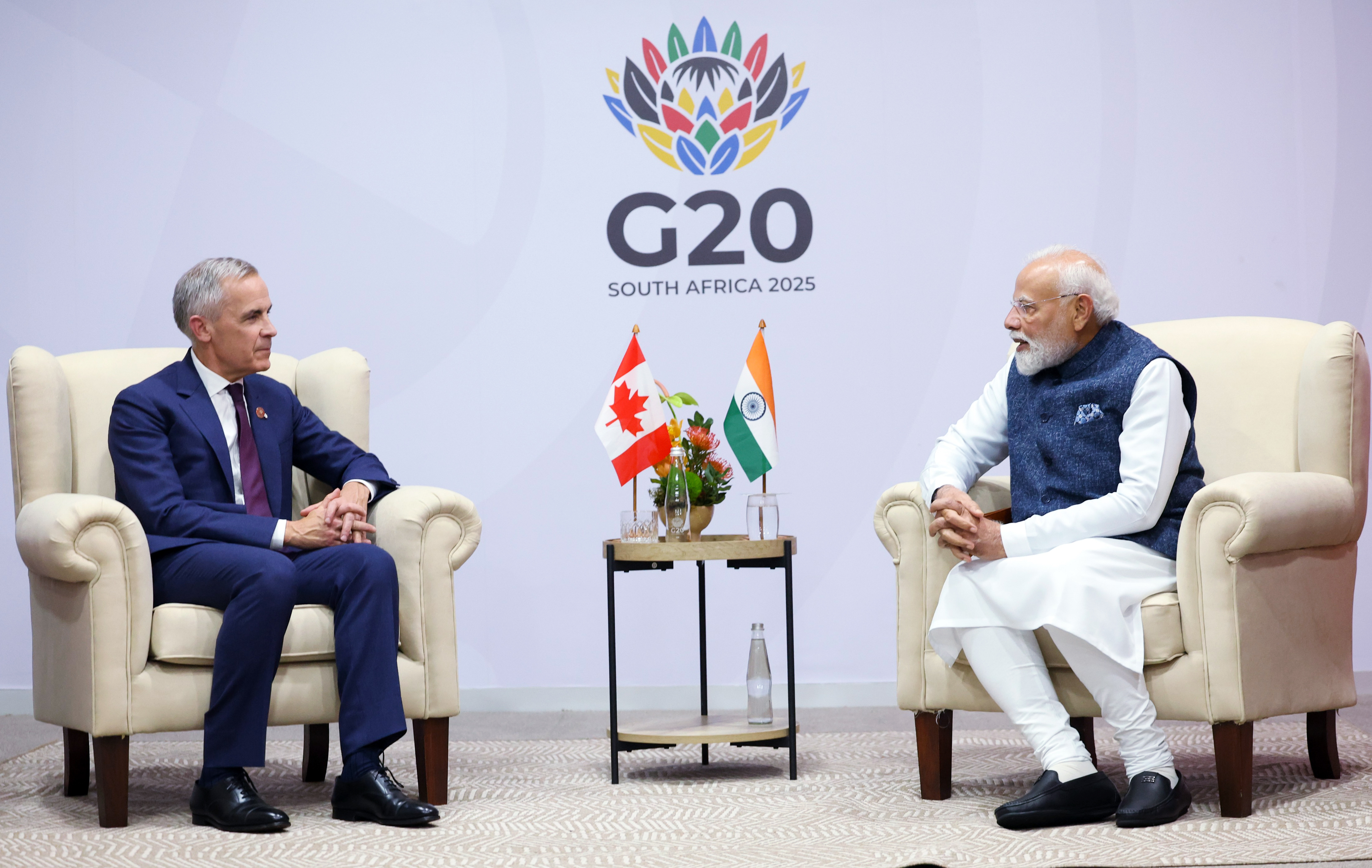
Prime Minister Narendra Modi meets Canada Prime Minister Mark Carney during a bilateral meeting on the sidelines of G20 Summit, in Johannesburg on 23 November (Photo: ANI)
Ottawa: Prime Minister Mark Carney’s outreach to Prime Minister Narendra Modi at the G20 has taken on deeper significance following Russian President Vladimir Putin’s recent visit to India. For Canada, this is a wake-up call. The Indo-Pacific is not just where the 21st century is being shaped—it’s where power is being brokered, and alliances are being recalibrated in real time.
Carney’s meeting with Modi was more than a photo-op. It signalled a strategic pivot: Canada is re-entering the Indo-Pacific with clarity, conviction, and commercial urgency. After the CEPA debacle under Trudeau—where Ottawa’s foreign policy posturing alienated New Delhi and collapsed economic talks—Carney is attempting a reset grounded in realism. The rekindling of CEPA isn’t just trade diplomacy; it’s damage control and a strategic necessity.
Trudeau’s 2023 theatrics in the House of Commons—exploiting the Nijjar killing to score political points—derailed what should have been a mature, values-based partnership with the world’s largest democracy. As I wrote last year, Trudeau’s performance art on foreign interference missed the real threat: the Chinese Communist Party’s covert operations in Canada. Instead, he targeted India, an emerging ally, and derailed bilateral diplomacy. Carney now has to clean up the mess—and fast.
PUTIN IN DELHI: STRATEGIC AUTONOMY ON DISPLAY
Putin’s high-profile visit with Modi confirms what many in Ottawa still misunderstand: India is not a Western proxy. Delhi is playing its own game—maintaining defence ties with Moscow, trade with Beijing, and cooperation with the West on tech and investment. Carney must understand that India’s “strategic autonomy” is non-negotiable. If Canada wants meaningful engagement, it must do so on equal, respectful terms—not with lectures, but with offers.
India’s deal-making posture has shifted the calculus for Canada. With Delhi reinforcing its Russian alignment and showing no signs of isolating China, the Trudeau-era fantasy of India toeing the Western line is officially over.
CANADA’S CHINA RESET: A STRATEGIC CONTRADICTION
Just weeks before Carney’s Modi meeting, Ottawa floated a so-called “strategic partnership” with China. Many rightly viewed this as incoherent. Is Canada trying to hedge or just appease? As Dr Charles Burton writes in The Beaver and the Dragon, Canada’s history of uncritical engagement with the PRC has compromised our values and security. Another round of economic diplomacy with Beijing—without conditionality—risks repeating two decades of failed policy.
If Carney’s Indo-Pacific policy is to be taken seriously, Canada must speak clearly: partnerships with authoritarian states must come with red lines—on espionage, human rights, and trade distortions. Anything less signals weakness to friends and foes alike.
INDIA: NOT A SUBSTITUTE, BUT A STRATEGIC ANCHOR
India is not Canada’s “China alternative,” it should be our partner of first choice. With its demographic might, economic momentum, and democratic credentials, India offers Canada a long-term strategic horizon. More than 1.7 million Canadians of Indian origin form a powerful living bridge; culturally, economically, and diplomatically. Ottawa has underleveraged this community for too long.
Reviving CEPA is just the beginning. Canada must co-invest in India’s clean energy transition, AI ecosystem, mining sector, and digital infrastructure. The opportunity is vast—but the political window may not remain open.
TRUMP’S CUSMA THREAT: AN INDO-PACIFIC IMPERATIVE
To make matters more urgent, former President Donald Trump has now floated scrapping the Canada-U.S.-Mexico Agreement (CUSMA). For Ottawa, this is a flashing red light: Canada can no longer assume North American trade stability. Diversifying toward Asia—and especially India—isn’t just smart economics anymore. It’s strategic survival.
Carney must now balance multiple fronts: maintain U.S. access under CUSMA uncertainty, re-engage India with humility and ambition, and resist Beijing’s seduction of markets over values. That’s a leadership test worthy of a G7 Prime Minister.
Domestically, Carney’s “One Canadian Economy” Act (Bill C-5) is foundational. By breaking down interprovincial trade barriers and enabling energy exports, he positions Alberta, not as a rogue province, but as Canada’s international energy engine. India’s need for energy diversification makes this a natural match.
Recent agreements to build an export pipeline delivering 1.4 million barrels per day to the Indo-Pacific demonstrate that Canada can—and must—help wean India off Russian oil. This is energy diplomacy with democratic values. It’s also the kind of pragmatic partnership India respects.
Mark Carney has the intellect, network, and mandate to deliver a Canadian Indo-Pacific strategy worthy of this moment. But speeches and summits are not substitutes for execution.
He must finalize CEPA, clarify our China position, and treat India as a co-equal power—not a pawn. He must also have the courage to speak hard truths about Canada’s own weaknesses: our institutional naivety, soft-on-threat diplomacy, and sluggish statecraft.
With Putin having walked the halls of Delhi and Trump threatening trade chaos, the window for Canadian strategic relevance is narrowing. Carney can still act—but only if he moves now.
The Indo-Pacific isn’t waiting. And neither should Canadian investors, business and government.
Dean Baxendale is Publisher, Optimum Publishing International.
