
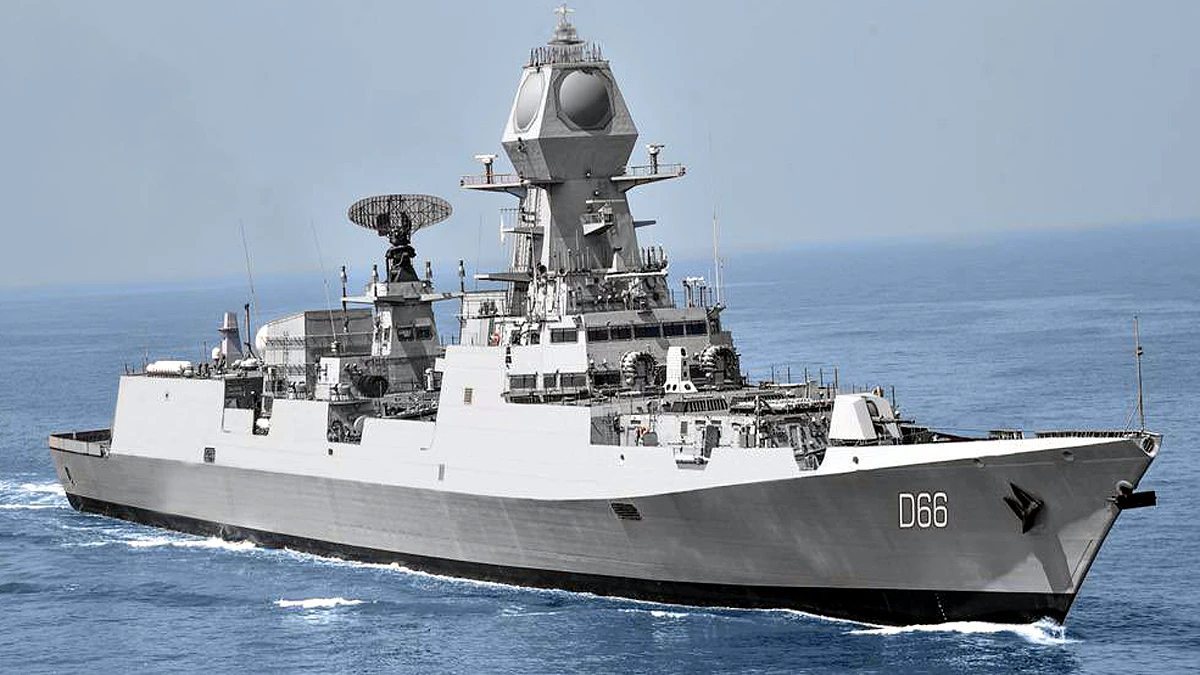
MUMBAI: Artificial Intelligence and Machine Learning are increasingly shaping a new operational capability for the Indian Navy, moving from theory to frontline application. The combat deployment of INS Surat during Operation Sindoor has emerged as a key marker of this shift, with the advanced destroyer employing intelligent systems under live operational conditions in the Arabian Sea.
INS Surat was commissioned in January 2025 by Prime Minister Narendra Modi at Mumbai Port. The warship is the final vessel of the Visakhapatnam class under Project 15B and is named after the historic port city of Gujarat. Built by Mazagon Dock Shipbuilders Limited with design inputs from the Navy Warship Design Bureau, the ship reflects India’s growing emphasis on indigenous capability and digital warfare.
Captain Sandeep Shorey, the Commanding Officer of INS Surat, confirmed that the ship played an active role in Operation Sindoor. He said the vessel demonstrated strong performance across surveillance, threat assessment and operational coordination. Officers associated with the deployment said the use of AI-based tools helped process large volumes of sensor data and present clear inputs to commanders, improving both speed and accuracy in decision-making.
This marks the first time such technology has been tested by the Indian Navy in an active operational environment. Until now, Artificial Intelligence and Machine Learning projects had largely been confined to policy discussions, controlled trials and experimental platforms. The experience gained during Operation Sindoor has given the Navy greater confidence that intelligent systems can directly enhance combat readiness.
INS Surat is often described as the first Indian warship designed with inbuilt support for intelligent systems. Its onboard architecture allows the integration of AI-driven applications across navigation, sensor fusion and combat management. Rather than relying solely on manual interpretation, the ship can assist commanders by filtering complex data streams and highlighting the most relevant operational options.
Beyond its digital capabilities, INS Surat remains a formidable combat platform. With a displacement of around 7,400 tonnes and powered by gas turbines, it can achieve speeds close to 30 knots and sustain long-duration deployments. Its weapons package includes BrahMos supersonic cruise missiles, Barak-8 air defence missiles, torpedoes and high-capacity rocket launch systems. It also carries rapid-fire guns for close-range defence and supports two helicopters for surveillance and anti-submarine missions.
The broader push for Artificial Intelligence and Machine Learning in defence began in 2018, when the government tasked NITI Aayog and the Ministry of Defence with preparing a roadmap.
NITI Aayog released the National Strategy for AI, while a dedicated defence task force identified priority areas for national security. Since then, the armed forces have been mapping practical applications where these technologies can deliver tangible operational value.
For the Navy, this extends well beyond warships. Officials are examining intelligent systems for inventory management to ensure the timely availability of critical equipment. Training platforms powered by Machine Learning are being explored to create realistic simulations and personalised learning for sailors and officers. Predictive maintenance tools can analyse sensor data to forecast equipment failures before they occur, thereby reducing downtime. Enhanced security and surveillance systems are also being planned to improve monitoring of bases and maritime zones.
There is also a growing recognition that this transition must be coordinated across services. Defence planners are advocating a tri-services approach to ensure that the Army, Navy and Air Force develop interoperable digital frameworks. The Department of Military Affairs, under the Chief of Defence Staff, is expected to play a central role in shaping this common strategy.
Industry and academia are viewed as crucial partners in this transformation. Many of the AI applications identified for defence have strong civilian relevance as well. Collaboration with private companies, startups and universities is being encouraged to build scalable and sustainable technologies within the country.
INS Surat, with approximately 75 per cent indigenous content, now stands as a symbol of this shift. Its performance during Operation Sindoor has demonstrated that India is not only capable of building advanced warships but also of integrating complex intelligent systems into frontline platforms.
In a recent outreach initiative, the Press Information Bureau organised a press tour in Mumbai, offering journalists a first-hand view of how evolving naval capabilities are strengthening coastal security and modernising maritime defence.
For the Indian Navy, this development is not limited to one ship or one operation. It signals the beginning of a long-term transformation in which Artificial Intelligence and Machine Learning will sit alongside weapons and sensors as core elements of maritime power.




